Interview with Professor Scott Ramsay

Can you share about yourself and what students can expect from MSE160?

I am from Vancouver originally. I did my undergrad at UBC, and did grad school at U of T, with a PhD in Materials Science and Engineering. In terms of my academic appointment, I’m a teaching stream faculty member, so my primary appointment is to teach. The only research that I do is pedagogical.

“[MSE160] is meant to be a course that will be useful for you as an engineer, regardless of your future specialization.”

It’s about understanding solids, and we go through everything from mechanical to optical, electrical, and magnetic properties. There is some thermodynamics in there as well, and we try to show how all the topics are interrelated. We start with one topic, and after we build up more about it, we connect it with the next topic, so hopefully by the end of it, people have a good understanding of solid materials, how they work, and the underlying structure property relationships.

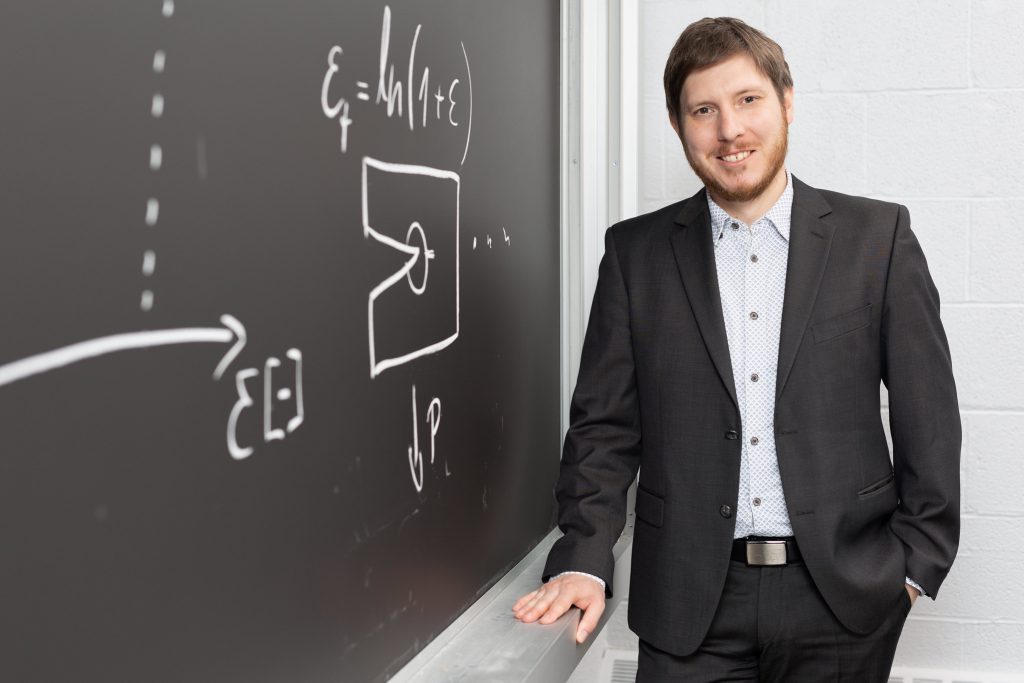
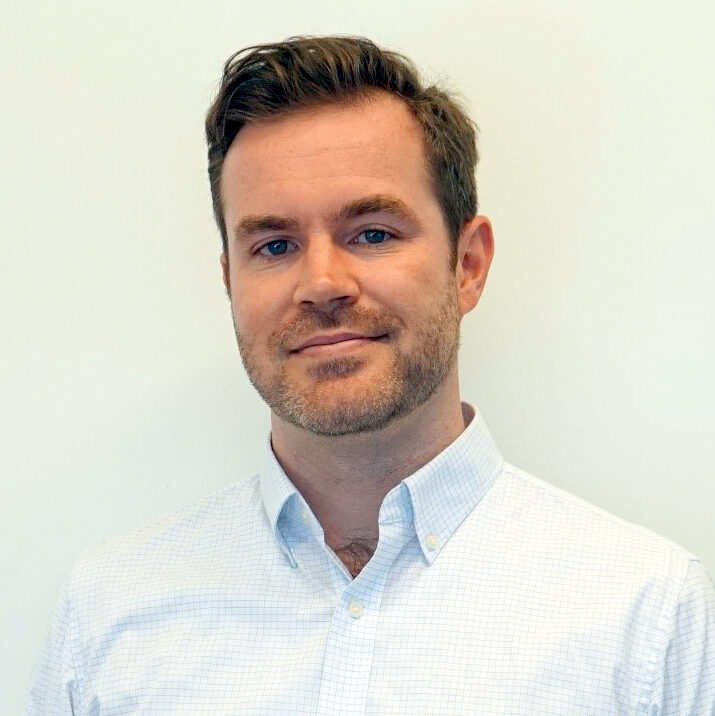
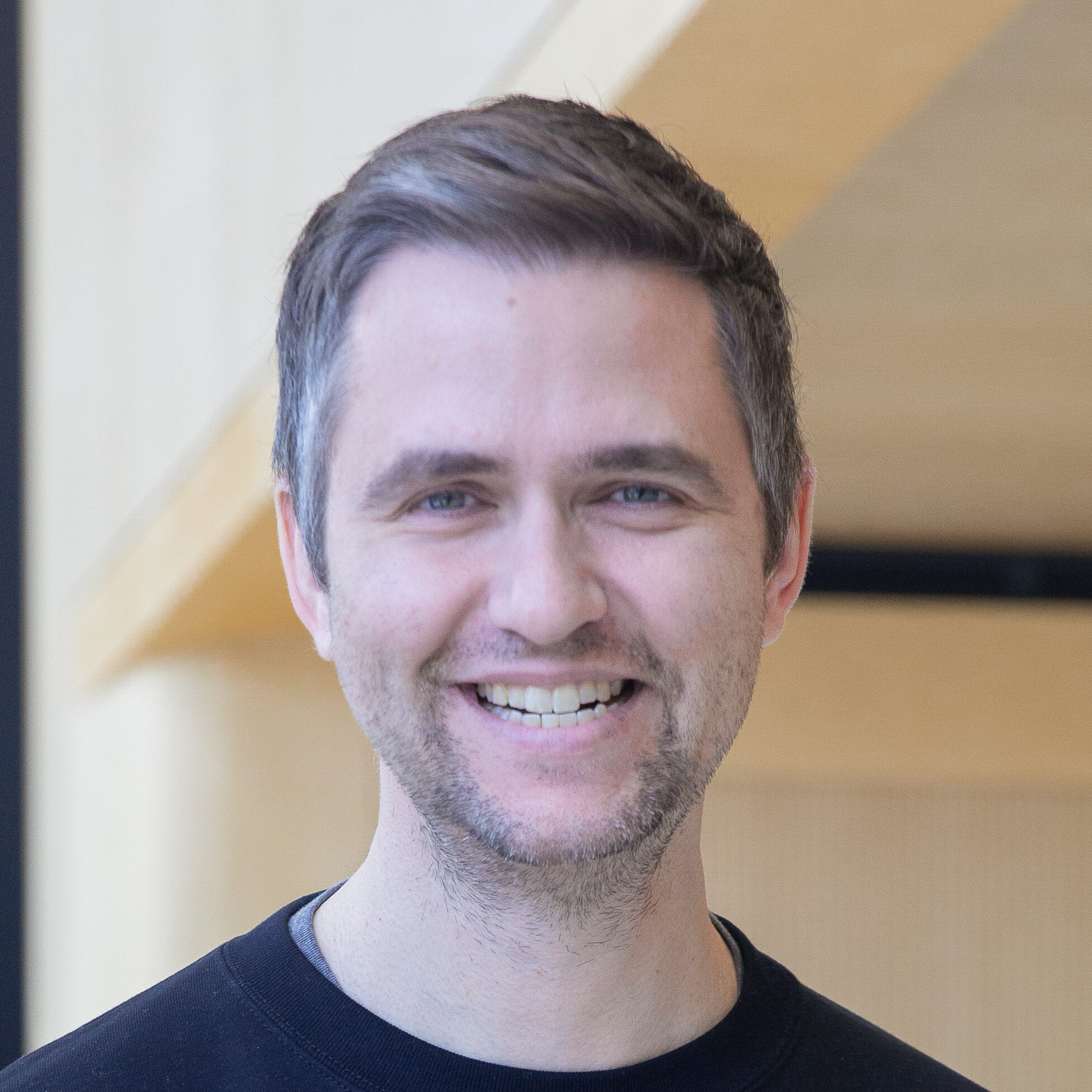
Professor Scott Ramsay [Source]

We want this course to help you choose the most appropriate material for a design, or understand how, for example, temperature will affect the properties of material, if you ever need it later on in your engineering career. You either know it or you know the fundamentals to go and figure it out later yourself.

How can students succeed in this course?

CC BY-SA 3.0, via Wikimedia Commons

It depends on the educational system that students have come from. I think most people have seen the structure of the atom and electron configuration, so we go into that fairly quickly and we try to build on new concepts for most people, like the band theory of solids and semiconductors. Then there’s a little bit of reviewing. Some people have done crystal structures or thermodynamics in high school. We don’t assume that people have the knowledge, but we will go a little bit more quickly for some parts if we feel that most students have some background in it.

To sum it up, there’s a lot of topics that build on things that students have seen before. As for doing well, I would say probably one of the most important things is to keep up. There’s a lot of topics that are covered as I mentioned, so if you fall behind, it becomes more challenging. Also, you sometimes lose the ability to make those important connections I was talking about earlier.

What is your teaching style and favourite part about teaching?

I try to be engaging, and I like lecture demonstrations. What we have been doing every week is to build up to a good-sized lecture demonstration, probably on Friday. Hopefully that makes it memorable and reinforces concepts from the lecture.

“I suppose my style or philosophy is to convey excitement I have about the subject material and convey a sense that you can figure out so many things if you understand these underlying concepts.”

When I see a student get inspired, see a connection, or even have a Eureka moment. When they say “I understand this” or “I see how this relates to something in my life” or “that broke and I fixed it.” Those moments of learning or sudden realization of something that students have are probably my favorite.

How does this course connect to your research?

Currently, I’m not directly involved in discipline-based research like engineering research. I had a master student a few years back and she did an engineering design project, but the data we collected was more pedagogical in nature. We collaborated with some people growing lung tissue using a machine she designed. MSE 160 is really about fundamental topics. It is the basis for understanding so much of the world using bits of Physics and Chemistry.

“It’s all this structure/property relationship that really helps us understand so much of what’s key to engineering.”

Any advice or comments for incoming first-year students?

I have really enjoyed teaching EngScis in the past three years. They are a fantastic group, and I’m always impressed with how even from 3:00-4:00pm on a Friday afternoon, they seem energized and they’re happy to come to class and be polite and professional. It is really nice to get to know the EngScis and I look forward teaching them. I’m excited and looking forward to meeting everyone.


Interview with Professor Philipp Seiler

Could you tell us a bit about yourself?

My name is Philipp Seiler. I studied Mechanical Engineering and Mechatronics in my undergrad in Germany, at the TU Braunschweig. I did my PhD in a completely different topic, in Material Science. After that, I went to the US, where I went to Purdue University to do a post-doc, then to the UK where I was a research associate at the University of Cambridge for 6 years. After that, I became a lecturer (assistant professor) at the University of Kent. I transferred very recently to Canada.

In my research, I work on materials under extreme conditions – for example, materials for rocket engines or gas turbines. I would like to answer questions like how we can design systems that can withstand very high temperatures. The other part of my research is about lightweight materials: how can you make these material structures light weight, but still make them very strong, stiff, and tough. For that, linear algebra is very important.

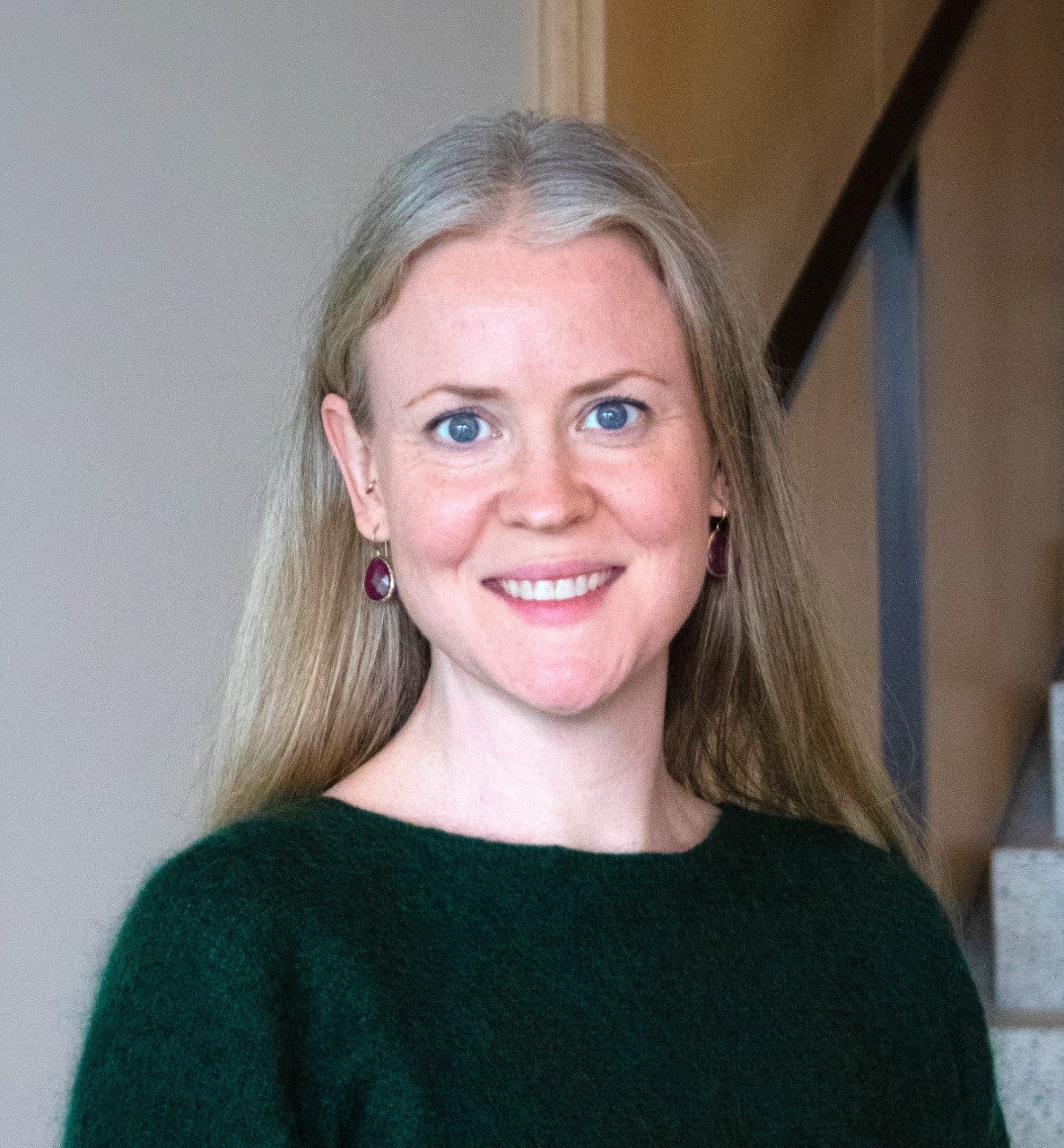
Professor Philipp Seiler [Source]

“I don’t think there is a single day where I don’t use linear algebra.”

There are many tools, such as Finite Element Analysis (FEA), a tool that can predict stresses and strains that use linear algebra. This tool basically solves a system of differential equations. But instead of solving two or three equations, you’re looking at a system of millions of equations. So, it’s very important to know the underlying physics as well as the algorithms used, to understand and interpret the results.

Could you describe your teaching style and your favorite part of teaching?

CC BY-SA 3.0, via Wikimedia Commons

Teaching is an integral part of being a professor. I like interacting with students, and I really enjoy seeing students grasp complex concepts during a lecture. It is amazing to meet former students a few years later and see them on track to get into their dream career.

I have an active teaching style, even with a large cohort size.

“I like going on academic detours – I would change the lectures when I see what students are interested in a certain topic.”

I do not plan lectures down to the minute. I come to lectures with a brief outline, then I see how the students follow and react. In particular, teaching linear algebra is like teaching a programming language. I start with the basic “commands,” such as vector spaces, vectors, matrices, etc., and then I apply these tools to solve equations in real world problems.

Why do engineers need to learn proofs, and do you have any tips for mastering them?

If I were to simply teach how a tool like matrix multiplication works, e.g. just by following an algorithm, students would quickly forget it. By knowing the proofs, you can understand why and how matrix operations work. Even if you forget the details, it will be easier to relearn it. Moreover, proofs can help students understand linear algebra conceptually.

“I want students to understand why certain concepts are true and why they work.”

Reading the textbook over the whole term is very important, so don’t just start before any midterm or exam. Also, continuously put work and effort into learning and following the lectures. While the learning curve isn’t steep in the beginning, it picks up very quickly, so you have to be on top of things. If you have questions, come to office hours or ask me after the lectures. I hope students are engaged and ask as many questions as possible.

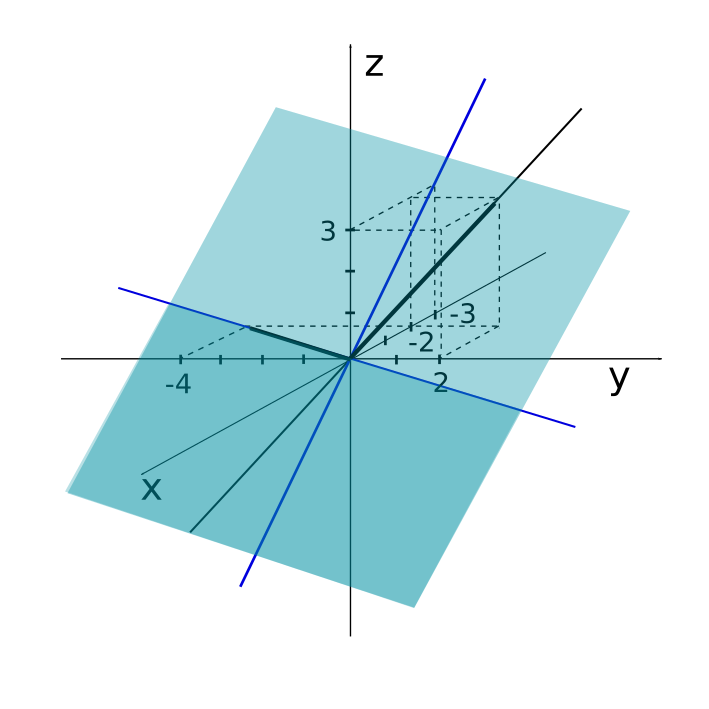
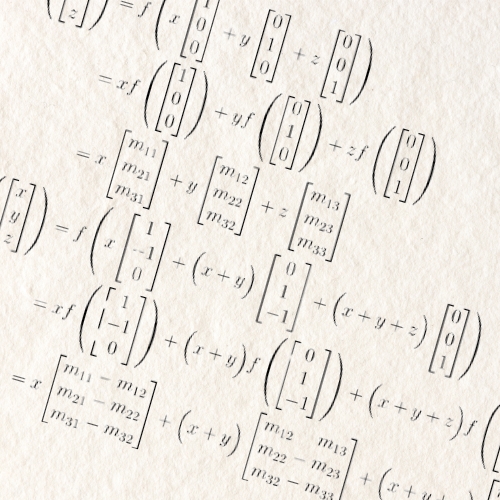
Example of a Linear Algebra Proof [Source]

What can students expect from this course, and what is the key takeaway you want them to learn?

“I would like students to forget what they learned in high school”.

One by one, I will introduce the necessary concepts for them to understand what matrices are. Lectures are typically based on proofs, where I introduce a tool and explain why it works. Lectures are in general more theoretical, but there are plenty of opportunities to get examples, exercises, and additional material.

[In terms of takeaways, ] they should know the fundamentals – what a matrix is, what a vector is, what are vector spaces, and how to use them. If I teach you the concept, that way you can learn to use it and apply it to different applications.

How does linear algebra connect with your work, research, or engineering in general?

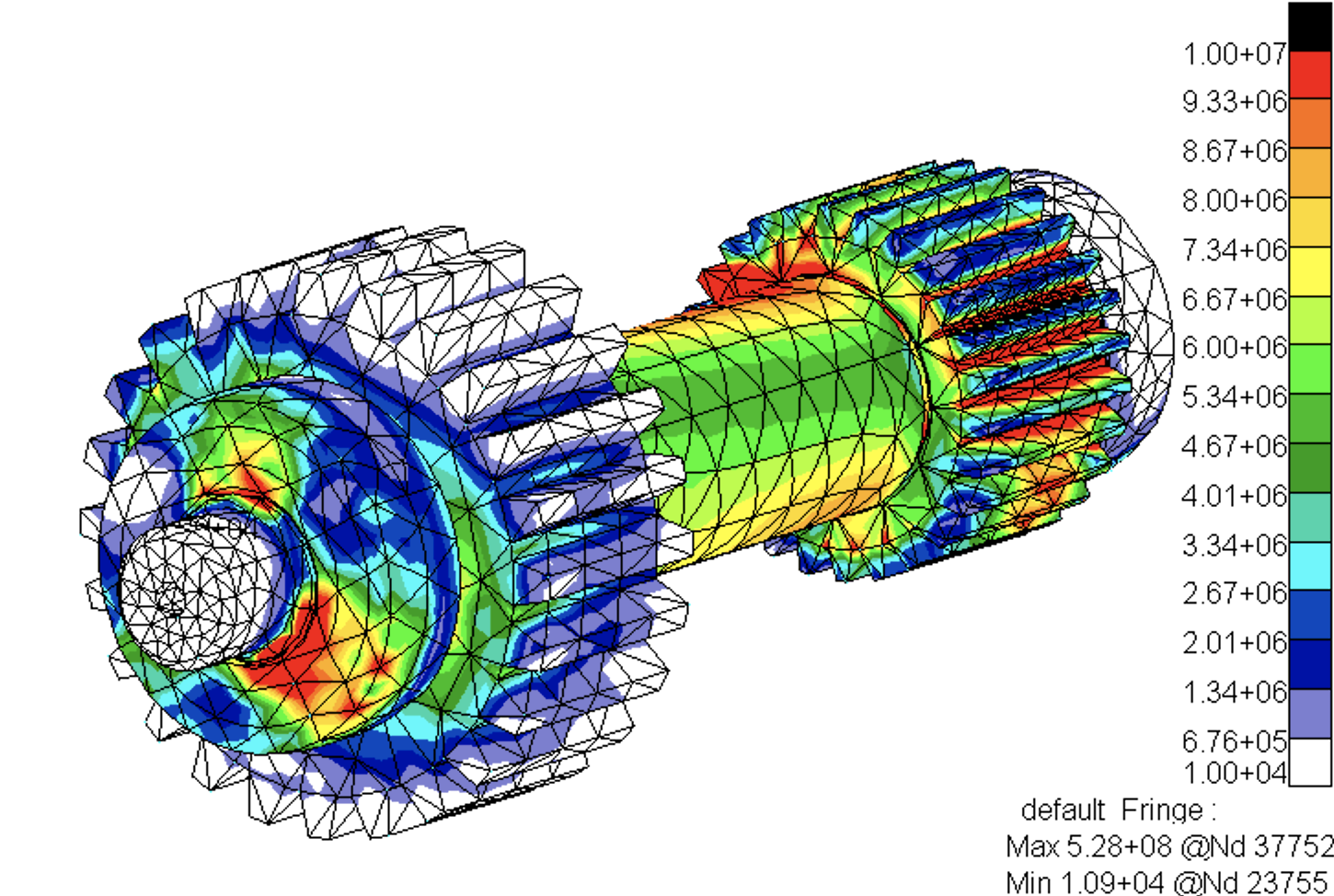
Colored finite element analysis (FEA) plot of a gear shaft, illustrating stress distribution. The legend indicates varying stress levels from blue (low) to red (high).
CC BY-SA 4.0, via Wikimedia Commons

Novel methods of artificial intelligence are typically highly non-linear. The question becomes, why is linear algebra still important? Linearizing a system of equations is still very powerful.

“Even machine learning technologies are all based on linear algebra.”

As I mentioned earlier, I’m doing research in materials science. If you are designing structures or materials, you are typically interested in predicting stresses and strains. One tool we use for these predictions is FEA and this is nothing but solving matrix equations. Here you could have a million-by-million matrix. Methods of linear algebra are used to efficiently solve these systems of equations. Nowadays, I don’t solve these systems by hand, but I should know how the results will look like and be able to interpret them. FEA produces colorful pictures, but just because they are colorful doesn’t mean they are true. You need to understand how stresses are computed and how the numerical solver works.

A second application of linear algebra is robotics. Let’s say you want to model a robotic arm by direct kinematics. Again, you are using matrix operations to describe the robotic system. For example, each joint of the robotic arm can be described as a matrix, representing translation and rotation. By using a matrix multiplication of the matrices of each joint, we can calculate the behaviour of the whole robotic arm.

Any other comments or thoughts to share?

For this course, ChatGPT is not a very useful tool to understand the proofs in the textbook. Currently, problems solved with ChatGPT can be false while still looking plausible.


PHY180: Classical Mechanics


Q: Why did the chicken cross the road?

Aristotle: It is the nature of chickens to cross roads.

Isaac Newton: Chickens at rest tend to stay at rest, chickens in motion tend to cross roads.

Albert Einstein: Whether the chicken crossed the road or the road moved beneath the chicken depends on your frame of reference.

Werner Heisenberg: We are not sure which side of the road the chicken was on, but it was moving very fast.

Wolfgang Pauli: There already was a chicken on this side of the road.


Classical mechanics is one of the fundamental topics in physics, and this course will set you up for success in later years. Everything from flying planes to walking robots can be explained through concepts taught in PHY180.  

The goal of PHY180 is to teach you about the equations and principles used to model a variety of real-world situations. For example, you might model the flight of a rocket to determine its energy and velocity at a given time. You’ll also use tools from other courses, like differential and integral calculus from ESC194, to model more advanced systems as you progress through the course including rotating objects and systems where energy is dissipated.     


Professor

Portrait of Jason Harlow smiling at camera
Professor Jason Harlow [Source]

Professor Jason Harlow

“I am an astronomer turned full-time physics teacher.” Professor Harlow has taught at the University of Toronto since 2004. He completed his undergraduate studies in the Department of Physics at the University of Toronto and received his Ph.D. in Astronomy and Astrophysics from The Pennsylvania State University in 2000. He has received many teaching awards, including the 2025 Physics Student Union Teaching Award. Professor Harlow is also active as a researcher and supervisor, with interests in physics education research, low-mass stars, fibre optics, and much more. 

Fun fact: Professor Harlow authored a book called Physics of Music


Professor Interview with Professor Harlow


Course Highlights

  • Labs are a great opportunity to connect the math and theory of the course with the real world. You’ll quickly see that the equations taught in the course can model the world around us.    
  • This course will teach you the fundamentals behind the motion of an object. Soon, you’ll be able to simplify many complicated physics problems to the basic equations taught in this course.  
  • Learning physics from a more mathematical approach. You’ll learn how to derive physics equations from first principles and then apply calculus and mathematical concepts to solve physics problems using those equations. 

Week in the Life of a PHY180 Student

Lectures

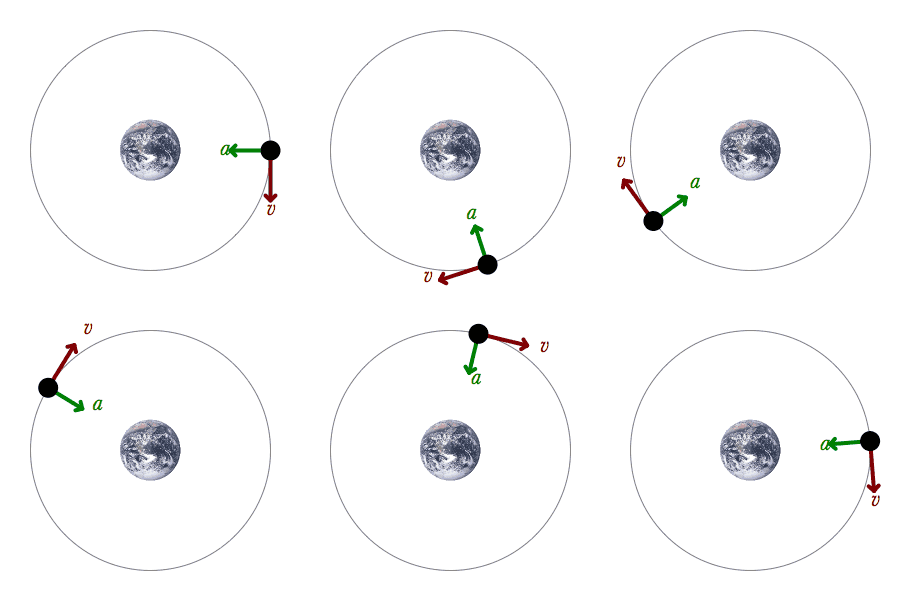
This course has three hours of lectures a week. You’ll cover concepts such as Newton’s three laws, kinematics, forces, oscillations, momentum, angular momentum, and energy.  

The best tip for PHY180 lectures is ensuring you understand each fundamental idea before moving on to the next one since the concepts in the course will build upon one another. Theory and derivations are mostly in the pre-class videos. Class time is mostly focused on examples, both conceptual and quantitative. If you understand the derivation techniques and apply the theory learned, you’ll implement your knowledge more effectively during independent study and when taking assessments.   

For some of you, the content covered in lectures may be a review of high school physics. Nevertheless, it’s important that you pay attention to lectures and take notes because the derivations are likely more advanced than what you have seen in the past. For those who haven’t seen the content before, don’t worry: the course starts from the basics, and everything is derived from first principles. 

Practicals

While there are no dedicated tutorial slots for this course, you’ll get to interact with your teaching assistants (TA) during practical sessions. Practicals are weekly  two-hour sessions run by TAs. The first hour is Q&A time for students to ask questions about the content and about the pendulum project, which is your main assignment throughout the course. During the second hour, you’ll solve exam-style questions in groups related to topics discussed in lecture. This is great preparation for the midterms and finals and allows you to integrate all concepts you learned so far. 

Pendulum Project

The pendulum project is a term-long experiment focussed on analyzing harmonic motion. It involves building an oscillating pendulum at home, recording data from observing its motion, analyzing its amplitude over time, and improving the accuracy of your setup and methods. This culminates in a series of two intermediate lab reports and one final report. This project gives you good exposure to setting up experiments with minimal assistance, observing results by controlling variables, and finally writing lab reports and communicating your results, which is great preparation for all the labs you’ll do in second year. 

It’s important to note that the pendulum project is relatively time consuming. And while the report submissions are distributed throughout the semester, make sure you allocate sufficient time on a weekly basis to work on the project to avoid cramming at the end.  

Disclaimer: This was the format for the course last year, and the types of lab assignments may change this year.

Other Assessments

Besides the main project, there are several smaller weekly assignments that amount to around 10% of your total grade. Do note that you only need around half of these marks to get all 10%. These assignments include prescribed questions on a digital textbook (WileyPLUS), in-class questions on Mathmatize, post-class questions on Mathmatize, and weekly reflections.   

Disclaimer: This was the format for the course last year, and the types of assignments may change this year.

Midterms & Exams

There are two term tests in addition to a final exam. Use the midterms as checkpoints to test that you’re staying on top of the material. There are three main types of questions on the tests/exam: blog questions, where you’ll be asked to explain a physics concept without using any physics terminology; numberless questions, where you’ll be given variables to carry throughout your calculations; and modelling questions, where you’re given the freedom to frame the question how you best see fit, which includes prescribing appropriate numerical estimates for values. 


How to Succeed?

Quick Advice and Equations

Energy: E = \frac{1}{2}mv^2 + mgh + \frac{1}{2}kx^2 – Total mechanical energy of a system is equal to the sum of its kinetic energy (motion energy) and potential energies (e.g., gravitational and elastic potential energy; potential energy from height and in a spring, respectively). 

Angular Momentum: L = mrv\sin\theta – Angular momentum L is the momentum of an object moving in a rotational path of radius r. 

Hooke’s Law: F = -k\Delta x – Hooke’s law, which states that the deformation in a spring is directly proportional to the deforming force. And the constant of proportionality is the stiffness of the material, K, better known as the spring constant. Fun fact: everything from concrete to glass has a spring constant! 

More Details

PHY180 moves quickly, so make sure you keep up with the material. Ask the teaching team if you’re confused about a certain topic. Because the material builds on itself, it’s important to cement your understanding as concepts are being taught. If you have holes in your understanding, it’ll be difficult to learn new concepts well.

While we encourage you to know the equations and how they work together, we also want to stress that knowing why something works is also useful in classical mechanics. If you can understand how the concepts work on a theoretical level, you’re better prepared to answer more difficult, concept-focused questions than you would be otherwise. In our experience, the best way to achieve this understanding is to ask questions about why these concepts work wherever possible. Asking these questions in lectures, tutorials, office hours, and on Piazza (a platform where you can communicate with some of your professors) will help build your understanding of what these concepts really mean. Classical mechanics is arguably the oldest science ever taught, so there are tons of resources that can help you learn.

Mastering the theory behind problems will require a lot of practice. As you do more questions, your understanding of the material will improve, and you’ll model situations with fewer mistakes.
The midterm and exam will have no “easy” questions, so there’s no point in repeating problems you can easily do! We suggest making a list throughout the semester of questions you struggle with. Then, before the term tests and exam, work through the questions. Try to do them without looking at the answers to ensure you know how to solve the problems.

This course has a lot of equations, and many of them can only be used in very specific conditions. We recommend making a list of equations and when to use them as you go through the semester. Seeing them in an organized way will help you memorize the trickier ones and remember how they connect. (You won’t be allowed to bring anything into the exam.)

Before jumping into calculations for a physics problem, sketch out the situation and draw a Free Body Diagram (FBD). This will help you understand the problem and keep track of system components.  

You may be able to solve some physics problems mentally. However, PHY180 problems can get quite complex, especially when you need to consider different time intervals. With a simplified diagram, you can connect physics concepts to a system without needing to remember every part of it. After you’ve visualized the problem using diagrams, you can focus on identifying and solving for your unknowns.

Additionally, diagrams can help assessors understand your solution, as they have a visual aid to guide them through your calculations.

Problems will often present you with information about a system of objects in motion and ask you to find a particular variable. If you’re struggling to determine which equation to use to find this variable, it’s helpful to list all known and unknown information from the question in the solution space first. This will allow you to run through the equations in your head and find the most relevant ones to use. This is especially helpful during term tests and the final exam to break complex problems down into simpler steps and solve them faster.


Beyond First Year

  • Classical mechanics is the root of most other science and engineering fields. The equations and concepts you learn in this course will become second nature by the time you graduate. Understanding these concepts is necessary to progress through engineering and for success in later courses.   
  • One classic problem-solving technique in physics is modeling. This course will teach you how to model a situation and how to apply the equations to solve for what you need. Many other courses you take will use this technique.
  • The materials covered here will serve as the basis for several second-year EngSci courses such as PHY293 and AER210, as well as upper-year courses in the Aerospace Engineering, Engineering Physics, and Robotics Engineering majors.  

Engineering Computing Facility

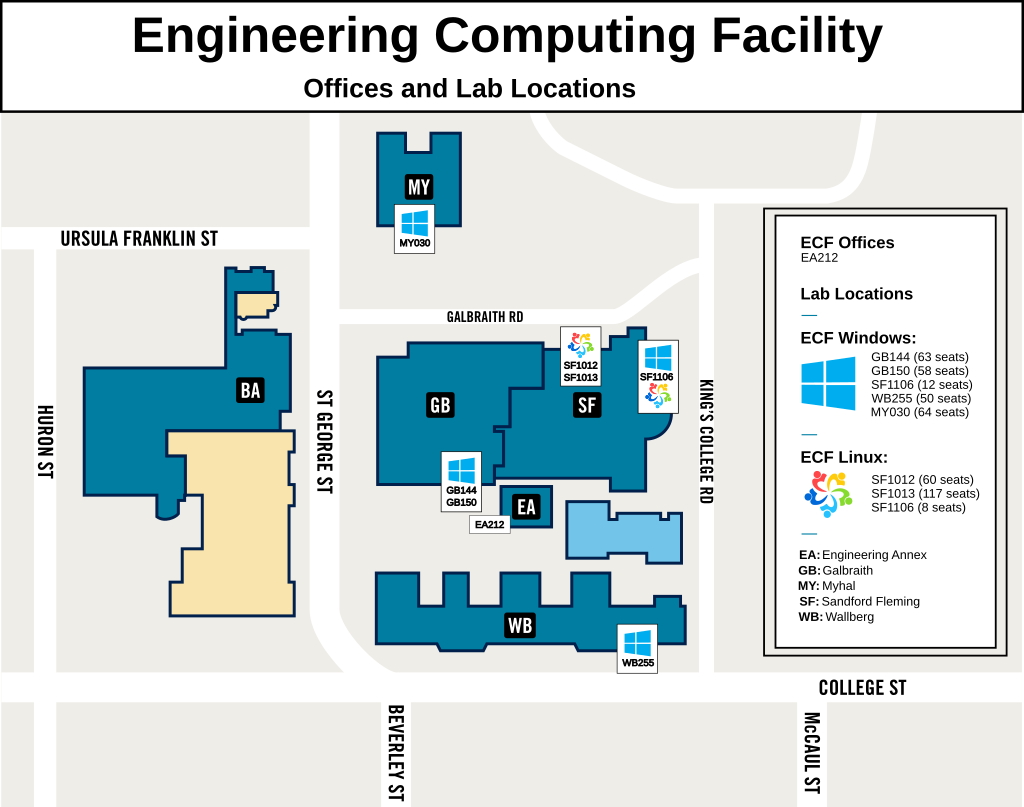
The Engineering Computing Facility (ECF) provides computing services to students. On campus, there are five Windows labs and three Linux labs with a total of 368 workstations. There are also some Windows computers in the EngSci Common Room. 

All engineering undergraduate students can access these computer labs 24/7. You can also access ECF workstations remotely from your own computer via the Secure Shell protocol (SSH). This’ll be useful in ESC190, in which you may need to use a debugging tool called Valgrind (which can be tricky to configure on your own computer). By SSHing into an ECF workstation with a couple basic commands, you can use Valgrind and many other tools right from your own computer.  

The ECF labs are equipped with comfy office chairs and big screens and always have an available computer. These are nice places to study in between classes and work on assignments.  

ECF Offices and Lab Locations [Source]

Using ECF Workstations

You’ll receive an email about setting up your ECF account in the fall. You’re required to set up your account to access ECF workstations, printing, and more. Account activation instructions can be found on this page: ECF Account Activation.  

All engineering students can print a limited number of pages for free at ECF printers. For first-year EngSci, you have 900 free pages of black-and-white printing per term, with a 25% discount for double-sided printing (i.e. 1200 pages) – cheaper and eco-groovy. Color printing costs twice as much – keep this in mind if you need to print CIV102 notes, Praxis materials, or any other large documents. 

ECF workstations are equipped with tons of useful software such as MATLAB, SOLIDWORKS, and VS Code. If you ever need to use software that your computer can’t run, the ECF is the place to go! The details of these computers are listed on the ECF Website.  

ECF resources are strictly for academic use, so be sure to familiarize yourself with the ECF Account and Lab Rules and Regulations for Students. Using the workstations for unauthorized activities can result in serious consequences, including payment of damages and loss of computer access.  

Additionally, ECF conducts random spot checks; if you’re caught with food or drink in the labs, your access will be revoked, and you’ll need to reapply to regain it.  


Meet the EngSci Office

Located right next to the EngSci Common Room in BA2110, the EngSci office is comprised of the people responsible for making our program a reality. They organize courses, students, professors, external communication, internal communication, events, and more. So, without further ado, here are the people making the magic happen. 

Keep reading to find our latest video, How Well Do Your Academic Advisors Know Each Other?


Cathy Pettigrew

Cathy Pettigrew

Front Line Student Advisor and Office Administrator (Acting) 

Cathy is our acting Front Line Student Advisor while Mandana is away. She can help with all your questions about courses, schedules, and more, and can direct you to where you can find additional help. Cathy has experience working in education and adult learning and ran a small business for over a decade.  She has worked extensively with neuro-diverse clients and students, with for-profit and non-profit organizations. She is an alumna of the University of Toronto, and has fond memories of student life, which has made returning to the campus a full-circle moment. 

Most recently, Cathy has been counselling people living with ADHD, autism, and learning challenges, providing mental health, academic, and pathways counselling, as well as conducting psychometric assessments to assist with diagnoses. She has served on various community initiatives, including a CIHR (Canadian Institutes of Health Research) research study at the Institute of Better Health, and as a Special Needs Consultant for the Archdiocese of Toronto.

Cathy is an outgoing person and enjoys doing public speaking engagements, advocating for people living with special needs, and promoting strengths-based learning and inclusivity. 

Fun Fact: Cathy was offered the role of Glinda in the first national tour of Wicked but declined to join EngSci. 


Don Newton

Don Newton

Curriculum and Research Officer 

Most of Don’s work is behind the scenes but is crucial to providing EngSci students the opportunities to travel and perform summer research. Don works on curriculum changes for the program and collaborates on ensuring EngSci remains an accredited engineering program, which means you have the opportunity to pursue your engineering designation once you graduate from EngSci. Don also manages the Engineering Science Research Opportunities Program (ESROP), which is an EngSci-exclusive program that gives students the opportunity to do summer research at U of T and abroad.  

Fun Fact: Don has been to Hawaii 10 times and is hoping to one day establish an ESROP placement for students to conduct research there.  


Stephen Johns

Stephen Johns

Academic Advisor, Years 1 and 2, Domestic Students 

Stephen is our advisor for first- and second-year domestic students, which means he will be the person who supports you during both the transition into EngSci and, later, into your major. His role is like your guidance counsellor’s in high school. Stephen can advise you on Faculty rules and regulations, scheduling issues, electives, minors, major selection, and campus resources like academic support and financial aid. When Stephen doesn’t know an answer, he can always direct you to someone that does.

Another major part of Stephen’s role is aiding students with their holistic transition to university. Stephen is always available to meet with students to discuss time management, EngSci-specific study tips, and other personal matters. If you ever want to have a conversation on whether you think EngSci is truly the right place for you, Stephen is always around to listen.   

Fun Fact: To the best of our knowledge, Steve is the only person who has ever seen Pearl Jam 48 times, The Phantom of the Opera 29 times, and held seasons tickets to professional sports teams in two different countries.

Irma Berardi

Irma Berardi

Academic Advisor, Years 1 and 2 (International) 

Irma’s role is very similar to Stephen’s; the main difference is that she works with first- and second-year international students. Irma is well-versed with the resources available within U of T Engineering, and all of the academic regulations and policies, in addition to supporting international students transition into the program and to a new country as a whole. Irma is always available to meet with students to discuss their new experience in Canada and how the Faculty can better support them. She can also help you get connected with the Centre for International Experience and their Immigration Advisors if you have questions related to your study permit.

Irma also leads EngSci Guided Engineering Academic Review Sessions, or GEARS. GEARS Mentors are upper-year students who were successful in the first-year courses you may need help with; they are great resources as you transition into EngSci. These drop-in sessions take place weekly and are designed for you to have a place to ask any questions about EngSci. If you want to know more, just ask Irma!

Fun Fact: Her cat’s name is Lana del Meow…can you guess the influence?  

Watch Our New Video:

How Well Do Your Academic Advisors Know Each Other?

Get to know your first- and second-year Academic Advisors, Stephen Johns and Irma Berardi, as they answer questions about each other and put their friendship to the test.


Brendan Heath

Brendan Heath

Academic Advisor, Years 3 and 4

Brendan will be your academic advisor in third and fourth year, which means he is well-versed in each of the major options and can provide support for you within your choice of specialization. When you get around to picking your major, Brendan is a great resource for learning about potential career paths (like industry or grad school). For some majors, your electives may cause course conflicts or you may want to take more courses than necessary (called “overloading”). Brendan can help you handle conflicts, get approval for overloads, plan for minors and understand when courses should be marked as extra credit. Topics related to graduation, like meeting your accreditation or complementary studies requirements, are also within Brendan’s considerable expertise.   

Fun Fact: Brendan grew up on an apple orchard in Quebec! He also started his undergraduate degree as a computer engineer at Waterloo but ended up graduating from Peace and Conflict Studies at U of T.  


Christina Heidorn

Christina Heidorn

External Relations Officer 

If you go to any EngSci events, you’re sure to see Christina helping run the show. She oversees events like the Engineering Science Education Conference (ESEC), which you’ll attend in your first two years in EngSci. You’ll hear exciting speakers from many engineering-related fields share their (sometimes surprising) career and life experiences.    

Maybe you’ve seen Christina at one of our recruitment events this past year, where she helps prospective students decide whether EngSci is the right choice for them. She also works with U of T Engineering’s huge online alumni network, U of T Engineering CONNECT. CONNECT is a platform you can sign up for once you become a student in the fall. It can help you get in touch with alumni for things like career advice, job opportunities, and more. 

One way you can be a part of Christina’s team is by signing up to be an EngSci Ambassador in September. Keep an eye on your email for application instructions. As an EngSci Ambassador you volunteer at recruitment and promotion events to talk to prospective students about the program and your experiences.

Fun Fact: Christina is an EngSci 9T1 graduate in the Chemical option (unfortunately it no longer exists ?). She used to be a television documentary producer for programs like CBC’s The Fifth Estate, and she favours colorful shoes.  She is also a season ticket holder for the AFC Toronto, so if you’re a footie fan, drop by and she might just give you a sticker!  ⚽?  


Diane Giang

Diane Giang

Manager of Finance and Administration 

As manager, Diane is involved in various high-level tasks for EngSci. Diane manages the finance, human resources and operational needs of the Division. She works with the EngSci Club, and helps support students that participate in the ESROP program, students that become TAs, and students that work for the EngSci Office at any time (as GEARS leaders, for example). An additional way she’ll directly work with you is when you submit a reimbursement form for a course project.   

Fun Fact: Diane enjoys playing board games, video games, and going on roller coasters with her kids.   


Kimia Moozeh

Kimia Moozeh

Senior Officer, Program and Student Experience

As part of her role, Kimia is involved in curriculum change/innovation, program review and enhancing student experience in Engineering Science. She is also involved in the accreditation process. Please feel free to contact her if you have suggestions/comments about the curriculum or the program.  

Fun Fact: She is now addicted to Krispy Kreme donuts after trying one for the first time since joining EngSci.


Mandana Esmaeili

Mandana Esmaeili

Front Line Student Advisor and Office Administrator (On Leave) 

Mandana, currently on leave, is usually the first friendly face you see in the office, sitting at the front desk ready to help. As the Front Line Student Advisor, she can answer all your questions about schedules, courses and more. Mandana is the best person to ask your questions first. She often knows the answer but if she doesn’t, she’ll direct you to where you can get the answer. Mandana also writes the EngSci newsletters every week, summarizing all things going on in EngSci so that it is easy for you to stay up to date. You will start to get these newsletters in September; make sure you read them every week, because there is a lot of very valuable information condensed in there.  

As the office administrator, Mandana can also deal with issues in the Common Room, help EngSci-related clubs book rooms on campus for events, borrow technologies, and tell you what forms you need to fill out for certain activities. Mandana also knows the schedules of everyone else in the office, so if you’re thinking of dropping by for a quick appointment you can ask her when someone’s free.   

In short, if you don’t know who to talk to, ask Mandana and she’ll help you find where you need to go.  

Fun Fact: Her hobbies include photography and cinematography.

About Blog Admins

Amanda Mongillo 

About Me: Hi everyone! My name is Amanda and I am an EngSci 2T8 + PEY, which means that this fall I will be entering into my third year of the program. I grew up just north of Toronto in Vaughan, and after spending my first year in residence at St Michael’s College, I am now living downtown in an apartment just off campus. I am going into the Aerospace major, and I hope to complete a minor in robotics. I am especially interested in space exploration and human spaceflight, and I am currently a general member of the U of T Aerospace Team (UTAT) space systems team working on mission operations. I have also been an executive for Women in Science and Engineering (WISE ) at U of T for the past two years and it is one of my favorite communities to be a part of ?. Outside of school, I love exploring the city with my friends, going thrifting, or binge-watching shows with my roommates (our latest obsession was Gossip Girl).

Why I Chose EngSci: Growing up, I never really thought of engineering as a possible career path, even though there were many early signs that I was drawn to STEM. I loved Lego robotics, begged my parents for STEAM kits from Toys-R-Us, and spent a lot of time building and creating things just for fun. In high school, my favourite classes were math, science, robotics, and woodshop, and I realized I wanted to study in a field that combined problem-solving and theory as I enjoyed learning with hands-on design work. Aerospace engineering was the first program that truly clicked for me. I chose EngSci specifically because when I looked it up online, everyone claimed that it was a program for people who loved to learn, and that resonated with me. I was excited to explore a variety of engineering and science topics (especially quantum physics in 2nd year, that sounded so cool!)

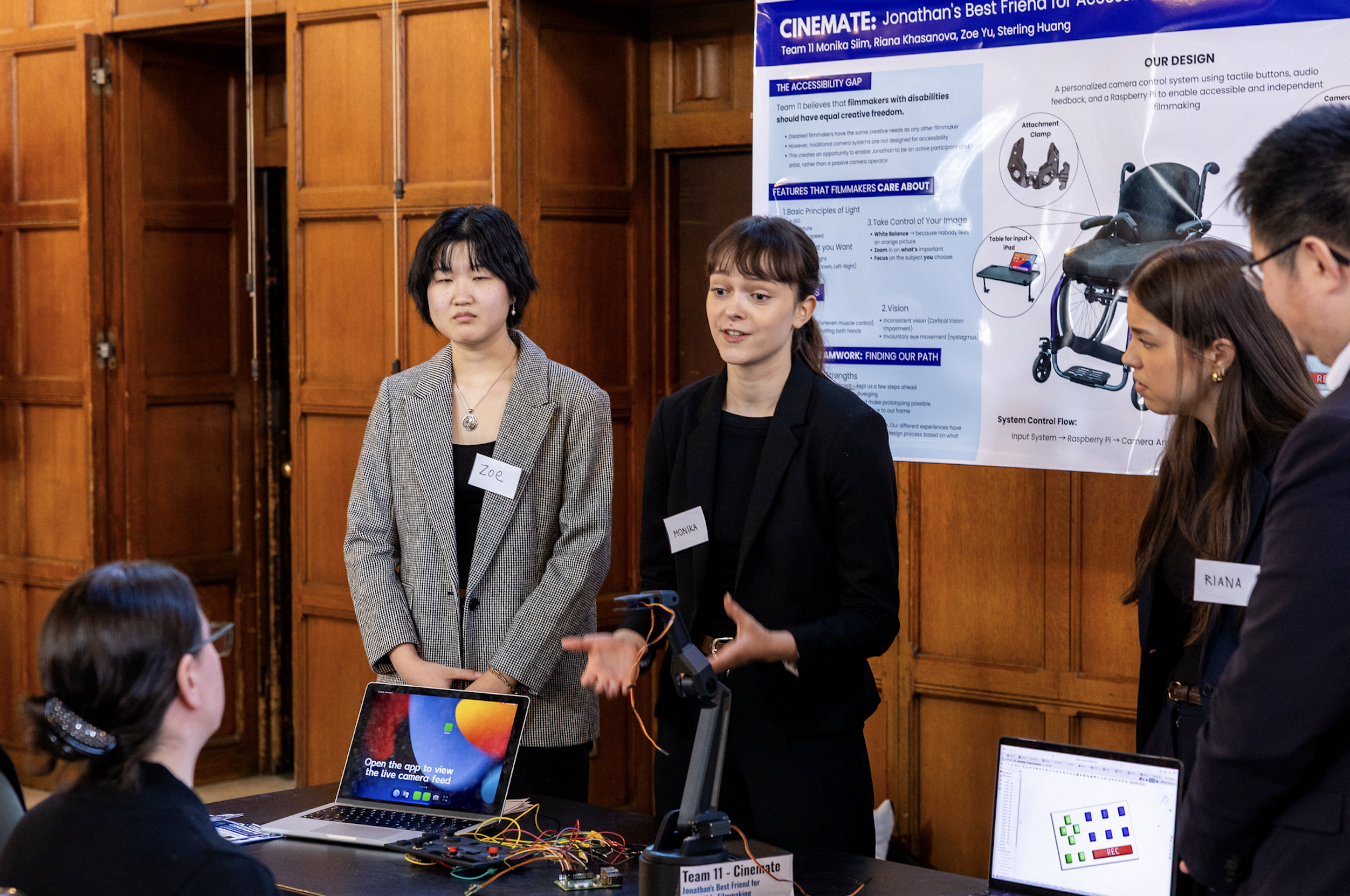
Picture of Blog Author

My EngSci Experience: The transition from high school to EngSci was definitely an adjustment for me. The pace of the program can feel fast at first, and during my first few weeks I had to learn how to balance the workload and figure out what study habits worked best for me. Upper-year EngScis reassured me that first year is really about adapting and finding your learning style, and that making some mistakes or facing some challenges is completely normal.  

 What truly got me through first year has to be the friends I made in the program. The key to succeeding in EngSci is truly working together. I would go to the common room whenever I was stuck on a problem set or CIV102 assignment, and sure enough there would be a group of first-years already working on them, and everyone was more than happy to include you and help each other out. I never could have imagined how close-knit the EngSci community is. You are always supported by your peers whom you are seeing in all of your classes, or the upper-years who will gladly send over their old problem set practice, or the professors who truly want to see you succeed and are so willing to answer any of your questions. This community made staying in the program worth it for me.   

My experience in the second year was a lot different than my first year. By second year, I had established strong friendships in the program as well as strong learning and studying habits that worked for me. I also found that the second-year courses were a lot more interesting for me, which in turn made it easier to study and practice for the courses. Even though courses like Quantum Physics and Digital Circuits weren’t completely related to the aerospace field, they were still super engaging and a great way to explore different engineering topics and skills outside of my intended field.  

My advice for any first-year student would be to get involved. Join one student club or design team that you are really interested in. In my first year, I joined WISE and UTAT, and I found these clubs such a great way to focus on something outside of schoolwork, learn new skill sets outside of coursework, and connect with other passionate people who share similar interests to me.  

Getting to be a part of the SKULE™ and EngSci community has been such an incredible experience filled with so many amazing people and opportunities. I am so excited for you to join our community and to meet you all! If you have any questions at all or would just like to chat about anything, please feel free to message me! 


Monika Siim-Kiviloo 

About Me:  Hello, hello! My name is Monika, and I am an EngSci 2T9 + PEY, meaning I am entering my second year of the program. I am an international student; I was born on a small island called Saaremaa on the west side of Estonia, but I mostly grew up in Tallinn, Estonia. During my first year in EngSci, I lived just off-campus in a student residence called Tartu College – it is owned by Estonians, so that is how I ended up there. I am mostly interested in Biomedical Engineering but am still in between choosing the Robotics major or Biomedical Systems major. Related to this, I am currently a part of the U of T Bioengineering Innovation and Outreach in Consulting Club (UT BIONIC), where we work on projects with actual clients. I am also in the very early stages of building a femtech-related start-up with my classmates. Outside of this, I work at VEMU Estonian Museum Canada to connect with other Estonians abroad. In my free time, I love exercising. I registered to run a half-marathon in October, so currently I am working on getting better at running. 

Why I Chose EngSci: After high school, I didn’t know I was going into EngSci. I have always been passionate about many things, so there were tons of things I was excited to learn more about. I initially studied film production at York University, which was nice, but I missed studying STEM subjects, which I’d previously focused on heavily prior to film. I then chose to transfer to U of T Engineering because I thought it was a unique field that allowed for both creativity and technical rigour. I chose EngSci specifically because 1) of my interest in biomedical engineering and the option to specialize in it, 2) I liked knowing that the program would push me outside of my comfort zone, and 3) after doing more research, the overall vibe of the program just felt the most inviting and right for me.   

My EngSci Experience: Before going into EngSci, I really didn’t know what to expect. I heard a lot of people say it would be very hard, and looking back now, the first semester was definitely intense, and a lot of things didn’t go as planned, but it was also very doable. Once you start building systems for yourself that work, the rest gets much easier. For example, the second term was definitely a lot easier for me. I got more into a routine of studying in a study group and spending almost every night with the same people at Robarts Library. Also, a few other EngScis and I started meeting every Sunday to share our wins and losses from the past week. I changed clubs and did extracurricular activities not to show that I had done something but based only on whether they were interesting and exciting to me. Starting first year, I could never have expected to meet so many inspiring people. Having people around you for life who you know are super talented and hardworking, and who you can always contact to start something together, whatever it is, is one of the most invaluable things a university can give you. 

Overall, if I were starting first year again, this would be the advice I would give myself: 1) Be very strategic with your time and have both a daily list of things you must do and a weekly list of things to get done. Be realistic about how long something will take when making it. 2) Spend more time early on socializing, being together with other people, and studying with other people. 3) Don’t make your life only about school. Pick clubs, activities, and sports that genuinely energize you and make you more passionate about life and what you are doing. 4) Reward yourself when you have done well, take breaks, and do fun activities. 5) Try your best to do very well, but if something goes badly, it is what it is. Analyze what you can do better next time and move on. 

If I had to go back in time, I would choose EngSci 100% again. It is one of the most rewarding experiences. You will be surprised by how quickly you can learn so many new skills, and the community here is for your entire life. I am so excited for you to start your first year! 


Skule History and Traditions

You, as 3T0s, are the next generation of U of T engineers. Throughout your time studying here, you’ll have a chance to participate in and learn more about the rich Skule history and traditions. You’ll also create your own traditions, community, and experience and put your own spin on what it means to be a U of T engineer. Are you ready to make your mark on over 150 years of engineering legacies? 


The Start of U of T Engineering

Founded in 1873 as the School of Practical Science (SPS) —later renamed Faculty of Applied Science & Engineering (a.k.a U of T Engineering)—our Faculty has grown and evolved to become the vibrant, diverse, and innovative place that we now know today. The SPS. was created to serve the needs of the growing economy and rise of technology at the time. Initially, the subjects spanned mining, mechanics, and manufacturing. Below is a timeline of the evolution of U of T Engineering: 

1873-1890

The first five Departments to in the SPS. were Civil, Mechanical, Architecture, Applied Chemistry and Mining Geology.

1913

The Department of Electrical Engineering became independent.

1925

The first Iron Ring Ceremony is conducted. The idea was proposed by University of Toronto Professor H.E.T. Haultain. Learn more about the ceremony on The Ritual of the Calling page.

1927

Elsie “Queen of the Hurricanes” MacGill graduates as the first woman electrical engineer in Canada.

1934

The Engineering Science program was founded as “Engineering Physics.” The program’s name was changed to Engineering Science (EngSci) in 1962.

1949

The University of Toronto Institute for Aerospace Studies (UTIAS) opened for graduate studies in aeronautical and space sciences.

1962

The Institute of Biomedical Electronics (now known as the Institute of Biomedical Engineering) was established for graduate studies.

1979

The Professional Experience Year (PEY) Co-op Program is created.

This is just a brief overview of the history of U of T Engineering. Today, the engineering disciplines are split into the Core 8 Programs and Engineering Science. To learn more about the history of U of T Engineering in general the U of T library has created a detailed exhibit that covers Engineering student life from 1878-1906. In addition, check out the Faculty’s history page.


Important Traditions

The Faculty of Engineering & Applied Sciences has always valued a tight-knit community with strong traditions, many of which have survived from the very beginning of the Faculty while some new ones have been created along the way.   

Over the years many students have helped document the SkuleTM community’s rich history and traditions. We can’t mention them all, but here are some notable ones:

F!rosh Week

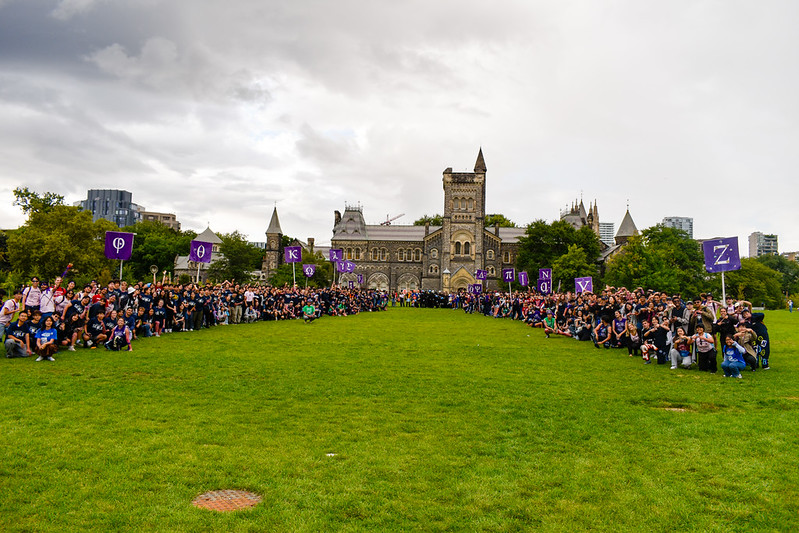
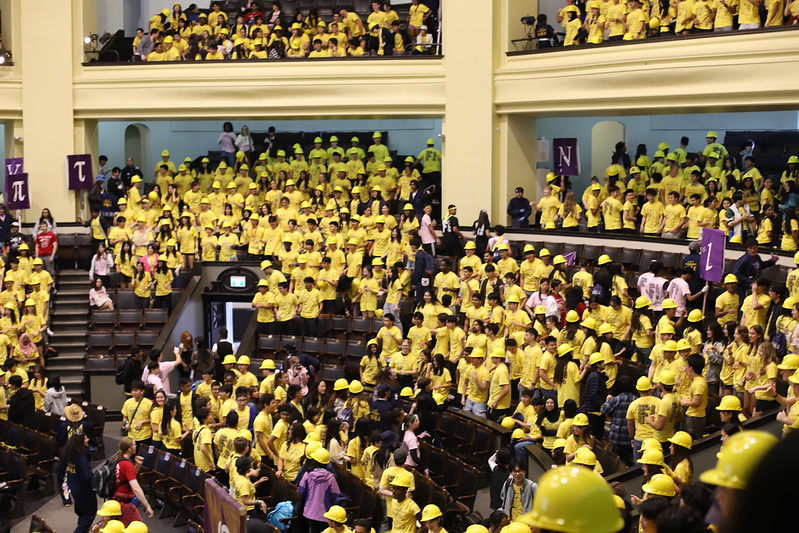
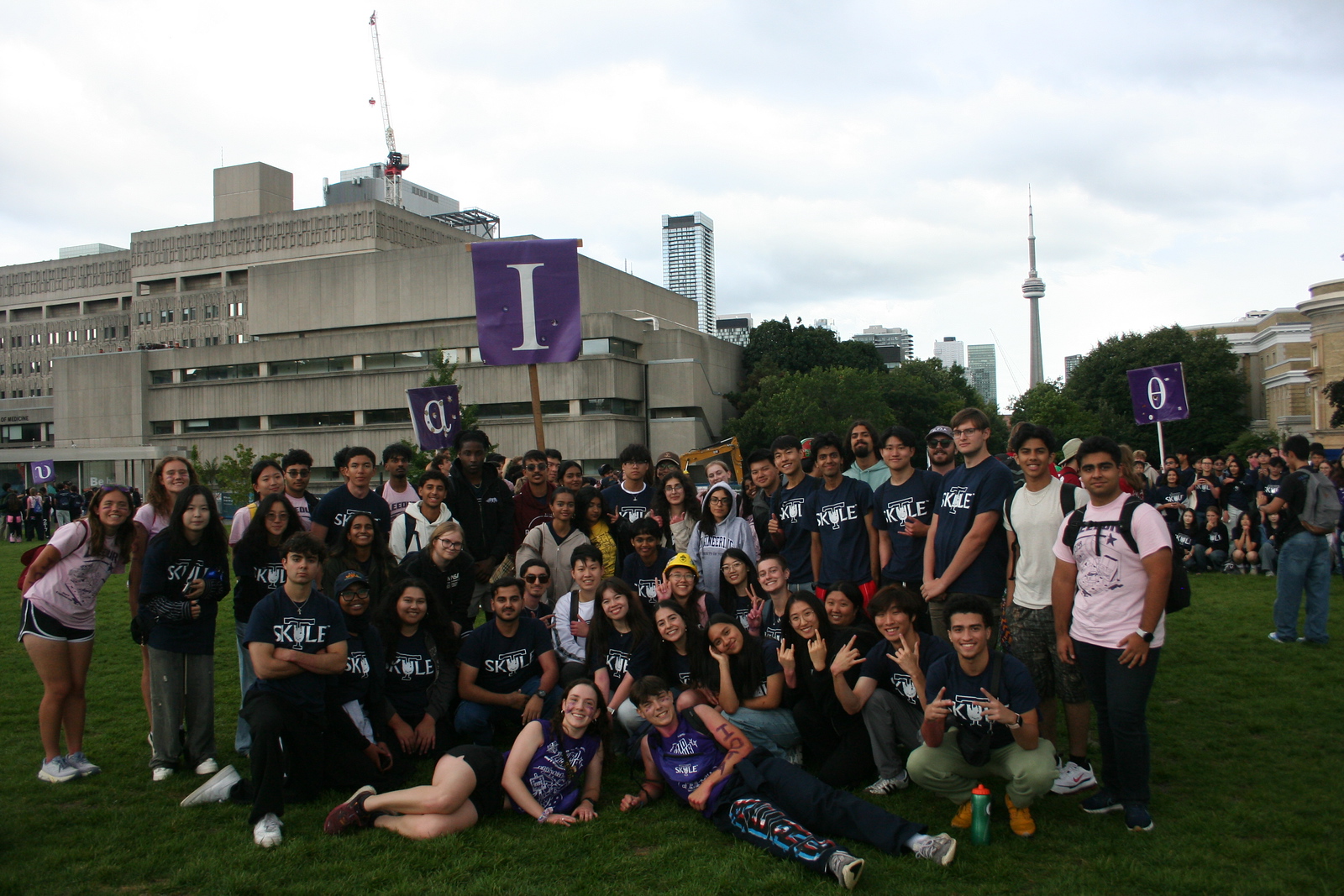
Just before the start of class each September, the Engineering Society hosts F!rosh Week, a weeklong series of events to introduce students to campus, welcome them to the community, and have some fun! Events include U of T Engineering traditions such as purple dye, Cheer Off, F!rosh Olympiks, SkuleTM Hunt, Nitelife, and much more. 

To read more about F!rosh Week and keep up to date on registration and events check out their Instagram page @froshweek, and register for the event.   

F!rosh Week 2T4 [Source]
Chariot race held in King’s College Circle in January 2020 [Source]

Godiva Week

Godiva Week kicks off the winter semester each year; the Blue & Gold committee organizes a week of charity events, competitions, and fun traditions. These primarily focus on deciding the Spirit Heads for the next year. These Spirit Heads include Mr. Blue and Gold, Lady Godiva, and Ultimate Frosh, all of whom you’ll get to meet this year at F!rosh Week.  You’ll also see the infamous chariot race!  

Iron Ring

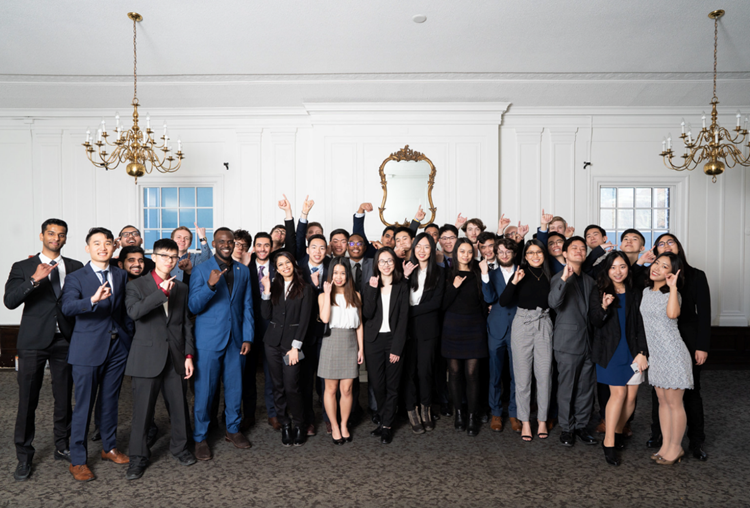
At the end of your journey to becoming an engineer you’ll get to celebrate your hard work and receive a symbol of the responsibilities and obligations of your profession through the Iron Ring Ceremony. It’s during this ceremony that you’ll be presented with a small, faceted iron ring which you can wear on the pinky finger of your drafting hand. The scrape and sound of the ring dragging when you’re writing and drafting is there as a symbolic reminder of the importance and responsibilities of being an engineer. As you continue to work over your career your ring will become worn down and polished to mirror the honing and perfection of your skills. 

Graduating EngSci students holding up their pinky fingers to celebrate their Iron Rings.

Toike Oike

The Toike Oike Sword [Source]

Voted the #1 Engineering Newspaper on campus, the Toike Oike is “The University of Toronto’s Humour Newspaper Since 1911.” Its name comes from the early days of the Faculty, when a caretaker would ask students working in labs till later hours to “take a hike”. However, due to his Irish accent, the phrase was heard as “toy-kee-oyk.” 

Each monthly issue has its own theme, and everyone can participate in brainstorming meetings and submit their articles and graphics. You can also help with “Distros,” or distributing the newspapers. Do you know there’s a Toike wagon just for that? You might even be promoted to senior wagon engineer! 

The current Skule Cannon, since 2013 [Source]

Ye Olde Mighty Skule™ Cannon and Cannon Guard

U of T Engineering’s mascot is a cannon! It’s fired (without actual cannonballs, but with the loud bang) at events such as F!rosh Week, Godiva Week, and other major internal and external events. The Cannon is protected and fired by the Chief Attiliator (whose identity remains a secret) and the rest of the Cannon Guard. It’s been the subject of various (attempted and successful) heists by other universities over the years. You’ll get multiple chances to see (and hear!) the Cannon throughout your time at U of T. 

Lady Godiva Memorial Bnad

Created back in 1950, the Lady Godiva Memorial Bnad (intentional misspelling) is a band comprised of engineering students who love to make noise with anything from buckets to drums to trombones and even stop signs. They’re characterized by their blue jerseys, hats, and of course their instruments and noise. They perform (crash) at various Skule™ events throughout the year and have even made appearances at public events!  

If you want to join the Bnad, follow along with their music, or just learn more about this beloved group, check out their website

LGMB celebrating Toronto Subway System’s 50th anniversary [Source]

Joining Design Teams and Clubs

Subscribe to our weekly newsletter to receive an invite to the EngSci exclusive club fairs!

U of T Engineering offers lots of ways for students to get involved outside the classroom. Even before you get to campus, you’ll probably hear a lot about different clubs and design teams that you can join. This raises an important question: how do you actually get involved with them?   

First-year students are allowed and encouraged to join design teams! You don’t usually need any previous knowledge or skills to join because you’ll be taught by upper year students. Design teams connect students from various engineering disciplines and years, and even run specific recruitment initiatives to engage first-year students.    


The Skule Club Directory divides student clubs into athletic clubs, community involvement clubs, fine arts clubs, hobby clubs, musical clubs, and professional development clubs. You can also find a complete list of affiliated design teams here. While there’s a club for everyone, nobody can be involved in all clubs. It’s important to review your options before selecting which clubs most interest you. 

Summer Student Tip: It’s much more important to make meaningful contributions to the clubs you join than to join many clubs simply to show that you joined them. 

Steps To Join

While different design teams and clubs will have their own recruitment cycles, in general, the steps to getting involved are below. 

Before committing to a team, you should explore the available options.  

You can get to know each team or club at the Club Fairs during F!rosh Week and at our exclusive EngSci Club Fair—check the Meeting Calendar for details. You also get to see exactly what you would get to do in the team/club. Speaking to the team leads in person at these events is the best way to demonstrate your interest. 

As mentioned earlier, first-year students can join design teams and clubs. However, you shouldn’t feel pressured to do so right away. Given the demanding nature of EngSci, you might be wondering whether you’ll have enough time outside of school for extracurriculars. That’s a valid concern, but at the same time, you should know that many EngScis before you have managed to excel in academics while dedicating time to design teams, clubs, and personal projects. We encourage you to ask upper-year students for advice. They will not only inspire you to pursue your own passion projects but also share time management and learning tips.   

Some of you may have a clear career goal and know which design teams to join for experience. If you want to dive right in, go for it! Or you might be exploring career options and prefer to focus on academics at the beginning of your first year. If you find yourself in the latter group, rest assured that design teams and clubs at U of T recruit students regularly, typically at the start of each term (fall, winter, sometimes summer). So, if you prefer to settle into university life and EngSci during your first year, you can join these teams at any point throughout your journey at U of T.      

Once you’ve decided which teams/clubs most interest you, follow them on social media and sign up for their mailing lists. This is usually how teams send recruitment announcements.

Summer Student Tip! 
Once you decide which design team(s)/club(s) interest you, it’s important to unsubscribe from the mailing lists of other design teams/clubs to minimize emails. Otherwise, the clutter may cause you to miss the information you value! 

Almost every design team/club will have a general information session, during which the leads will describe the team’s/club’s structure, timeline, subteams (if applicable), and available opportunities. We recommend attending sessions for multiple teams to strengthen your overall understanding.  

Specific to design teams: 

Every design team has different subteams. Learn what these options are and pick the one that fits you best. You may choose to join a subteam to learn specific skills (e.g. joining a mechanical one to learn CAD or a software one to learn C++), or you might just see something that looks cool and go with that. 

Specific to clubs

Some clubs, especially those related to music and sports, have limited spaces. You’ll likely have to try out and demonstrate how your abilities make you a great candidate.   

Specific to design teams: 

Some teams such as aUToronto, UTMIST, and the Computer Vision subteam of UTRA’s Autonomous Rover Team have limited spaces. You’ll likely have to apply by explaining how your prior experiences and interests align with your desired position on the team. You may also need to pass a technical interview. Don’t be discouraged if you don’t get the position; try a different opportunity and apply again next semester/year with your newfound experience.  

Specific to student governing bodies:     

If you’d like to hold a position on the Engineering Society (EngSoc) you’ll have to run a campaign and get elected by the student body. To learn more about the various ways to get involved with EngSoc, visit skule.ca.

Specific to design teams:  

Congratulations on making it onto your desired team! You may need to complete an introductory task to gauge your familiarity with the team’s work. The task may be integrated into one of the early team meetings or be a separate thing altogether. It could range from setting up the correct software environments on your computer to completing a brief design challenge to doing an online course. While this may sound daunting, keep in mind that you’re already on the team, and you’re encouraged to seek support.   

The point of this task is ensuring that new members will put in the time and effort to learn the necessary skills – it isn’t meant to test what skills you already have. Do not let the task deter you from staying on a design team!

The only way to gain practical experience through design team or club positions is to put in the effort! Attend every meeting and work session, engage actively in your tasks, complete any assignments on time, and maintain a positive attitude towards your fellow members. Be a team player! Balancing academics with extracurriculars and other responsibilities can be challenging, but with determination and effort, you can manage it.  

Design teams seek driven first-year students who bring fresh ideas and a willingness to learn and grow in their roles. As long as you have a genuine interest in your work, you can make the most of these opportunities. 

Clubs offer another avenue to become a well-rounded engineer, allowing you to engage in diverse activities and develop skills in ways you might not have imagined. By participating actively, you can expand your horizons and enrich your university experience. 

Specific to design teams:

What would design teams be without competitions? If you’re a dedicated team member you might be invited to join competitions in Canada, the U.S., and around the world! Competitions are amazing environments to partake in fast-paced and high-stakes engineering work and network with other universities and potential employers.

Your team/club leads will eventually need someone to take over their position; apply to subteam lead or other positions within your design team/club to grow those highly marketable leadership abilities.    


University-wide clubs and teams 

U of T has hundreds of clubs outside of Skule™. Joining a non-engineering-related club is a great way to broaden your horizons, meet new people from other faculties, and engage in some unique activities. 


MC – Mechanical Engineering Building

The Mechanical Engineering Building (a.k.a. MC) is home to the Department of Mechanical & Industrial Engineering (MIE). Initially constructed to accommodate the expanding needs of MIE, this building has undergone several renovations and expansions to keep pace with technological advancements and the growing student body. 

Front of Mechanical Engineering Building

Notable Classrooms

MC102 Lecture Hall

The Mechanical Engineering Building houses several key lecture halls. Noteworthy among these is MC102, which is one of the most spacious lecture halls you’ll see in your first year. Like MY150 in the Myhal Centre, MC102 can usually accommodate both cohorts of EngSci students, giving you a chance to meet with the other half of your peers that you may not see very often. In your first year, you may have MSE160 lectures in this room.  Some other lecture halls that you may use in your second year include MC252 and MC254.    

Thermodynamics Lab 

You will have some of your second-year labs (likely including CHE260) in these lab spaces. 

MC102 Lecture Hall [Source]

Study Spaces 

There are multiple round tables and chairs near the labs on the second floor of MC. You can also find tables and chairs on the third floor. 

Picture of Stool-like Tables
Tables and Chairs on Upper Floors of MC

Nearby Food Spots

While the Mechanical Engineering Building doesn’t have dedicated dining facilities, you can easily access several nearby food spots. The nearby Sandford Fleming Building is home to the Hard Hat Cafe (temporarily closed). The MedSci cafeteria, which is full of different food options, is close by. Several restaurants on College Street are also minutes away. 


Notable Facilities & Institutes 

The offices of many faculty members and professors in the Department of Mechanical and Industrial Engineering are in this building. The department’s main office is room 105.   

There is a Machine Shop in MC 78, on the lower level of the Mechanical Engineering building. It is fully equipped with milling machines, lathes, laser cutters, and other essential tools. You can use this shop for design consultation, machining, and assembling prototypes. Note that you can only gain access to the shop after you have completed the access/training requirements.  

Picture of Machine Shop
MC78, Machine Shop

  • Address: 5 King’s College Rd, Toronto, ON M5S 1A8

  • Types of Classes Held: Lectures, Tutorials, Practicals

  • Building Facilities: Machine Shop, Thermodynamics Lab, etc.

  • Important Offices: Department of Mechanical and Industrial Engineering

Engineering Mathematics, Statistics & Finance


The median and the mode walked into a bar.

The bartender asks, “Where’s your other friend?”

The median says, “We don’t like him anymore. He’s mean.”


What is Mathematics, Statistics, and Finance?

The EngSci Mathematics, Statistics, and Finance (MSF) major teaches the theory behind the financial instruments and markets that impact our global economy, giving students a strong background in using engineering mathematics to tackle problems in any domain. The first of its kind in Canada, MSF provides students with the mathematical, statistical, and engineering tools they need to be successful in industries including consulting engineering, finance, the public sector, energy, aerospace, manufacturing, and more. 

Course themes include mathematics and statistics (including probability, stochastic processes, statistical computation, and econometrics), finance and financial engineering (including economics, option pricing, portfolio optimization, and real options), and computation (including numerical methods, optimization, Monte Carlo methods, and partial differential equations). MSF courses are taught by professors in U of T’s Departments of Mechanical & Industrial Engineering and Chemical Engineering & Applied Chemistry in cooperation with the Department of Statistics, the Department of Mathematics, and the Rotman School of Management. 

Photo by Dylan Calluy on Unsplash

Why Choose MSF? 

Why Choose This Major?

You’re interested in:

  • Math and statistics. Of course, you can’t escape math in engineering, but students who are particularly passionate about math might lean towards MSF (or Engineering Physics). The math in MSF is more related to data, statistics, and optimization
  • Economics or finance. MSF courses cover plenty of economic and financial theory, and techniques to analyze and predict economics. Knowing this theory is especially helpful if you want to study these subjects in graduate school.
  • Combining math and programming through data processing, simulation, and computation. 
  • Generalizing data and modelling to many fields, especially in graduate studies
  • Working in almost any industry. Everyone relies on mathematics, statistics, and finance, so you can put your degree to excellent use.

The program’s location in downtown Toronto, close to the heart of Canada’s financial sector, provides students access to professionals, companies, and opportunities.  

Where Can This Major Take You?

Recent EngSci MSF graduates have pursued graduate studies at top universities such as:

  • Columbia University
  • Cornell University
  • MIT
  • Stanford University
  • University of Michigan
  • University of Toronto

Sample employers for recent MSF graduates include:

  • BCG
  • BMO Investment Banking
  • CPP
  • Goldman Sachs
  • IBM Consulting
  • JP Morgan
  • McKinsey & Company
  • Yahoo.com

Upper-Year Insights

Matthew Wilson
EngSci MSF 2T3 + 1 + PEY

Some of the most interesting MSF courses are Financial Engineering (MIE375) and Financial Optimization Models (MIE377), both of which are taught by Roy Kwon [the chair of the MSF major] […] The foundation years give you the ability to understand and work with financial instruments, with a level of technical detail beyond what you can find almost anywhere else.

[My] advice when going into MSF is to connect the new content you’ll be learning back to the foundation years. MSF, more than most majors, will look and feel entirely different from [the foundation years]. The foundation will still be useful for everything in years 3 and 4, but you’ll have to apply it to contexts that you’ve never seen before. […] In [courses] taught through the Department of Mathematics, you’ll see similar concepts to the math and stats you’ve done before, but with different philosophies and styles behind how they’re studied and used. Similarly, in courses such as MIE375 and MIE377, you’ll be using the same math that you’ve learned in Ordinary Differential Equations (MAT292) and Calculus II (ESC195), but now applied to the world of financial instruments. The [key is to] relate the content back to what you’ve learned, rather than trying to start from scratch and understand everything all over again.”

Chair of the Engineering, Mathematics, Statistics and Finance Major   

Dr. Roy H. Kwon
Photo of Dr. Roy H. Kwon [Source]

Dr. Roy H. Kwon

Professor Kwon’s research interests lie in mathematical optimization and its applications in logistics, supply-chain management, financial engineering, and smart material design. He has a PhD in operations research from the University of Pennsylvania. Professor Kwon has published in Management Science, Naval Research, the European Journal of Operational Research, and many others. He is also a professor in the Department of Mechanical & Industrial Engineering at the University of Toronto. 

Courses in Year 1 and Year 2 That Relate to Mathematics, Statistics, and Finance

Year 1

ESC103 will give you the basics of computer-assisted computation. The lab portion of this course introduces you to mathematic programming. You’ll also be introduced to a fundamental domain of math: linear algebra. MAT185 will give you a more rigorous, pure mathematical perspective to linear algebra.

ESC180 will introduce you to computer programming, an essential tool in computation and modelling. ESC190 will teach you how to implement algorithms, such as searching, sorting, and optimizing, as well as data structures, which are objects or systems in computers that store data in a useful way. With modern finance being so dependent on data and computers, the skills you’ll gain from these courses are indispensable.

What would math be without calculus? ESC194 and ESC195 will cover a lot of calculus from a proof-based approach. A strong foundation of calculus is essential to understanding further concepts in math and stats, especially when applied to finance.

ESC101 and ESC102 will involve a lot of stakeholder communication, risk management, and collaboration as you and your team solve a real-world engineering opportunity. You might need to consider factors such as budget, and the management, project planning, and project execution skills you’ll develop during these courses will be essential for a career in MSF (or any field, for that matter).

Year 2

MAT292 will build upon the differential equations you learned in Calculus I. There are only a few types of differential equations for which we can produce exact answers using mathematical techniques. We can find an approximate solution for the rest using a computer. Differential equations are extremely important to the finance field. A derivative (the main part of a differential equation) is really just the trend of a function at any point. A trend gives us some hints about what’s going to happen next. On a simplified level, when we make predictions in finance, we’re analyzing these trends/derivatives to make a prediction.

MIE286 will cover the basics of probability and statistics. You’ll apply the techniques of these courses in MSF to gain powerful analytical and predictive tools.

ESC203 teaches you about the global implications of engineering. Since markets impact and are impacted by global events, it’s crucial to be knowledgeable about world events, policy, and sustainability throughout your engineering career.


Interesting Courses in This Major 

MIE375: Financial Engineering 

This course will cover the fundamentals of financial engineering through interest rate theory, fixed income securities, bond portfolio construction, term structure of interest rates, mean-variance optimization theory, the capital asset pricing model, arbitrage pricing theory, forwards and futures, and an introduction to option pricing and structured finance. 

MIE377: Financial Optimization Models

In this course, you’ll learn how to create optimization models for the design and selection of an optimal investment portfolio through risk management, mean variance analysis, models for fixed income, scenario optimization, dynamic portfolio optimization with stochastic programming, index funds, designing financial products, and scenario generation. Applications of these topics include international asset allocation, corporate bond portfolios, and insurance policies with guarantees.

MIE424: Optimization in Machine Learning

This course is about applying machine learning into optimization problems within finance and marketing, such as stock return forecasting, portfolio management, fraud detection, and customer segmentation. 

CHE471: Modelling in Biological and Chemical Systems

This course applies differential equations to problem-solving within biological contexts such as environmental issues, chemical and biochemical processes, and biomedical systems. Topics include physical laws, compartmental and distributed models, and conservation laws for discrete and continuous systems. 

See the full course listing for each EngSci major in the academic calendar.


Beyond First Year? 

University of Toronto Engineering Finance Association (UTEFA)

UTEFA aims to teach students about the financial industry through engaging investment activities. UTEFA hosts weekly meetings where you can learn about capital markets, compete in stock pitches, network and learn from experienced industry professionals, and more. To learn about their upcoming events, check out their schedule here.   

University of Toronto Sports Analytics Student Group (UTSPAN)

UTSPAN combines many mathematical fields to study and predict the performance of sports teams. The student group’s goals are to connect members who share a passion for sports analytics, organize and conduct research, and connect members to industry leaders in the field. UTSPAN is always working on cool projects, including working with Canada’s national basketball team. If you want to combine programming, math, and sports, you can’t go wrong with this club. Fun fact: they consistently place highly in the NFL’s annual Big Data Bowl, and even earned first place in 2023! Here is a link to their Big Data Bowl report from two years ago: 2024 NFL Big Data Bowl Projects by UTSPAN.

Clubs at the Rotman School of Management

The Rotman School of Management, much like our own Faculty of Applied Science & Engineering, has many clubs through which you can connect with industry leaders, conduct research, and engage in community and university events. The clubs cover a variety of topics related to MSF such as asset management, venture capital, finance, and more.  

Visit the Skule Clubs and Design Teams pages to find more extracurriculars. 


Check out the EngSci majors website here for more info: