
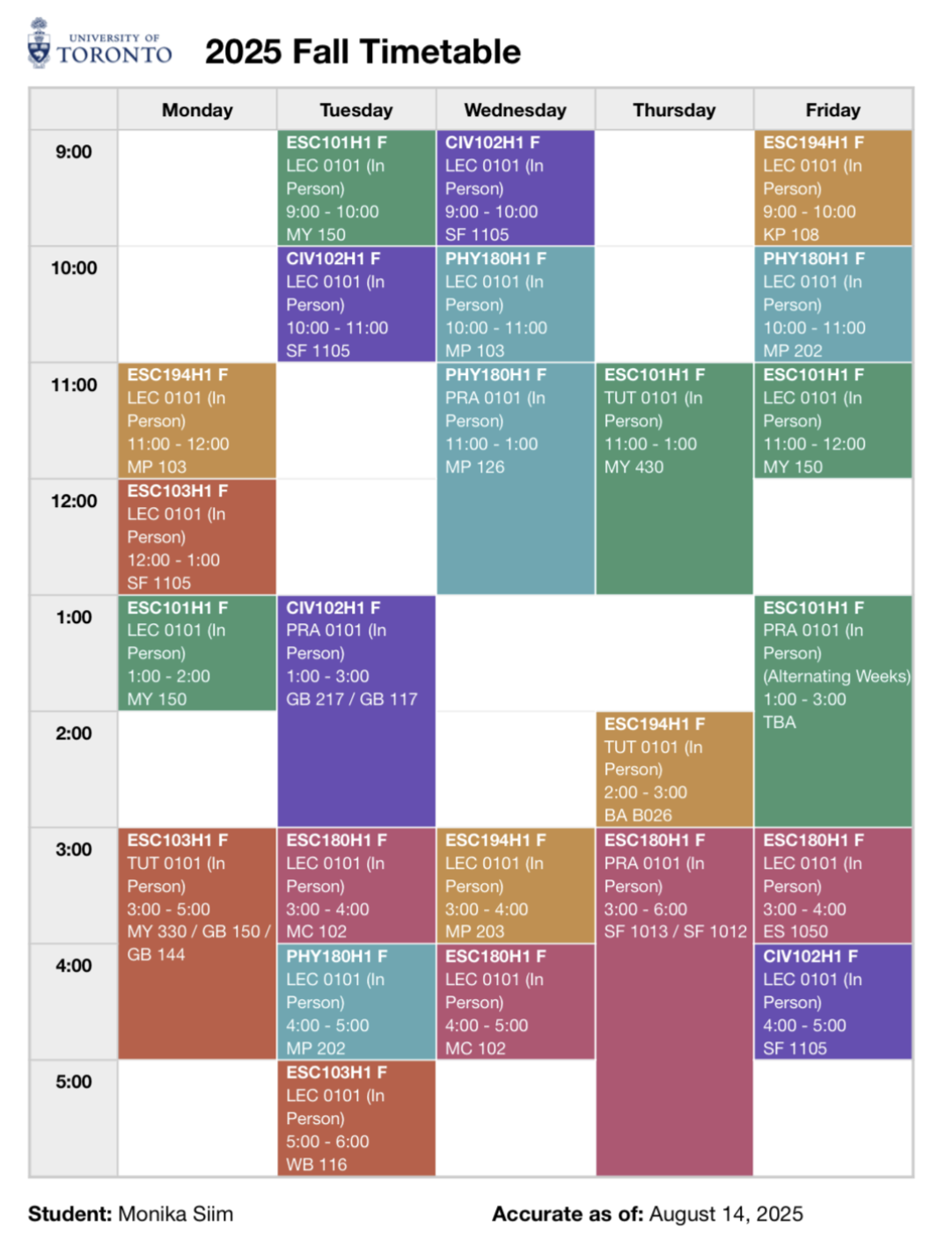
You’ll have a timetable for each semester of university. In first year, your timetables are made for you. You can access your timetables in late June on ACORN, U of T’s student information service and a hub for everything you need to manage your student life. Your timetable provides the times, locations, and sections for the lectures (LEC), tutorials (TUT), and practicals (PRA) for each of your courses throughout the week. Above is a sample first-year EngSci timetable from Fall 2025. You’ll see similarities with your timetable for the upcoming semester.
Don’t worry if details such as room numbers haven’t shown up on your own timetable yet – they’ll be added before the start of classes. It’s also typical to see timetable conflicts between courses early in the summer while the timetable’s being finalized. We advise you to wait at least until mid-August to report any conflicts to your academic advisors as they should be resolved before then. Also, make sure to check your timetables right before the first day of classes, as last-minute changes may occur.
Reading Your Timetable
Course Code
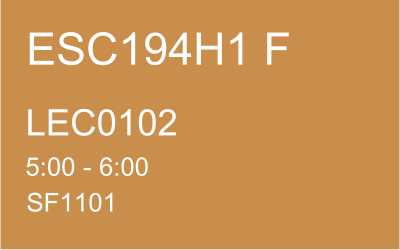
Each colour in your timetable corresponds to a different course (e.g., all ESC180 class activities will be the same colour). However, the text will be different. Each block will have either a “LEC,” “PRA,” or “TUT,” followed by a number.
Sections
On the same line as the LEC/PRA/TUT label are four numbers. Examples include LEC 0102 or TUT 0107. First-year EngSci is a large group, so students are divided into smaller cohorts for lectures. If your LECs include 0101, you are in cohort #1, and if they include 0102, you are in cohort #2. Some lectures, such as those for ESC101, are common to both sections: all shared lectures will be indicated as LEC 0101 by default.
Within your cohort, there are smaller sections for tutorials and practicals, which is why TUTs and PRAs can have numbers like 0107 or 0111. These groups are distinct for each class; you’ll have the opportunity to meet many different classmates throughout your coursework in first year! You’ll remain in the same cohort throughout first year, but your section may change in second year.
Time
One unique thing about U of T is “U of T time”! All classes start ten minutes after the hour. For example, if your timetable indicates you have a class starting at 2:00 PM, the instructor will begin teaching at 2:10 PM. This gives you time to travel between buildings to get from one class to another.
Reading Locations
The first two letters indicate the building code. For example, the code for the Galbraith Building is GB. To learn more about all the buildings and their codes, check the Campus Buildings section of our blog.
The three or four numbers indicate the room number itself, with the first number indicating the floor the room is on. For example, GB144 is room #144 on the first floor of the Galbraith Building, while BA2195 is room #2195 on the second floor of the Bahen Centre. If you’re having trouble locating any of the buildings for your classes, then check out this great interactive campus map. Toronto’s ClassFind is another great resource to find step-by-step directors to specific classrooms.
Important Things to Note
All your lectures, tutorials, practicals, and midterms in first year will be during the school week (Monday – Friday) from 9:00 AM – 7:00 PM. In your timetable, there will be two-hour gaps during which midterms will be scheduled; in the sample timetable above, this test block was on Mondays and Thursdays from 9:00 AM – 11:00 AM (this may be different for your year).
Final exam schedules come out later in the semester, but they are usually held Monday – Saturday between 9am and 9pm
Every day, you’ll have at least one hour-long break between classes, which acts as a lunch period (this break may not occur at the same time every day). We recommend you use it to take a break and eat with friends! Be sure to check out some of our food recommendations.
Many of your back-to-back classes will be in different buildings. This may seem odd at first, but walking is an excellent healthy break between the long sitting times in lectures. Due to the proximity of the engineering buildings, the classes are also within reasonable walking distance; plus there’s U of T time, so you won’t need to run.
First-year schedules usually cannot be rearranged unless religious, medical, Varsity athletic, or other important accommodations need to be made. If you have a significant request, we encourage you to speak with your academic advisor.
You should follow your timetable and attend all of your designated lectures and tutorials. Tutorials and practicals may include attendance or quizzes for marks, so if you have a justification for attending a different time slot just once, speak with that course’s teaching team to make a request. If you require recurring accommodation, speaking with your Academic Advisor is the best option.
In first year, between going to class, doing homework, and studying, you’ll likely put in around 50 hours of work per week (this number may increase or decrease based on midterms, projects, and exams). This will likely be more than what you had in high school, and it is okay to feel a little bit overwhelmed! Yes, first year will be challenging, but you can absolutely get good grades, engage in extracurricular activities, and make time for personal endeavours with proper time management, focus, and effort.
Try your best to attend all lectures, tutorials, and practicals (especially those which take attendance). Try and find a schedule that works for you and always remember to take breaks and relax. There are plenty of supports available to you through the university. We also encourage you to talk to upper years to learn their strategies for success in EngSci and beyond; they’ll always be happy to help!
Sometimes, things do not go as planned. A petition, which is submitted through the Engineering Portal, is your formal request for an exception to a Faculty or University rule, regulation, or deadline. Check out the Petitions Website for more info.