
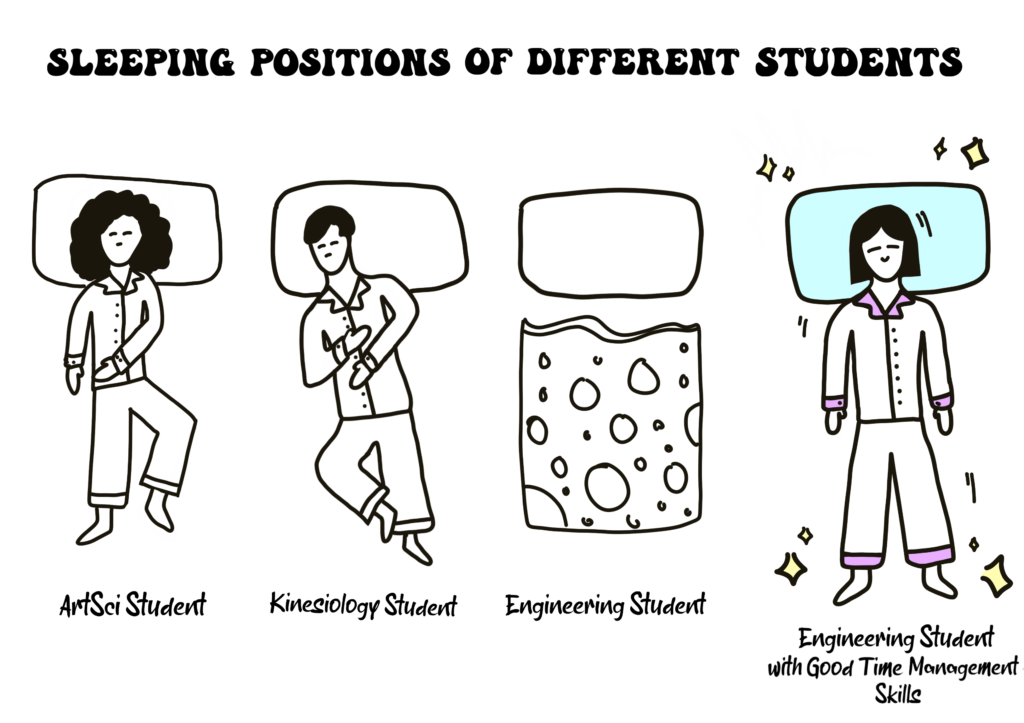
First year is BIG on learning time management. This skill will allow you to sleep well and set aside time for extracurriculars, health/wellness, and socializing – even on the busiest days.
How You’ll Spend Your Time in EngSci
First-year EngScis have an average of 6.5 hours of class per weekday, including lectures, tutorials, and labs.
Let’s assume that every weekday you’ll need an hour to get ready and have breakfast, an hour to eat lunch, an hour for dinner, and an hour to commute. Then, let’s factor in up to four hours for self-directed studying on weekdays. This can be learning material, completing labs and assignments, and preparing for midterms. Note that this is simply an estimate and your actual schedule will vary depending on the day/week.
Added together, at the busiest estimate we get 14.5 total hours a day spent on classes, studying, and eating/getting ready/commuting. That leaves at least 9.5 hours every weekday for you to spend outside of school. You may spend this time on relaxing, taking care of yourself, clubs/design teams, sports, hobbies, socializing, and sleeping!
Time Management Tips
Open your phone and check your screen time. Seriously, do it now! How many hours did you spend on your phone last month? On social media? Scrolling mindlessly?
Think to yourself: “With a busy EngSci schedule, do I really want to spend this much of my limited time on my phone? Imagine how much else I could get done in that time!” Try everything in your power to mitigate distractions, whether on your phone or otherwise. Remember, the best way to resist temptation is to remove it. Instead of telling yourself that you should use your phone less, just put your phone away in another room while you work. Research suggests that the mere presence of a smartphone even if you aren’t looking at it reduces cognitive peformance. While your methods may vary, the result should hopefully be an increased amount of time to pursue academics, extracurriculars, hobbies, or sleep.
Summer Student Tip: A lot of my friends in EngSci have completely deleted social media apps like Instagram, TikTok, and YouTube from their phones to make their social media usage more intentional. If you have to open your browser to search for the app, you’re more likely to think the decision through. I also know a couple of people who have switched their phones to black-and-white mode to make them less addictive.
Use a calendar, whether physical or digital. Really, give it a shot! With a digital calendar, you can import your timetable from ACORN and build upon that. On your calendar, block off time for eating, commuting, or studying for different classes. This will hold you accountable to work on specified tasks and avoid procrastination.
However, don’t forget to be flexible and don’t be too tied to your original plans! Plans can change at any time for a variety of factors, so make sure you have appropriate backup plans for how you’ll spend your time.
A tip for those from different time zones: when you get to Toronto, make sure your devices’ calendars are set to Toronto time (ET)! If they aren’t, you’ll end up with appointments at the wrong time when someone sends you a meeting invitation.
When blocking your time, make sure you dedicate time to each subject every week instead of jumping from one subject to another based only on whichever midterm is coming up next. You should be on track with all of your courses all of the time – but it’s also natural if sometimes things go a little off track. Just make sure to recognise it and to steer yourself back.
Many students block their time and keep a daily, weekly, or monthly to-do list on the side. As soon as you receive your course syllabi, you should write down all upcoming assignments, tests, and deadlines in a single calendar or document. Sketch in some prep time. You could even add a column for the grades you receive. That way, throughout the semester, you’ll have a clear system for tracking what’s coming up and how well you’ve progressed over the term.
Not all tasks are created equal. Depending on your own priorities, you may choose to spend less time on calculus problems than design team projects, for example. Deadlines approach fast, so keep those in mind; work on a difficult task with an approaching due date as opposed to something due at a much later date. It may not be optimal to pour hours into an assignment that’s worth few marks. It’s important that you carefully make these decisions and optimize your own plans.