
Q: Why did the chicken cross the road?
Aristotle: It is the nature of chickens to cross roads.
Isaac Newton: Chickens at rest tend to stay at rest, chickens in motion tend to cross roads.
Albert Einstein: Whether the chicken crossed the road or the road moved beneath the chicken depends on your frame of reference.
Werner Heisenberg: We are not sure which side of the road the chicken was on, but it was moving very fast.
Wolfgang Pauli: There already was a chicken on this side of the road.
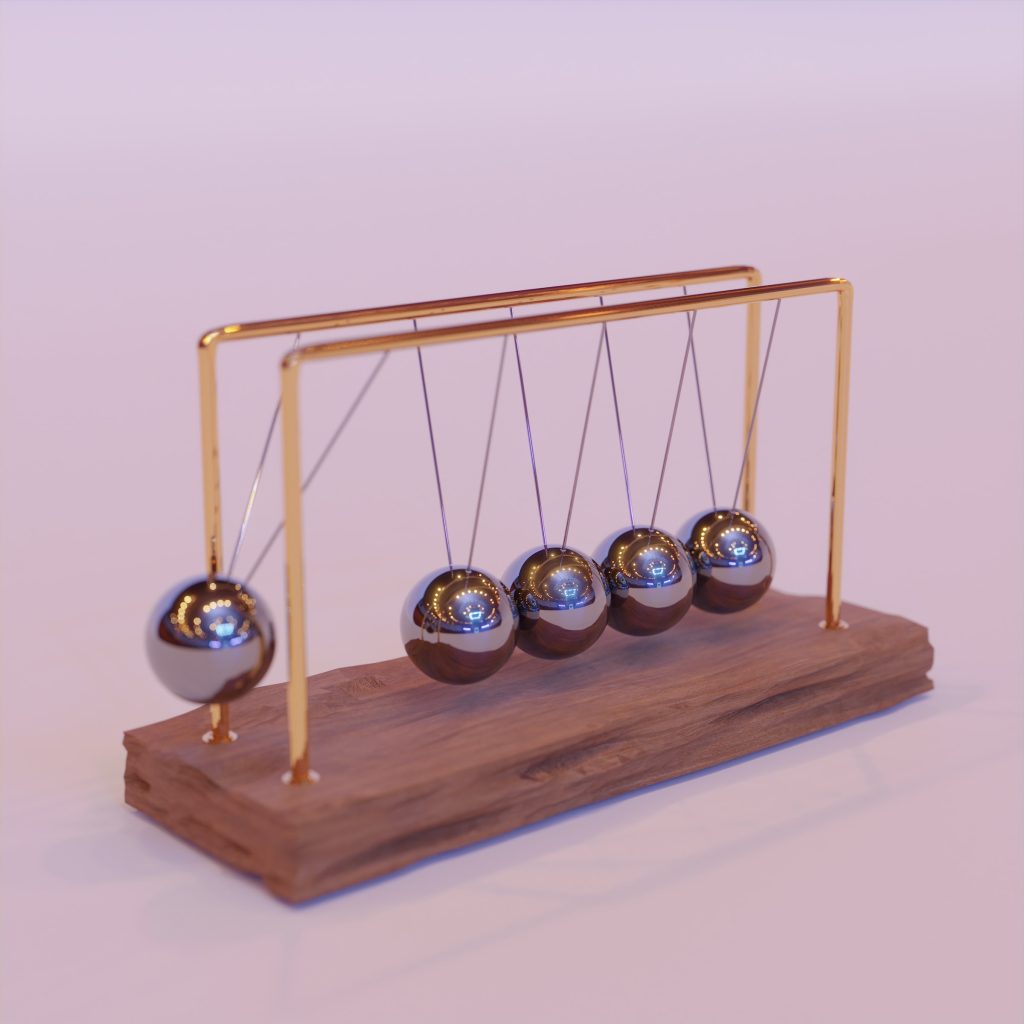
Classical mechanics is one of the fundamental topics in physics, and this course will set you up for success in later years. Everything from flying planes to walking robots can be explained through concepts taught in PHY180.
The goal of PHY180 is to teach you about the equations and principles used to model a variety of real-world situations. For example, you might model the flight of a rocket to determine its energy and velocity at a given time. You’ll also use tools from other courses, like differential and integral calculus from ESC194, to model more advanced systems as you progress through the course including rotating objects and systems where energy is dissipated.
Professor

Professor Jason Harlow
“I am an astronomer turned full-time physics teacher.” Professor Harlow has taught at the University of Toronto since 2004. He completed his undergraduate studies in the Department of Physics at the University of Toronto and received his Ph.D. in Astronomy and Astrophysics from The Pennsylvania State University in 2000. He has received many teaching awards, including the 2025 Physics Student Union Teaching Award. Professor Harlow is also active as a researcher and supervisor, with interests in physics education research, low-mass stars, fibre optics, and much more.
Fun fact: Professor Harlow authored a book called Physics of Music.
Professor Interview with Professor Harlow
Course Highlights
- Labs are a great opportunity to connect the math and theory of the course with the real world. You’ll quickly see that the equations taught in the course can model the world around us.
- This course will teach you the fundamentals behind the motion of an object. Soon, you’ll be able to simplify many complicated physics problems to the basic equations taught in this course.
- Learning physics from a more mathematical approach. You’ll learn how to derive physics equations from first principles and then apply calculus and mathematical concepts to solve physics problems using those equations.
Week in the Life of a PHY180 Student
Lectures
This course has three hours of lectures a week. You’ll cover concepts such as Newton’s three laws, kinematics, forces, oscillations, momentum, angular momentum, and energy.
The best tip for PHY180 lectures is ensuring you understand each fundamental idea before moving on to the next one since the concepts in the course will build upon one another. Theory and derivations are mostly in the pre-class videos. Class time is mostly focused on examples, both conceptual and quantitative. If you understand the derivation techniques and apply the theory learned, you’ll implement your knowledge more effectively during independent study and when taking assessments.
For some of you, the content covered in lectures may be a review of high school physics. Nevertheless, it’s important that you pay attention to lectures and take notes because the derivations are likely more advanced than what you have seen in the past. For those who haven’t seen the content before, don’t worry: the course starts from the basics, and everything is derived from first principles.
Practicals
While there are no dedicated tutorial slots for this course, you’ll get to interact with your teaching assistants (TA) during practical sessions. Practicals are weekly two-hour sessions run by TAs. The first hour is Q&A time for students to ask questions about the content and about the pendulum project, which is your main assignment throughout the course. During the second hour, you’ll solve exam-style questions in groups related to topics discussed in lecture. This is great preparation for the midterms and finals and allows you to integrate all concepts you learned so far.
Pendulum Project
The pendulum project is a term-long experiment focussed on analyzing harmonic motion. It involves building an oscillating pendulum at home, recording data from observing its motion, analyzing its amplitude over time, and improving the accuracy of your setup and methods. This culminates in a series of two intermediate lab reports and one final report. This project gives you good exposure to setting up experiments with minimal assistance, observing results by controlling variables, and finally writing lab reports and communicating your results, which is great preparation for all the labs you’ll do in second year.
It’s important to note that the pendulum project is relatively time consuming. And while the report submissions are distributed throughout the semester, make sure you allocate sufficient time on a weekly basis to work on the project to avoid cramming at the end.
Disclaimer: This was the format for the course last year, and the types of lab assignments may change this year.
Other Assessments
Besides the main project, there are several smaller weekly assignments that amount to around 10% of your total grade. Do note that you only need around half of these marks to get all 10%. These assignments include prescribed questions on a digital textbook (WileyPLUS), in-class questions on Mathmatize, post-class questions on Mathmatize, and weekly reflections.
Disclaimer: This was the format for the course last year, and the types of assignments may change this year.
Midterms & Exams
There are two term tests in addition to a final exam. Use the midterms as checkpoints to test that you’re staying on top of the material. There are three main types of questions on the tests/exam: blog questions, where you’ll be asked to explain a physics concept without using any physics terminology; numberless questions, where you’ll be given variables to carry throughout your calculations; and modelling questions, where you’re given the freedom to frame the question how you best see fit, which includes prescribing appropriate numerical estimates for values.
How to Succeed?
Quick Advice and Equations
Energy: E = \frac{1}{2}mv^2 + mgh + \frac{1}{2}kx^2 – Total mechanical energy of a system is equal to the sum of its kinetic energy (motion energy) and potential energies (e.g., gravitational and elastic potential energy; potential energy from height and in a spring, respectively).
Angular Momentum: L = mrv\sin\theta – Angular momentum L is the momentum of an object moving in a rotational path of radius r.
Hooke’s Law: F = -k\Delta x – Hooke’s law, which states that the deformation in a spring is directly proportional to the deforming force. And the constant of proportionality is the stiffness of the material, K, better known as the spring constant. Fun fact: everything from concrete to glass has a spring constant!
More Details
PHY180 moves quickly, so make sure you keep up with the material. Ask the teaching team if you’re confused about a certain topic. Because the material builds on itself, it’s important to cement your understanding as concepts are being taught. If you have holes in your understanding, it’ll be difficult to learn new concepts well.
While we encourage you to know the equations and how they work together, we also want to stress that knowing why something works is also useful in classical mechanics. If you can understand how the concepts work on a theoretical level, you’re better prepared to answer more difficult, concept-focused questions than you would be otherwise. In our experience, the best way to achieve this understanding is to ask questions about why these concepts work wherever possible. Asking these questions in lectures, tutorials, office hours, and on Piazza (a platform where you can communicate with some of your professors) will help build your understanding of what these concepts really mean. Classical mechanics is arguably the oldest science ever taught, so there are tons of resources that can help you learn.
Mastering the theory behind problems will require a lot of practice. As you do more questions, your understanding of the material will improve, and you’ll model situations with fewer mistakes.
The midterm and exam will have no “easy” questions, so there’s no point in repeating problems you can easily do! We suggest making a list throughout the semester of questions you struggle with. Then, before the term tests and exam, work through the questions. Try to do them without looking at the answers to ensure you know how to solve the problems.
This course has a lot of equations, and many of them can only be used in very specific conditions. We recommend making a list of equations and when to use them as you go through the semester. Seeing them in an organized way will help you memorize the trickier ones and remember how they connect. (You won’t be allowed to bring anything into the exam.)
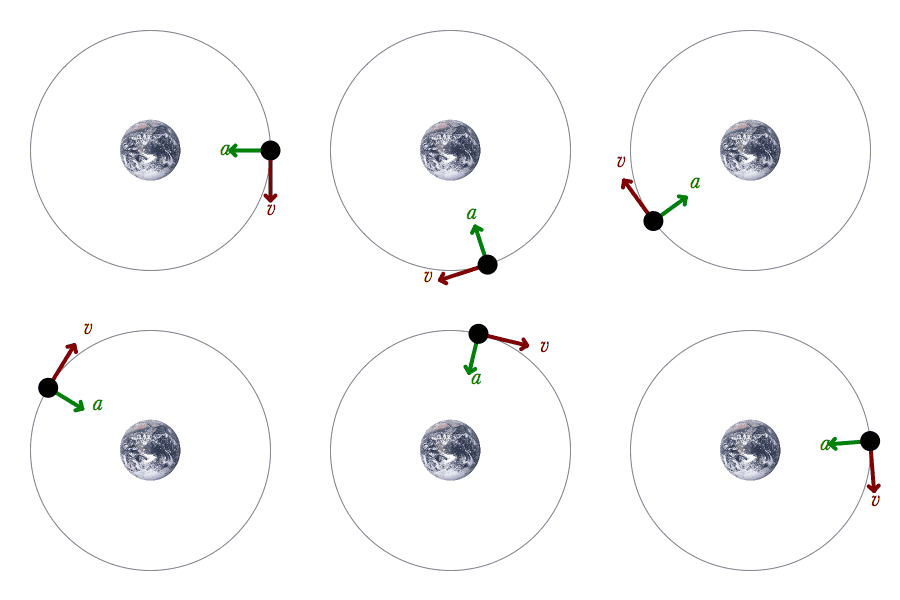
Before jumping into calculations for a physics problem, sketch out the situation and draw a Free Body Diagram (FBD). This will help you understand the problem and keep track of system components.
You may be able to solve some physics problems mentally. However, PHY180 problems can get quite complex, especially when you need to consider different time intervals. With a simplified diagram, you can connect physics concepts to a system without needing to remember every part of it. After you’ve visualized the problem using diagrams, you can focus on identifying and solving for your unknowns.
Additionally, diagrams can help assessors understand your solution, as they have a visual aid to guide them through your calculations.
Problems will often present you with information about a system of objects in motion and ask you to find a particular variable. If you’re struggling to determine which equation to use to find this variable, it’s helpful to list all known and unknown information from the question in the solution space first. This will allow you to run through the equations in your head and find the most relevant ones to use. This is especially helpful during term tests and the final exam to break complex problems down into simpler steps and solve them faster.
Beyond First Year
- Classical mechanics is the root of most other science and engineering fields. The equations and concepts you learn in this course will become second nature by the time you graduate. Understanding these concepts is necessary to progress through engineering and for success in later courses.
- One classic problem-solving technique in physics is modeling. This course will teach you how to model a situation and how to apply the equations to solve for what you need. Many other courses you take will use this technique.
- The materials covered here will serve as the basis for several second-year EngSci courses such as PHY293 and AER210, as well as upper-year courses in the Aerospace Engineering, Engineering Physics, and Robotics Engineering majors.