
Work experience is integral to a complete engineering education. As a student in the Faculty of Applied Science & Engineering (FASE), Students are required to have completed a total of 600 hours of acceptable practical experience before graduation (normally during their summer vacation periods). Satisfactory completion of the Professional Experience Year (PEY) Co-op Program will also completely fulfill the Practical Experience Requirement (PER).
The FASE’s Professional Experience Year (PEY) Co-op program can help you achieve your Practical Experience Requirement through an optional 12–16-week summer co-op work term after 2nd year and a 12–16-month co-op work term after 3rd year. Outside of the PEY Co-op program, you can also do four-month “external” summer internships that will not count towards degree credit. PEY work terms and external internships are paid, professional, learning-oriented work experiences for students. This longer term allows students to take on greater responsibilities for larger projects and build closer connections with their colleagues/employers.

Through work experiences, you can earn a competitive salary, gain real-world industry experience at top companies before even graduating, develop practical skills related to your field of study and career goals, and place yourself at an advantage for return offers or higher salaries after graduation.
On top of the experiences and connections you’ll make during your work term, there are a lot of professional development activities provided to outgoing PEY students as they’re applying for jobs. The Engineering Career Center supports your transition into your PEY job by running mentorship events with industry alumni, hosting sessions to help you improve your resume, cover letter, planning practice interviews, and more. The ECC helps you prepare for your PEY and make the most of it while you’re working.
How EngSci Prepares you for Internships
EngSci’s multidisciplinary foundation years and specialized majors let you learn advanced, discipline-specific concepts that give you a foundation for internships. The multidisciplinary curriculum exposes you to many different fields, giving you a broader perspective and skillset; this can enable you to work in a variety of industries/roles. The advanced coursework also means that your labs and assignments (in addition to your theoretical knowledge) are technical.
Building strong practical skills is essential for getting and succeeding in internships. ESC180/190 and CIV102 involve major projects, and a lot of your upper-year courses will be project-based. These projects provide you with invaluable practical experience that you can discuss in your résumé and cover letters.
The expectations in Praxis II are high, but this leads to very cool projects and a lot of knowledge/skill acquisition. You’ll work with real clients on interesting projects; you can discuss the products of your work on your résumé, and the process/backstory behind it can make for compelling cover letters and interviews.
PEY Co-op Program Timeline
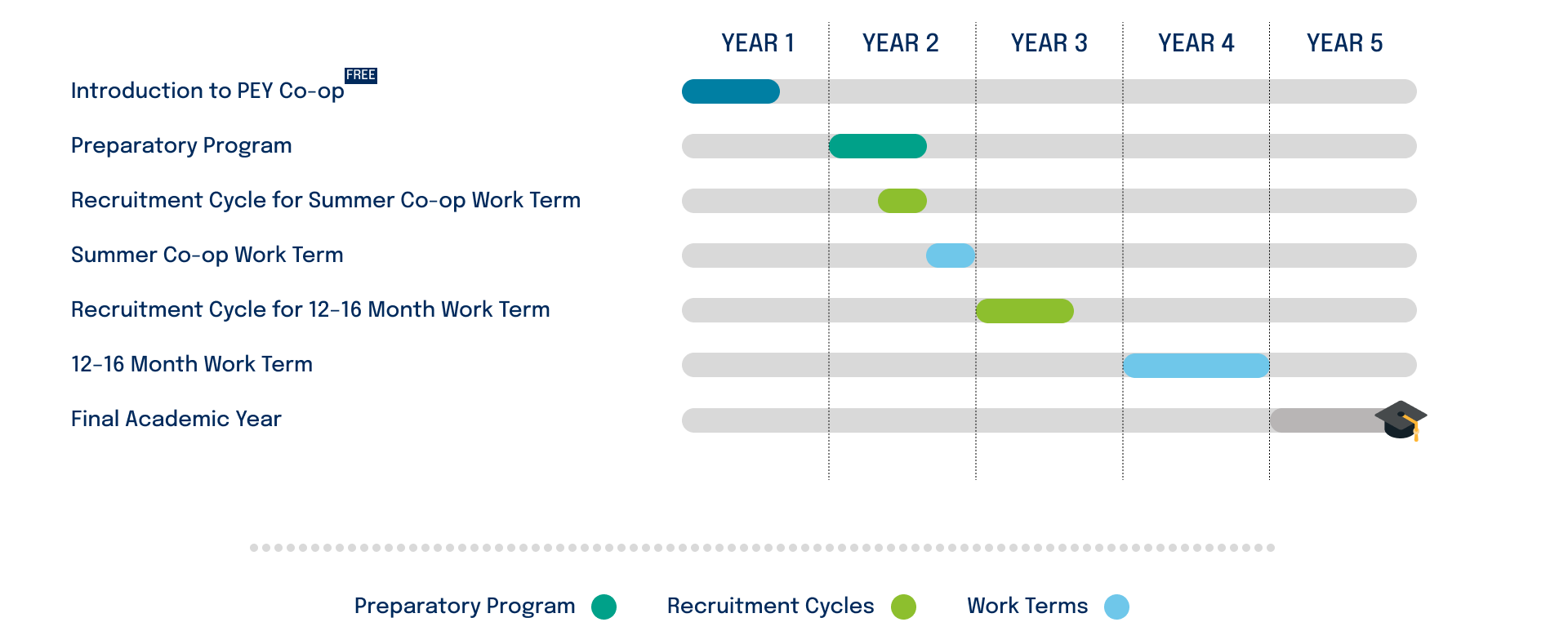
- Register for PEY Co-op during your first year or before the second-year application deadline if you didn’t apply when you applied to U of T Engineering.
- Complete online learning modules during your first and second years to prepare for the program and gain access to the ECC Job Portal.
- OPTIONAL: During your second year, apply for a summer work term through the ECC Job Portal (and external job boards).
- Prepare for the main recruitment cycle in your second year by exploring job postings and completing modules.
- Apply for a 12- to 16-month work term in your third year through the ECC Job Portal.
- Submit required work term deliverables, including self-reflections and reflection reports, to receive PEY Co-op credit.
To learn more about the program timeline, components, and requirements of the PEY program, please visit the Engineering Carrer Center Website.
External Job Search Platforms
Registering for the PEY Co-op program and completing the requirements gives you access to the ECC job portal, which contains exclusive job postings from various companies.
Regardless of whether you’re in PEY, you should search for positions outside of the ECC job portal, especially if you’re hoping to work in a specific role at a certain company/industry.
Platforms such as U of T Engineering CONNECT, LinkedIn, Indeed, Glassdoor and Job Bank (Govt of Canada) can give you a great starting point for exploring a broader range of companies and positions.
For engineering- and tech-specific job postings, you can use job boards such as Engineeringcareers.ca, MaRS, and communitech.ca. You may notice the same posting/companies on these job boards after a few search sessions, so once you have an idea what positions you’re interested in, it’s useful to set up job search alerts.
If you’re interested in a particular industry within the broader engineering sphere, you may need to do some extra research to find job boards that cater to that specific industry. Some examples include Le Spot (Aerospace), BioTalent Canada (Biomedical), or ECO Canada (Environmental).
Many big companies post their jobs on their own website rather than on external job boards. If you’re particularly interested in working for a specific company, here are some tips:
- Regularly check the careers page on the company website.
- Sign up for applicant accounts and/or set up job alerts, if available.
- Follow the company on LinkedIn and keep an eye out for hiring related posts.
Upper-year tip: Once you have access to the PEY Co-op Resources Hub on Quercus, use the “External Job Search Resource” and the “Labour Market Research Sources” page for guidance on finding relevant job boards. And while you’re doing job search, use a job application tracker (template available on the PEY Co-op Resources Hub) to keep track of where you found a job posting, when deadlines are, etc.)
Job Search & Application Process
The following guide gives a general overview of the job search and application process. For more personalized advice, reach out to your ECC Co-op Coordinators during recruitment cycles. You can also talk to ECC staff outside of recruitment cycles or to upper-year students to get tips and learn from their experiences.
Job Search Process:
As discussed, after completing the requirements, you’ll gain access to the ECC job portal during the recruitment cycle where you can browse through job postings and apply.
Some tips to help you at this stage of the process:
- Cast your net wide: Search the ECC Job Portal, company career pages, and other job boards.
- Stay organized: Use an application tracker to keep track of deadlines and applications.
- Network: Attend career fairs, employer events, and conferences to explore opportunities and connect with recruiters.
- Apply strategically: Focus on roles that match your interests and qualifications, and tailor each application.
Job Application Package:
Typically, you’ll be asked to include a resume, a cover letter, and a copy of your most recent transcript in your job application. When applying for multiple positions, you’re strongly encouraged to tailor your resume and cover letter for each application based on the job posting.
Some tips to help you at this stage of the process:
- Build a strong application: Tailor your resume and cover letter for each position, and include your latest transcript if required.
- Highlight relevant experience: Include design teams, clubs, projects, hackathons, volunteer work, and technical skills.
- Use available resources: Review the PEY Co-op Resources Hub, YNCN’s Student Resume Guide, LaTex Resume Templates, etc.
- Book résumé/cover letter review appointments with Co-Op coordinators at the ECC office during recruitment cycles.
Interview Process:
Usually, you’ll go through two types of interviews: general and technical. In the general interview, you’ll mostly be asked behavioral and situation-based questions. In the technical interview, you’ll be given an engineering task related to the role which you’ll need to complete. Some tips to help you at this stage of the process:
- Prepare for both behavioural and technical interviews: Review past projects, refresh key technical concepts, and practice common interview questions.
- Use preparation resources: Complete the Interview Preparation module, practice on platforms like LeetCode or SOLIDWORKS, and review resources such as YNCN’s guide for software internships.
- Practice with support: Book mock interviews with ECC staff for feedback.
Job Offers:
For positions you found through the ECC Job Portal, you’ll be extended offers by an ECC Co-op Coordinator or by the employer directly. Some tips for accepting job offers:
- Review offers carefully before accepting, as you’re expected to honour your commitment.
- Complete next steps promptly: Notify the ECC Office, upload required documents, cancel remaining interviews, and complete any work term requirements.