ESC195: Calculus II builds on the skills you learned from ESC194: Calculus I. You’ll start by studying methods of integration—essentially, ways to compute the “unsolvable” integrals you might have encountered in Fall semester. You’ll also be introduced to sequences and series before diving into the world of multivariable calculus and vector functions. All these concepts are fundamental to science and engineering collectively.
Like ESC194, this is a theoretical course that covers a lot of material at a fast pace and in great depth, so keeping up with the work and further developing your problem-solving skills is key.
Note from your advisors: ESC195 might be the most important course in first- and second-year EngSci, at least from a course progress point of view. ESC195 is a prerequisite for five second-year courses; that makes it an important course to pass, but beyond that, understanding the course material is very important. While you are taking the course, put effort into actually understanding the content, rather than just blindly memorizing. Treat it like you’d treat a second language: the more you practice, the more comfortable you’ll get using it, and the better you’ll be able to do.
Professor
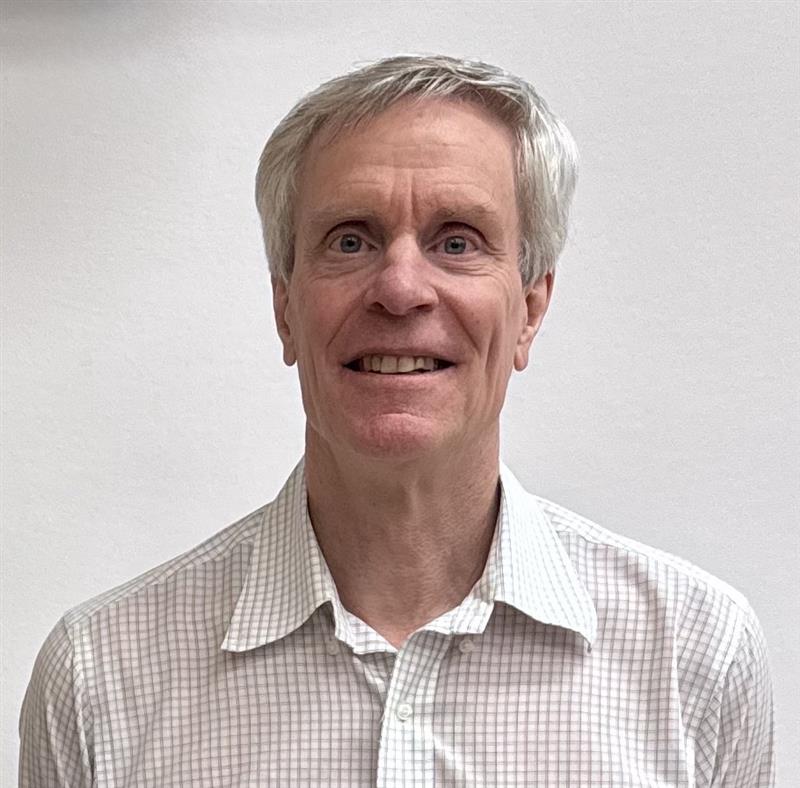
Professor James Davis
Professor James Davis
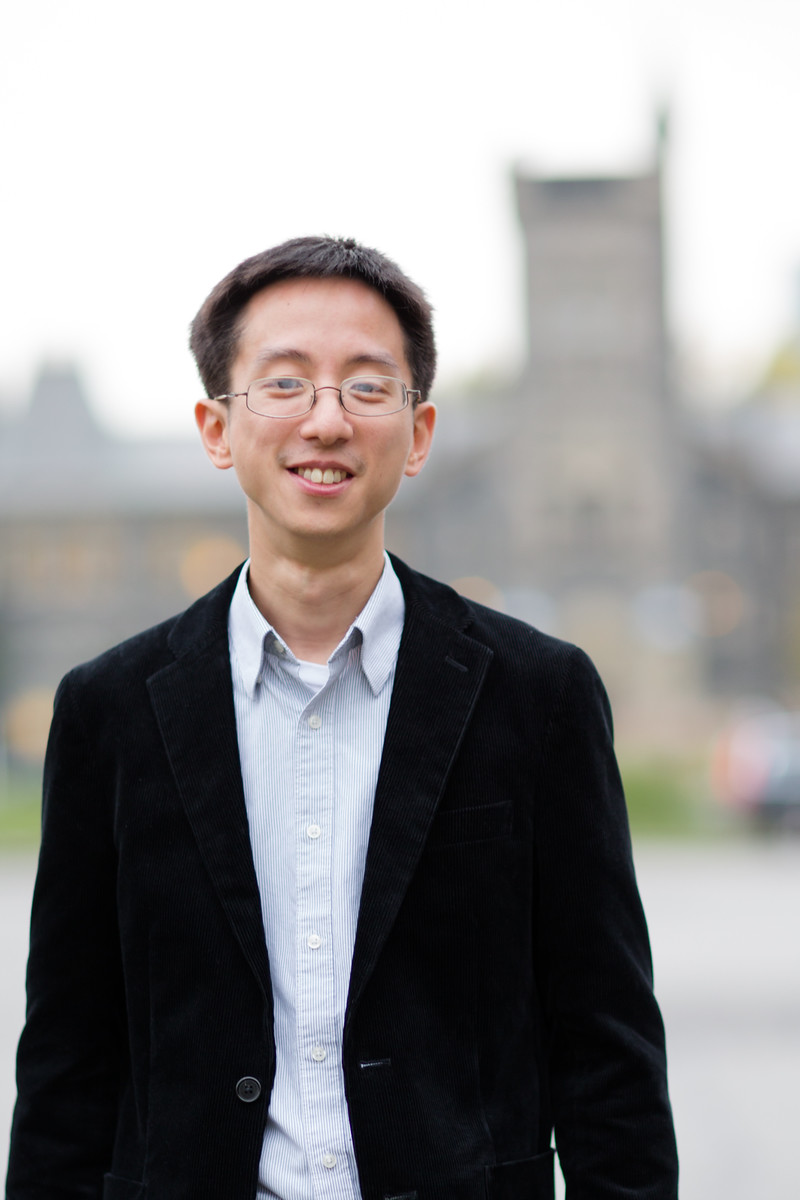
The instructor for ESC195 is Professor Davis, whom you’ll recognize from ESC194.
Professor Interview
“All of physics really came down to one equation – F = ma with calculus […] Everything from things like the Bernoulli equation governing fluid flow, to the rocket equation governing how big rockets have to be – it’s all just F = ma with calculus.”
“A student will only learn by doing. You’re not gonna learn by reading the textbook, you’re not gonna learn by attending the lectures alone. You actually have to do the work, and that’s the only way you’ll be able to learn this material”
“Anything that gets in between a student and pencil and paper is detrimental to the learning of mathematics.”
Course Highlights
You’ll learn integration by parts, trig substitution, and partial fractions. These may sound complicated now, but you’ll get the hang of them.
Infinite sequences and series – you’ll learn about some of their properties and applications, including how Fourier series can represent any periodic function.
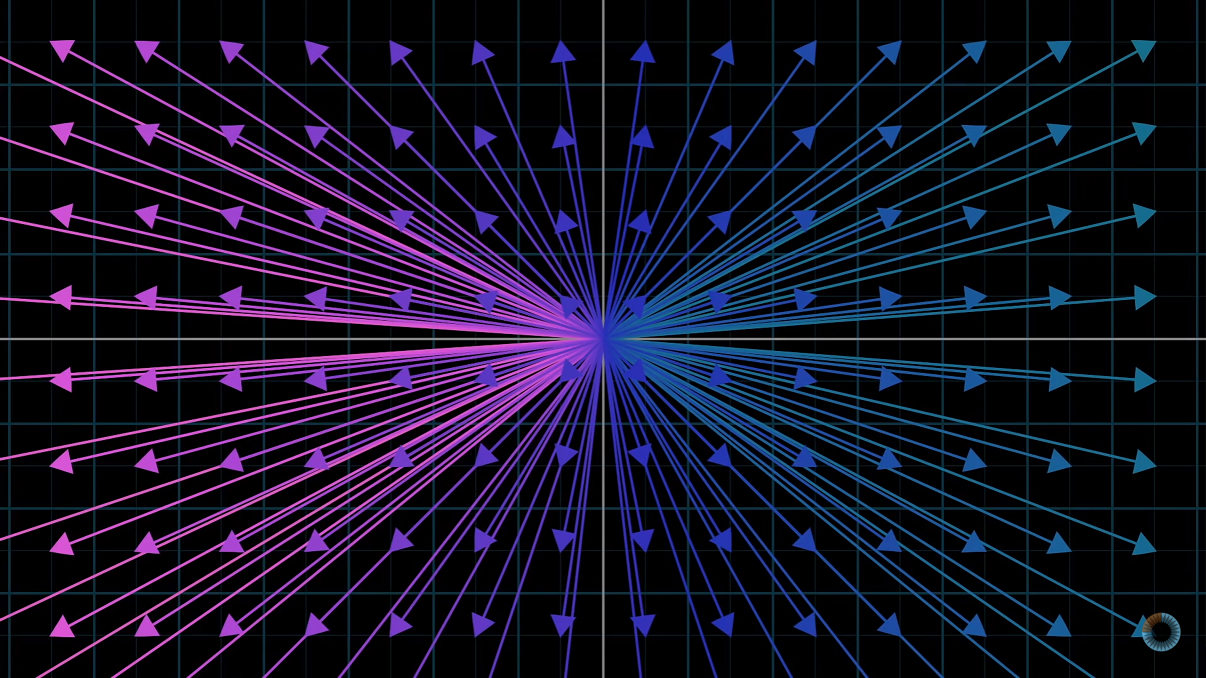
A lot of multivariable calculus! You can now solve problems in three dimensions. ?
Sketching polar graphs (all the complicated-sounding graphs like limaçons, lemniscates, and cardioids) and 3D surfaces (all the even more complicated-sounding graphs like paraboloids and hyperbolas).
Week in the Life of an ESC195 Student
Lectures
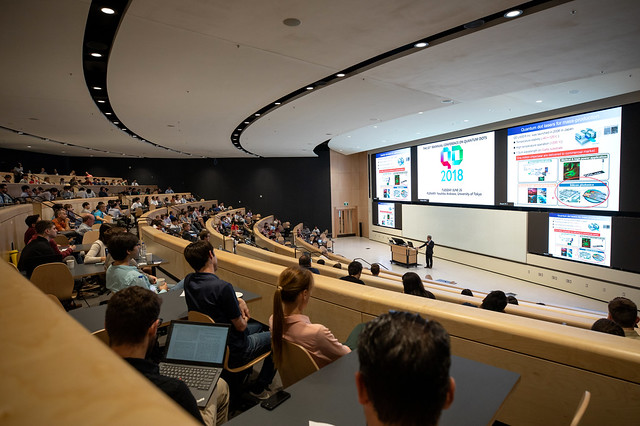
ESC195 has three hours of lecture each week. It may not seem like much, but the lectures move very quickly. They cover derivations of course concepts and many worked examples. Students occasionally have trouble taking notes in this course because the professor tends to write quickly on the chalkboard. If you can’t keep up with his notes, we recommend you at least copy down the examples. Knowing how professors solve examples can help you solve similar problems on your own. The course textbook (Stewart’s Calculus, same as in ESC194) supplements your course notes well.
Tutorials
Like ESC194, there are no practicals. There is one hour of tutorial every week. As in ESC194, you’ll be in smaller classes (20-25 students). TAs will work through problems like the assigned homework questions. At the end of each tutorial, you’ll also do a quiz. Each quiz is worth 2-3% of the final grade and are a great way you’re of staying on top of the material. The questions for the quiz stem directly from the problem set for that week, so it incentivizes you to do your homework!
Assessments
As in ESC194, there aren’t any formal assignments for this course beyond the weekly quizzes. However, you’re provided with recommended practice problems every week. DO THESE! They’ll build your calculus skills and help prepare you for assessments.
The assigned problems are all from the Stewart textbook (same textbook as in ESC194). The Stewart textbook already contains the final answers to all odd-numbered questions. You can use it to check your work, discover alternative solution methods, and help yourself if you get stuck.
Our recommendation to you, as in ESC194, is practice, practice, practice. Spending a few extra hours per week on calculus questions will make a huge difference for you!
Midterms & Exams
The midterms and final exam in ESC195 are like those in ESC194. Check out the ESC194 course overview for advice on how to prepare and manage exams. Key takeaway: practice with the Stewart textbook as well as past midterms/exams and be strategic when writing the assessments. Questions aren’t necessarily ordered by difficulty, so if you get stuck, skip ahead and return later to harder questions.
How to Succeed
Quick Tips & Equations
Note: You’re not expected to know the following technical information. You’ll learn it all in the course.
A Taylor series is an infinite series of polynomial terms that can be used to approximate complicated functions such as exponential, logarithmic, and sinusoidal. As the degree of the polynomial (and number of terms) increases, the Taylor series becomes a better approximation for the function. Make sure you know how to derive a Taylor series (and possibly memorize some common ones) and how to calculate its error.
Do A LOT of integration problems involving many different methods. Unlike derivatives, some integration problems will need trial and error to solve efficiently. Regular practice will let you solve them faster during exams.
Practice sketching polar curves. Polar coordinates are essential to solving problems involving circles, cardioids, and limaçons, among others. And the more comfortable you become at solving problems in the polar coordinates, the easier it’ll be for you to work with cylindrical and spherical coordinates, introduced in second-year courses.
Gain an intuition for gradients,which are like derivates in higher dimensions, and how they work. You should be able to derive these from first principles. Practice plenty of gradient-based problems, including tangent planes and Lagrange multipliers. Although you’ll learn these topics in the last week of class, don’t neglect them, as they are likely to appear on the final exam.
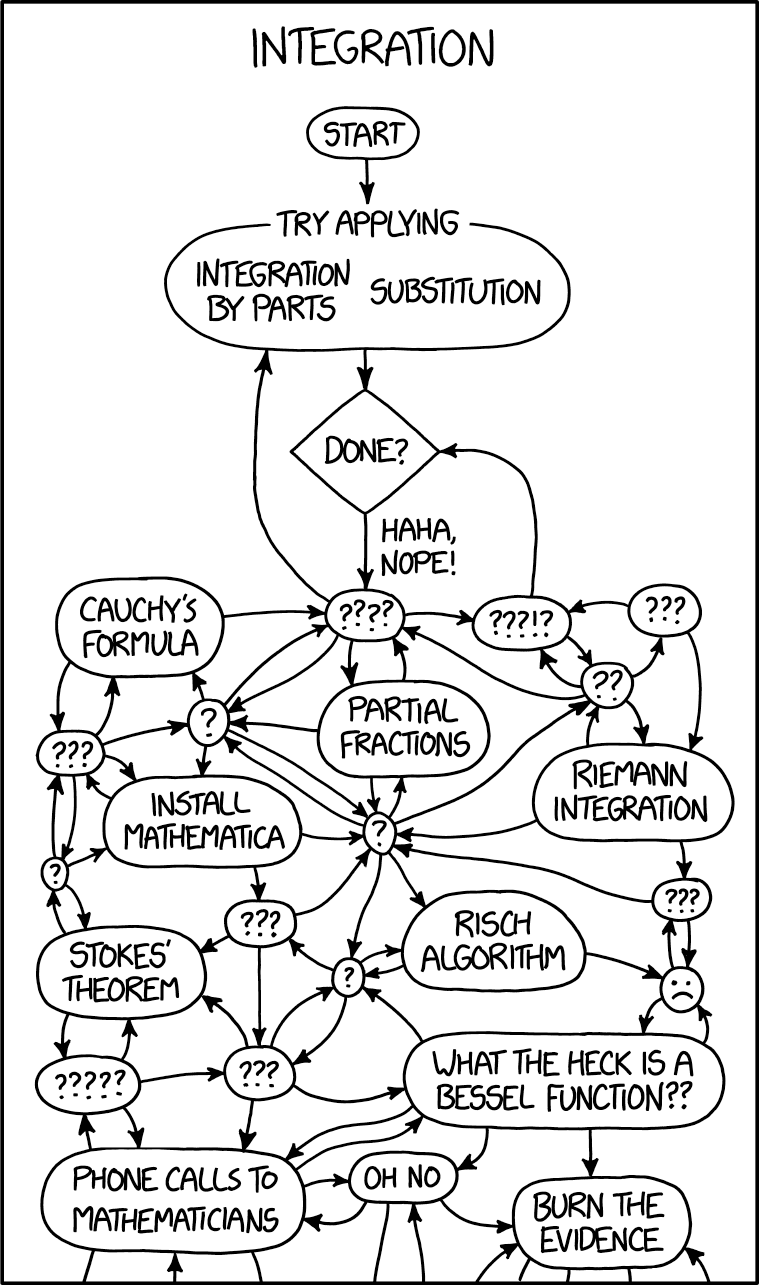
Integration sometimes feels like this…but you’ll figure it out eventually! [Edited – Source]
More Details
All the tips from ESC194 will be useful here too, so check them out in the Calculus I overview. However, we still have one piece of advice specific to ESC195.
ESC195 is a very formula-heavy course. Even though you aren’t allowed to bring a formula sheet to the midterms or the final exam, we highly recommend you make one to help with review, which can both help you keep track of what formulas you need to memorize and help you with the actual memorization.
A specific example would be sequence and series techniques. When analyzing series, such as the convergence and/or limit of series, there will be many techniques to remember. To make it easier, we suggest creating a cheat sheet: list all the techniques (formally called “series convergence tests”) and when to use them. Then, as you’re doing practice problems, you can reference this cheat sheet.
Another example: when doing vector function problems, there are many formulas that must be used and memorized, such as the formulas for the unit tangent vector or curvature of a plane. It is a good idea to keep all these formulas written down so that you can reread them and memorize them quicker.
Beyond First Year
After ESC195, you’ll be able to appreciate not only more advanced scientific fields, but also more advanced math jokes—you know, jokes about cows and bears and all that.
On a more serious note: the advanced math that you’ll learn in this course will help you understand and work in more specialized fields. Integration techniques and polar coordinates are used extensively in ECE259 (Electromagnetism) next year. Partial derivatives become important in a variety of other fields, including physics, and vector functions are extremely important in computer science.
Note: The course code for Calculus II used to be MAT195. You may still see it referred to as such on some websites (e.g. courses.skule.ca).
Now that you’ve learned the basics of programming from ESC180, you can start learning about its applications. In ESC190, you’ll be introduced to the C programming language, algorithms, and data structures. Algorithms are a set of instructions that process an input into a desired output. Examples of algorithms include data sorters, search engines, and shortest path finders. Data structures are ways of storing data. Examples include linked lists, stacks, queues, and hash tables.These are useful in a variety of contexts, as you’ll see in the course.
The course will have sections covering a type of algorithm, programming method, or data structure. Along the way, you’ll code in Python and C, learn how to implement different algorithms and data structures, and analyze their performance. This course is not about learning every feature of a language. ESC190 is about using the simple tools learned last semester to build more advanced programs.
Course Highlights
Learning the C programming language! C, unlike Python from ESC180, is much more low-level, and memory management must be done by the programmer. While C programming is more difficult, C provides greater insight into what occurs inside the computer, and programs typically run faster.
Learning about different data structures and algorithms that you might have heard of in the past:
Complete projects that have real-world significance. Last year’s projects were a weighted autocomplete function that worked on tens of thousands of words and a seam carving program for smart image-resizing
Week in the Life of an ESC190 Student
Lectures
There are typically three hours of lecture per week in ESC190. These cover a range of topics, from basic C programming to gradient descent. There is no textbook for this course, so make sure you go to lectures and take notes. Also, much like in ESC180, there will be many in-lecture quizzes throughout the semester.
Practicals (Labs)
The labs in ESC190 will likely be held similarly to those in ESC180. However, both courses will have different instructors this year, so the structure and expectations may change.
Labs and Projects
Like ESC180, ESC190 has two types of assignments: labs and projects. They are structured similarly as they are in ESC180, but topics are much more advanced (and interesting).
Midterm and Exam
The midterm and exam are structured similarly to those in ESC180. ESC190 tests can include a combination of Python and C programming. Tests are a little more theory-focused than in ESC180, so make sure to study the course theory on top of writing the labs. Past midterms and exams are also good study resources. However, like with other courses, the types of questions that appeared on previous years’ exams might not be the same as yours.
How to Succeed
Quick Tips & Equations
Understand everything about pointers in C. Briefly put: * will provide the value at an address, and & will provide an address.
Identify the key differences between each data structure and use these differences to memorize how the structure functions and how different operations (e.g., set, get, remove) can be performed.
Practice different ways of implementing the same algorithm. During assessments, you may be asked to implement an algorithm in a specific way (e.g., using recursion).
Practice working with Abstract Data Types (ADTs) – examples can be found in past tests and exams.
More Details
Many of the tips from ESC180 will be useful here too, so check them out in the Introduction to Computer Programming overview. We have included a few more below that are specific to ESC190.
If you’re writing a function in C and are struggling with the beginning, remember that the most important parts of a function are the output (the very end) and the processing (the middle). So, try to write the middle or end of the function and then work your way up to the start. This might make things easier, as you’ll know whether the function meets processing and output specifications. This lets you focus on connecting the beginning of the function with the code you have already written.
Note: this technique can be especially useful when writing a recursive function.
When it comes to programming and computer science, you can easily get caught up in only writing and using code. Since there is more theory in ESC190 than in ESC180, you’ll need to review lecture notes and do the labs. Warning: this doesn’t mean that you can get by only reading your notes. Your emphasis should still be on implementing algorithms and data structures for different applications. The theory will just help you structure your code and thinking.
Pointers are a big part of this course, so make sure to pay attention at the start, and gain a thorough understanding of them early on. Don’t be afraid to watch YouTube videos or do tutorials related to pointers, as knowing pointers will make all of C so much easier.
Beyond First Year
By the end of this course, you’ll know how to program in C.
In ESC180, you saw how small functions can interact to make a useful program. ESC190 will take this one step further: it will demonstrate how more complicated algorithms and data structures can be made to work together. These interactions form the basis of the complex software used in our daily lives. They’re also the basis of fields like machine learning and artificial intelligence.
You’ll see that computer science is closely tied to math. Computer scientists use calculus (e.g., gradients) and linear algebra (matrices, vector spaces, etc.) extensively in their work.
Given the theoretical foundation of computer science, you don’t need to be a great programmer to succeed in the field. Similarly, you don’t have to be a great computer scientist to be a great programmer. However, this doesn’t mean that you should neglect one or the other. We would recommend building your skills in both areas as much as possible.
If you want to land a software-related internship, ESC190 will introduce you to the theory and implementation behind some concepts that are commonly seen on programming interviews.
The programming skills gained here will help you in several upper-year courses in the Electrical and Computer Engineering, Robotics Engineering, and Machine Intelligence majors.
Note: The course code for Computer Algorithms and Data Structures used to be CSC190. You may still see it referred to as such on some websites (e.g. courses.skule.ca).
When people find out I’m not very good at building circuits, they’re shocked!
Circuits are the building blocks of all electrical devices – including the device on which you’re reading this. In EngSci’s introductory circuits course, ECE159, you’ll be introduced to circuit properties such as current, voltage, and resistance, as well as circuit components like sources, resistors, capacitors, inductors, and op-amps. You’ll learn about DC (direct current) and AC (alternating current) circuits and will use techniques like mesh analysis, nodal analysis, Thévenin equivalents, differential equations, and complex numbers to analyze circuits.
The goal of the course is to solve circuits for their properties by understanding how their components interact. These interactions are expressed mathematically, so a large portion of this course is solving systems of equations. Succeeding in the course requires understanding the theory behind circuit analysis, being able to build circuits in real life, and most importantly, knowing how to apply the right formulas in the right situations. Are you ready to learn the fundamentals of harnessing electricity?
Practice and regular review will be your best friends in this course. The key is to become familiar with the approach required for each type of question, since there are only a limited number of question types that can appear on a test. Also, while electricity can be more difficult to visualize than larger mechanical systems, try to build a conceptual understanding of how circuits behave so that the equations and results feel intuitive rather than purely memorized.
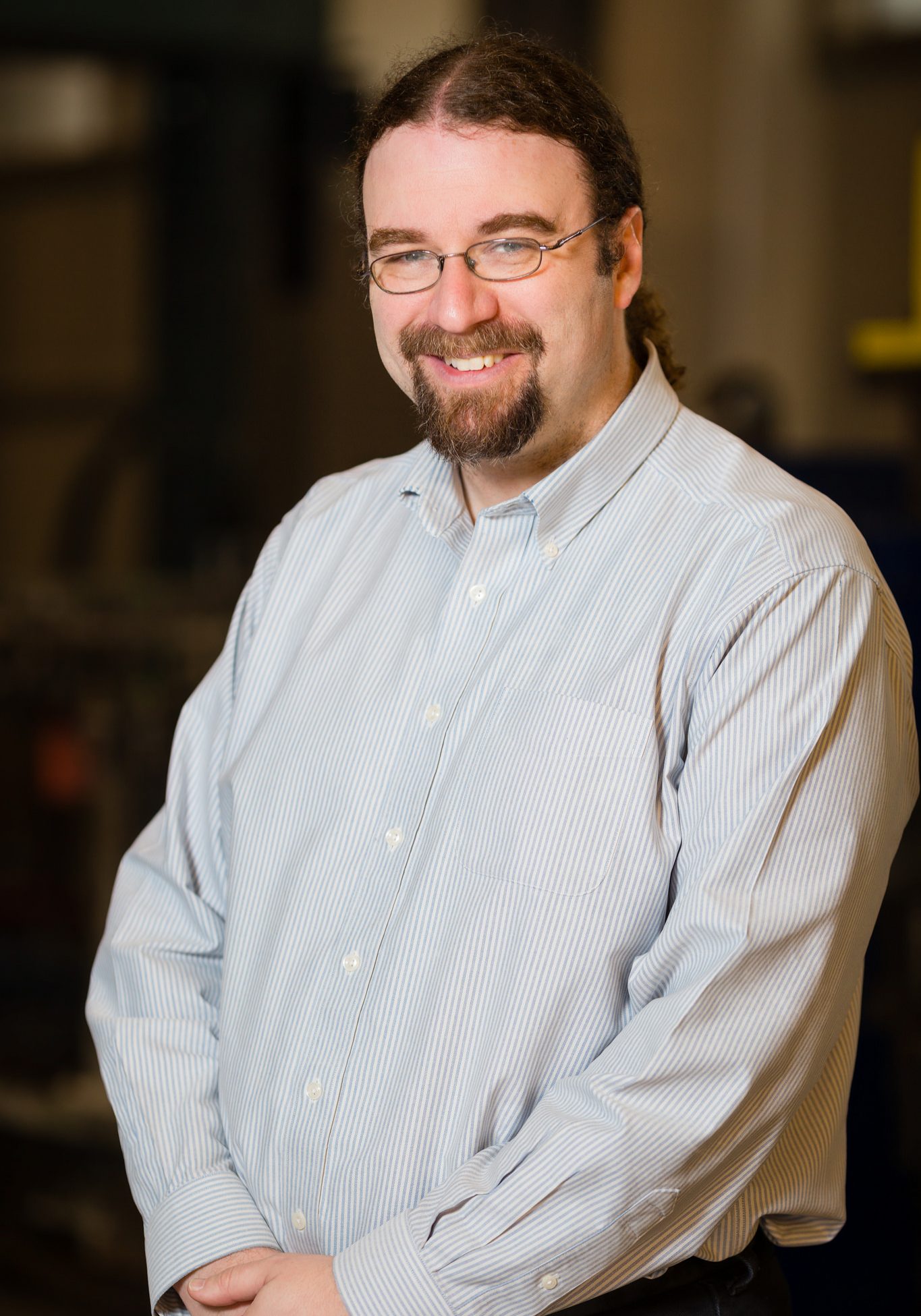
Professor Micah Stickel is a Teaching Stream Associate Professor in the Department of Electrical & Computer Engineering. He completed his undergrad, masters, and PhD degrees at U of T with a focus on electromagnetic networks and developing devices for high-frequency systems. He’s a returning professor for this course and is well-known for his incredibly clear and engaging presentation, his insightful worked examples, and the occasional joke in lecture.
Professor Interview
“The heart of the course is really about problem solving […] It’s really about understanding how circuits behave with the hope that once you develop the ability to analyze circuits, then you can design circuits, and that’s the power that math and science together bring to engineering.”
“For [students] who go into [mechatronics, robotics, or any combination of software and hardware], the core ideas [of circuits] will come back. […] They’re really critical ideas.”
“I’ve described engineers as master approximators. […] To analyze [an electric circuit] we’d need Maxwell’s equations, the fundamentals of electromagnetics, and vector calculus, which [results in a] difficult problem. […] We don’t need to think of [the circuit] at an atomic level [and can] approximate it with a resistor, capacitor, or inductor […] Electric circuits are fundamentally just approximations of a real-world system”
Course Highlights
Labs: Every other week, you’ll gain hands-on experience by building and testing circuits on breadboards. Come prepared to experiment, troubleshoot, and have fun!
Have you ever looked at a circuit diagram and thought, “I wish I knew what this all meant”? Well, you’ll be able to interpret and analyze many different types of circuits after ECE159!
This course will introduce you to using complex numbers to model real systems.
Week in the Life of an ECE159 Student
Lectures
There are typically three hours of ECE159 lectures a week. There you’ll learn the circuit laws you’ll use to solve problems on assignments. The professor will conceptually explain circuit topics, as well as go through examples of circuit analysis. Note these examples down: they serve as models for midterm and exam questions.
Tutorials
There is one hour of ECE159 tutorials built into your weekly schedule. While tutorials touch upon theory, the emphasis will be on learning how to problem-solve. Your TA will work through lots of examples, and we recommend taking notes of their problem-solving steps. ECE159 TAs are extremely helpful, so make sure to pay attention!
Practicals (Labs)
ECE159 labs are held every other week. Make sure to do the pre-labs before every lab session: they’re worth marks and are crucial to your ability to understand the lab. They can be a time crunch because the whole lab is done in a three-hour period. During this time, you’ll build circuits in the lab and observe their properties with different electrical instruments such as oscilloscopes.
Your performance during labs will be graded. Although three hours may seem like a lot of time, the labs can be time-consuming and many students won’t end up finishing some labs on time. TAs will grade the notes you take during labs, your ability to build circuits, and your respect for the workspace. Some TAs will also mark your ability to keep your lab notebooks organized, so make sure you get in the practice of including your name, the date, and prelab questions in your notebook every time you start a new lab.
Midterm and Exam
ECE159 has a midterm and a final exam. They consist of circuit analysis questions, and each question can be thought of as multiple difficult questions packed into one. You’ll be permitted to bring a single double-sided handwritten aid sheet.
How to Succeed
Quick tips and equations
Passive Sign Convention: if positive current flows out of the positive terminal of a voltage source, then the element is delivering power. Otherwise, it’s absorbing power.
Consider the hydraulic analogy, where voltage and current are analogous to water pressure and flow of water, respectively.
V = IR (Ohm’s Law)
P = VI (Electric Power)
These are general equations to represent voltage and current in a circuit:
v(t) = v(\infty) + [v(0) - v(\infty)]e^{-t/\tau} or
i(t) = i(\infty) + [i(0) - i(\infty)]e^{-t/\tau}
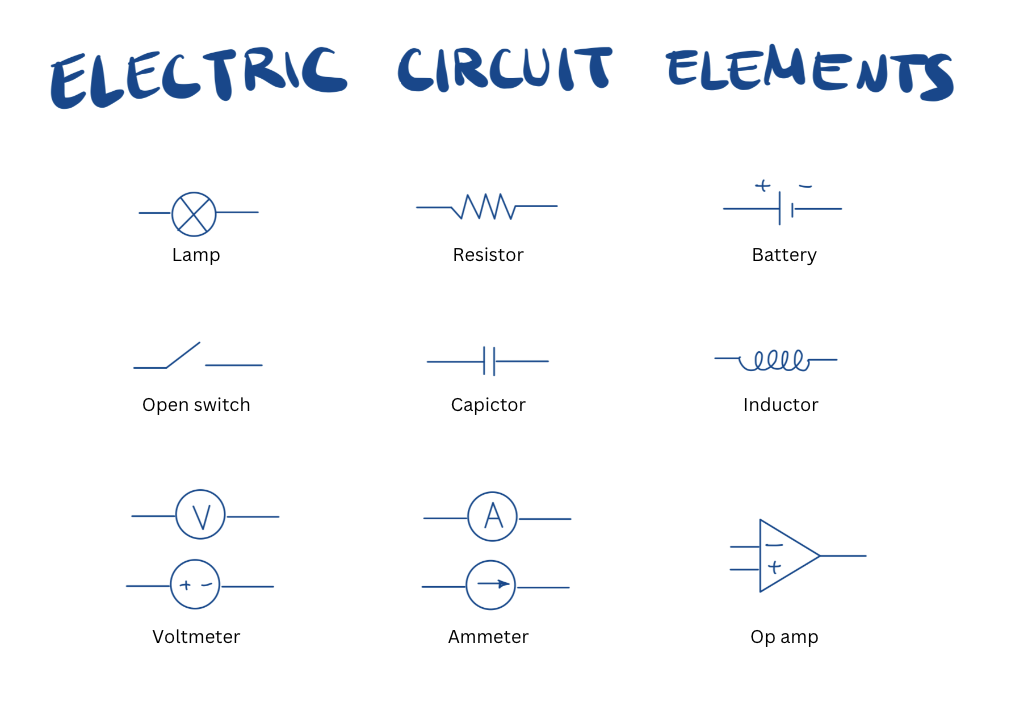
Common electric circuit component diagrams
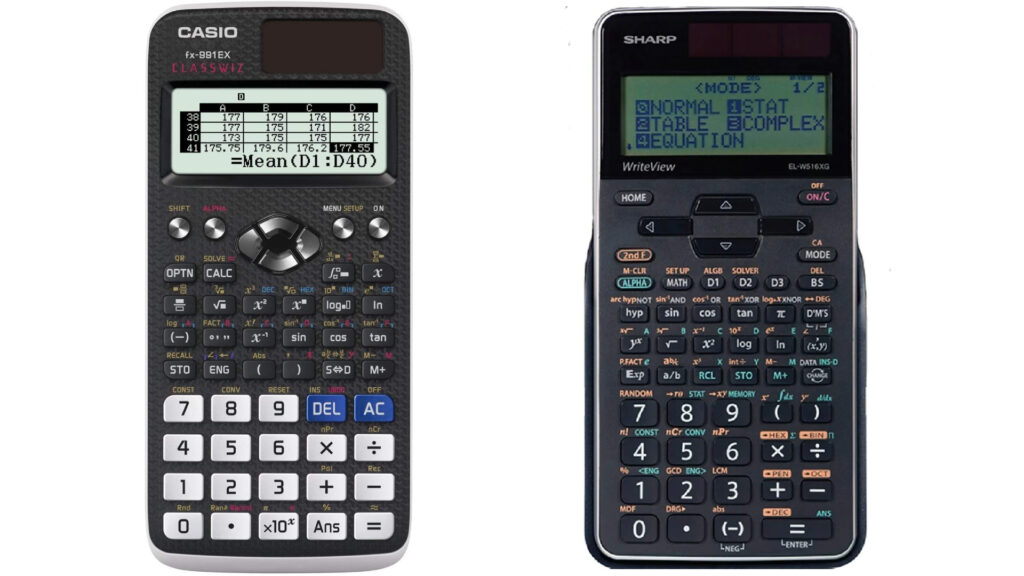
You’ll learn how to use complex numbers to model AC circuits. Normally, this would involve many difficult computations. However, certain types of Faculty-approved calculators can perform almost any complex calculation for you.
Remember that circuit analysis is a mere representation of the physical world. If, during a lab, your data isn’t exactly as you had expected, don’t worry: small sources of error are common.
More Details
This course may start off looking like basic high school review. However, it kicks into gear later, so make sure not to fall behind so you aren’t caught off-guard. New topics will be introduced very quickly and they’ll build upon each other.
Technically speaking, you could get through this course just by knowing nodal and mesh analysis. However, you’ll waste considerable time on questions if they’re all that you use. Pay attention to concepts that can speed up your problem solving. Examples include the fact that parallel branches have the same voltage or that certain op-amp configurations are designed to perform addition, subtraction, differentiation, and integration.
The best way to remember the equations and how they connect is by writing an equation sheet as the course progresses. This will also be a helpful resource when you work through homework problem sets – and on the exams, you’ll be allowed a single double-sided handwritten aid sheet.
This course is about problem-solving, so the more practice questions you do, the more successful you’ll be. You’ll be assigned many textbook problems related to the lecture topics, and staying up to date with the homework is a great way to practice and reinforce the material covered in class. The lectures are also very interactive and focus on working through lots of examples together as a class. Find past ECE159 midterms and exams on courses.skule.ca.
Introductory circuits is a very old and standard course. There are many online videos and textbooks that you can use if you’re struggling with a concept and need a new perspective.
Beyond First Year
You’ll get crucial experience in building circuits, which is important in engineering prototyping (you’ll likely need this in Praxis III in your second year, and you can use these skills on design teams and for personal projects).
This course will provide a foundation for all upper-year electrical engineering courses and the coursework for majors such as ECE and Robotics.
Even if you don’t find electronics interesting, the problem-solving skills you develop in this course will be used heavily in future courses with many connected concepts and equations, such as thermodynamics.
CIV102 is one of the most iconic and challenging courses in first-year Engineering Science. It even contains material normally taught to upper-year Civil Engineering students. But we promise we aren’t trying to scare you away: in this course, you’ll learn a lot and have a lot of fun.
CIV102 provides an overview of civil and structural engineering and covers topics such as static systems, truss bridge analysis, bending beams, and concrete. Material is often introduced in its historical context, so you get both a technical understanding of the concepts and their societal relevance. You’re taught a set of equations and problem-solving techniques for each topic and are assessed using problems that ask you to apply these equations in new scenarios. The trick with this course is understanding how and where to apply your equations and rules, not necessarily how the equations and rules were derived.
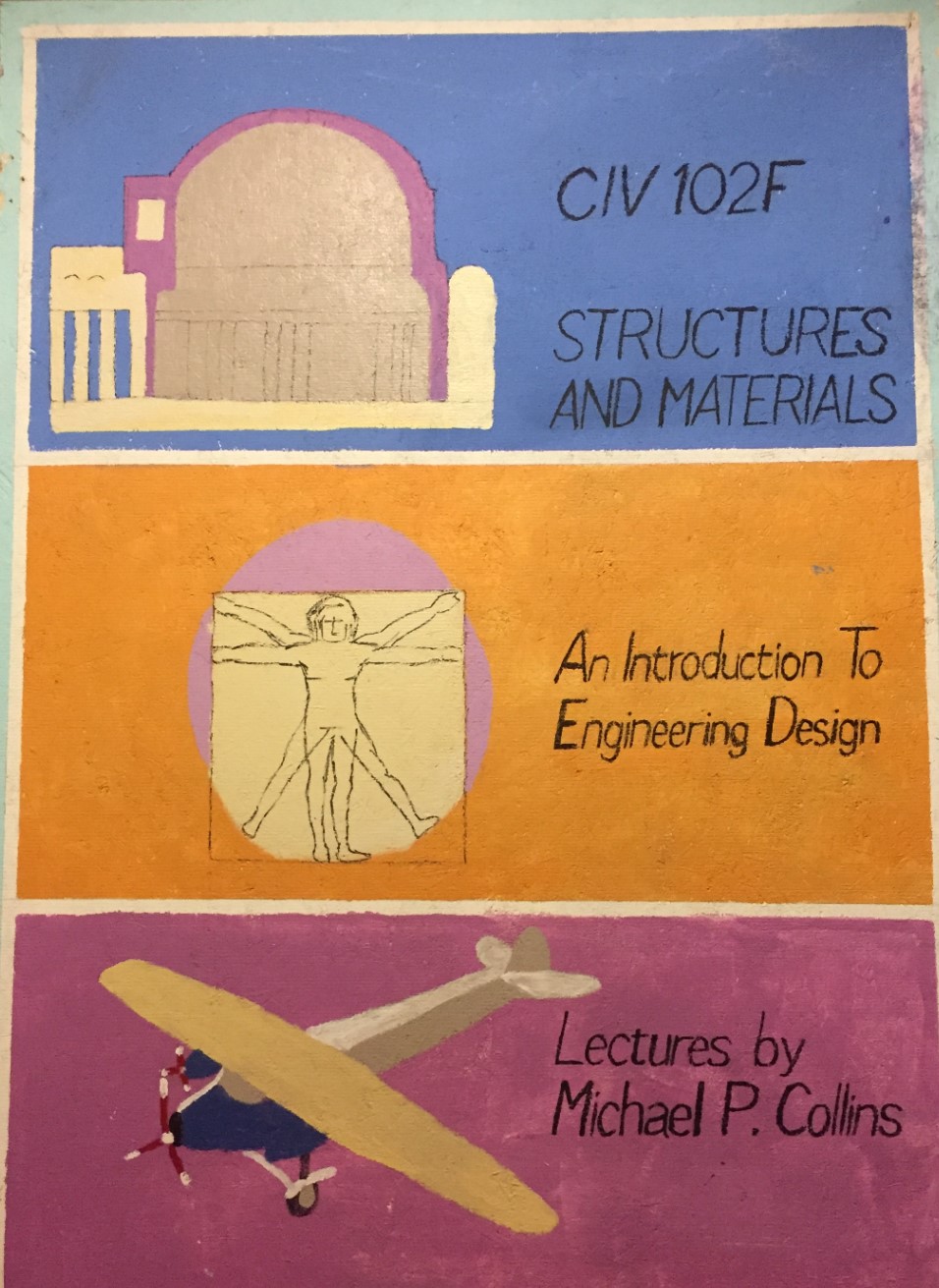
Giant version of the old CIV102 notebook, located in the EngSci Common Room.
CIV102 is taught by Professor Evan Bentz. He’s an expert in structural software; in particular, he explores the best methods for the upkeep, repair, and maintenance of structures before critical failures occur. Professor Bentz completed his PhD at U of T and has been teaching CIV102 since 2021. He brings a tremendous amount of experience and knowledge from his many years working in the field of civil engineering while providing a unique perspective on structural engineering to EngSci students. He was also recognized with the 2025-2026 Sustained Excellence in Teaching Award.
Fun Facts: Professor Bentz has also recently been appointed the Vice Dean Undergraduate, and he loves milk! In 2024, Professor Bentz won the EngSci Teaching Award. Also, he is from Thunder Bay!
Professor Interview
“All of engineering is […] about managing uncertainty […] [We have to] make sure that things are safer than they need to be — not too much safer, or else we can’t afford to build it, or indeed the environmental consequences are too big — but appropriately safe given the statistical variation of all the things we have happening.
“Hold on tight, it’s going to be an exciting time – it’s a development towards the next phase of your life and you’ll see that there’s a lot of people around here that are really sharp, and initially you’re going to say, ‘Geez, do I belong here?’ And the answer is, yeah, you do. If you’re getting in, you’ll succeed at it.”
Course Highlights
Nothing will bring you closer to your peers than the legendary weekly problem sets. The questions are challenging but essential to helping prepare you for the quizzes and the final exam.
Demonstrations and experiments are run by the instructors. We saw wood beams getting crushed and heavy weights dropping on the floor – don’t worry, we were safe… we think…
Stress will gain a whole new meaning, and you’ll have great positive moments! 🙂
Matboard Bridge Project! For this group project (which many consider the highlight of the first-year fall semester), every team is given a limited amount of adhesive and a cardboard-like material called “matboard.” Your job is to design a bridge to sustain as much weight as possible, applying your civil engineering knowledge and utilizing MATLAB, Python, and best engineering design practices. The best designers win special prizes from Professor Bentz and, more important, eternal bragging rights (especially if you make the “KiloNewton Club”). See this video from a past competition.
Week in the Life of a CIV102 Student
Lectures
CIV102 lectures usually happen three times a week. They cover mathematical and physical concepts behind structures while providing historical background as to how these structural properties were discovered and used. These historical anecdotes will help you understand the societal implications of an engineer’s work, especially in civil engineering.
Practicals
While there are no dedicated tutorial slots for this course, the two-hour long practicals function as tutorials and are where students usually get the most value from CIV102. They vary weekly but typically consist of a material or design demonstration from Professor Bentz, followed by a lab or a teaching session and then a 30-minute quiz. In a lab, you’ll need to build testing structures and analyze material properties you are learning in the course. In weeks without labs, a TA will walk you through course material and worked examples to help your understanding. Then, you’ll be given a quiz on the material. Your quiz marks add up by the end of the semester, so make sure you review each week. If you need help outside of practicals and tutorials, there are plenty of extra TA office hours throughout the week.
Assessments
The ✨legendary CIV102 problem sets✨ are a staple of any EngSci’s Fall semester. You’ll analyze stress, strain, concrete, beams, and more. Working through the problem sets will help you understand course concepts and succeed on quizzes and the final exam, so make sure you stay on top of them! Upper-year EngScis may tell you about the stress these problem sets caused them. Nevertheless, the material is very interesting, and assignments are more manageable when you’re working alongside peers.
Midterms & Exams
There are no midterms in CIV102. No checkpoints. Nowhere to test your skills (except quizzes, problem sets and past exams). There is only a final. This is a difficult cumulative assessment. Because of the single-exam nature of this course, students often neglect it during the semester thinking, “I’ll cross that bridge when I come to it.” However, you won’t succeed in crossing the CIV102 bridge (like this one right here) by only studying for the final. The way the course content is laid out is very intuitive. There are several big topics and multiple smaller concepts related to each topic taught consecutively, so try and keep a mental map of how different concepts relate to each other throughout the semester. Use the weekly problem sets and quizzes as an example of how these concepts are going to be tested, as the final exam is effectively your weekly quiz questions tested together on one occasion.
\epsilon = \frac{\Delta L}{L} [Strain = Change in Length/Original Length]
\sigma = \frac{F}{A} [Stress = Force/Area]
A bending moment diagram (BMD) is represented as the area under the shear force diagram (SFD)
Know every equation related to reinforced concrete. There are so many that we can’t write them all here!
Quick Tips
CIV102 lectures include lengthy and complicated mathematical derivations of structural engineering concepts. Although you are not expected to know these, attempting to understand where certain equations come from can enhance your overall understanding of the content. In case you missed something, the official course notes are your friend!
Do not — we repeat, do not — wait until a couple hours before the deadline to start your problem sets. Start them early, which gives you time to not only complete them but revise them in case you realize a mistake or to go to office hours for clarifications regarding the questions. Remember that you can work with peers so make sure to tackle these questions together.
Every assessment in CIV102 is open book. You are allowed to bring in the notebooks you used throughout the semester, equation sheets, and whatnot. Pay attention and take detailed notes in class to stay on track. Don’t rely 100% on your available resources during an assessment as you only have a set amount of time to complete it. Advice from us as your blog admins is that your resources are there only as aids; do not underestimate the amount of studying needed. The main challenge with both quizzes and the exam is usually that there is not even close to enough time.
*There may be restrictions on the material allowed (such as “no electronic devices”) so confirm with your professor/TA beforehand.
When answering a question on a quiz or an exam, be clear about what you know. Describe your process and don’t give up! If you answer most of the question properly but cannot produce a final answer, you could still receive 8-9 out of 10 marks.
The TAs for this course are some of the best you’ll have. They’ll either be past EngScis who know exactly what position you’re in or experienced civil engineering graduates. Office hours are valuable: TAs will answer your questions, especially when you need some one-on-one time before quizzes, exams, and problem sets.
Beyond First Year
You’ll understand the physical world around you in terms of fundamental concepts. These can then be applied beyond the field of civil engineering. For example, airplane wings act like cantilever beams. The former flies while the latter supports weight on the ground, but the basic principles of the two structures are the same.
The responsibility that comes with being an engineer is emphasized quite a lot in this course. As an engineer, you need to be aware of people’s safety, a must in all your designs.
Several concepts from CIV102 will show up in courses in the Aerospace Engineering, Engineering Physics, and the Robotics Engineering majors.
ESC194: Calculus I is the first calculus course you’ll take in Engineering Science. It’s arguably the most important course in Fall semester — it’ll change the way you look at mathematics and lay the groundwork for your future Engineering Science courses. From rigorously logical proofs to challenging practice problems, you’ll be exposed to many different aspects of Calculus. The concepts that you learn will appear in many of the EngSci courses and will be used throughout your engineering career, so make sure you learn them well. It sure sounds to me as though this course is integral to your success in the program (hmmm… see what we did there?).
Professors
Professor James Davis
Professor James Davis
Professor James (Jim) Davis is an EngSci alumnus (EngSci 8T2 Aerospace). Professor Davis is affiliated with the University of Toronto Institute for Aerospace Studies (UTIAS) and has taught ESC194 for several decades. Outside of the classroom, his research and laboratory work revolve around the development of nuclear fusion as a future energy source. Specifically, he focuses on the use of low-energy particle accelerators to simulate the effects of high-temperature plasmas on the materials proposed for the first-wall armor inside magnetic confinement fusion reactors.
Professor Morgan Hooper
Professor Morgan Hooper
Professor Morgan Hooper is an EngSci alumna (EngSci 1T5 + PEY Aerospace) affiliated with the University of Toronto Institute for Aerospace Studies (UTIAS). She’s an assistant professor teaching Calculus I and engineering design in the EngSci Praxis III course.
She received her MS and PhD in Aeronautics from the California Institute of Technology (Caltech). Her research there focused on experimental unsteady aerodynamics and fluid-structure interactions, with applications in sustainable energy harvesting.
Professor Interview
Course Highlights
The course is fast-paced and will teach you to learn efficiently and effectively. It is a difficult adjustment at first, but this skill will be incredibly valuable in the future.
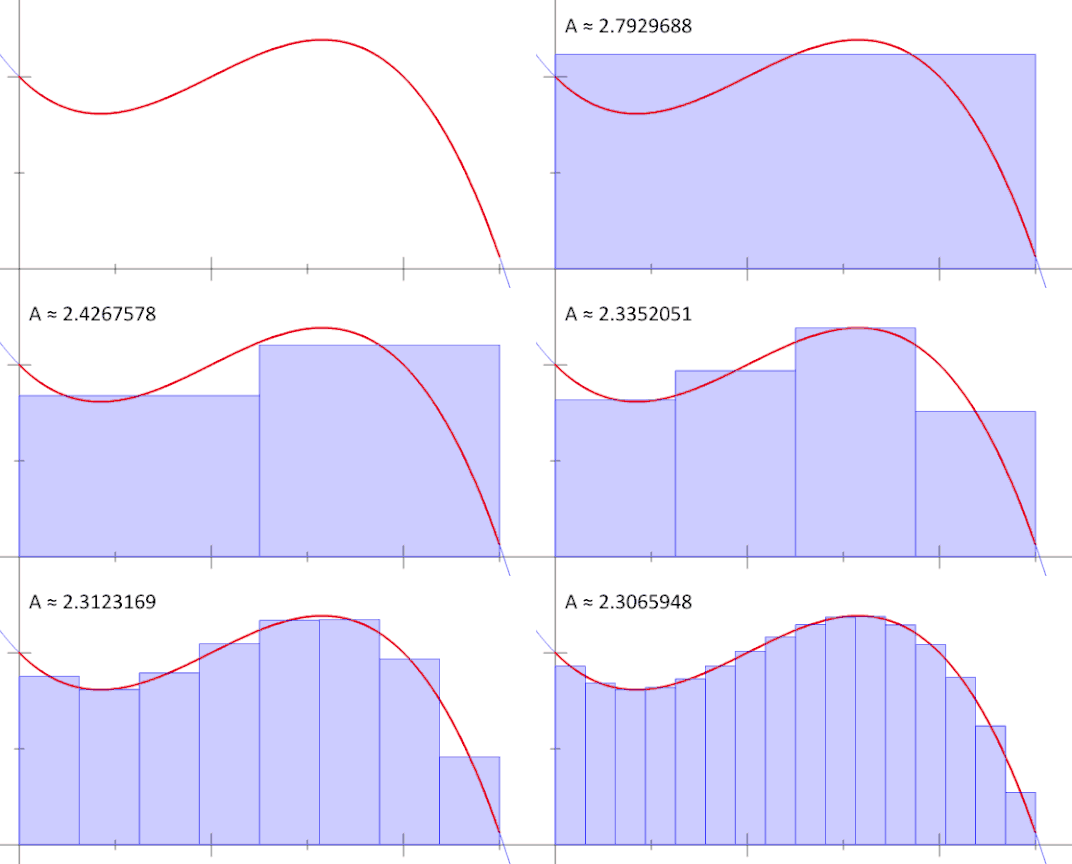
You’ll learn about a side of calculus that you may not have been exposed to: integral calculus. Now you’ll be able to find both the slope of a curve and the area under it. Integrals show up all over engineering and science. Learning about them will give you new tools for solving a variety of problems.
The first principles approach of ESC194 helps you understand high school concepts on a fundamental mathematical level. The logical thinking skills you develop here will help you in your other courses, including MAT185 and ESC195 in the Winter semester.
This course also serves as an introduction to differential equations, a field of math you’ll study in second year in MAT292. Solving differential equations will form a large part of most of the technical courses you take as an undergraduate engineering student, so make sure you pay attention!
Week in the Life of an ESC194 Student
Lectures
There are typically three lectures per week for ESC194. The lectures are fast-paced and cover a lot of material. The professors aim to do about 1-2 textbook sections per lecture, so prepare for an hour of intense focus. Lectures cover theory and many worked examples.
Tutorials
There are no practicals for ESC194. However, tutorials happen once a week and usually cover about 30-40 minutes of material from the lectures. The TAs are helpful and explain content clearly, so this is the best time to ask questions about material you don’t understand and take notes along with the worked examples.
The instruction is followed by a 10-to-15-minute quiz on the material you just went over. These quizzes seem small, but quiz marks add up and the skills and concepts you learn will help you succeed on the midterms and final. Completing the assigned textbook problems each week will help you prepare for the weekly quizzes, midterms, and final.
Assessments
There are no formal assignments for the course. However, you’re provided with recommended practice problems every week. DO THESE! It’ll build your calculus skills and help prepare you for assessments. Some questions on quizzes, midterms, and exams are similar to assigned homework questions.
We cannot stress this enough: the best way of succeeding in ESC194 is through practice. Spending a few extra hours per week on calculus questions will make a huge difference.
The assigned problems are all from the course textbook, Stewart’s Calculus. A nice thing about the textbook is that it can be bought in a package with a student solution manual. This contains worked solutions to all odd-numbered problems. You can use it to check your work, discover alternative solution methods, and help yourself if you get stuck!
Note: Although it can be helpful, the student solution manual is not required for this course. The Stewart textbook already contains the final answers to all odd-numbered questions.
Midterms & Exams
ESC194 has historically had two midterms and a final exam. The best way to study for these is by doing homework questions from the Stewart textbook. Once you have a strong understanding of these concepts and have practiced a variety of questions, you should verify your abilities by completing past midterms and exams(the questions will resemble those from the textbook).
Keep in mind that while this strategy has worked for us, it’s not universal. If it’s not a good fit for you, that’s OK! Try different things and consult with your Academic Advisor or the Engineering Learning Strategist to get new study techniques.
Time is also an important factor on ESC194 assessments, so try to practice doing the questions quickly in addition to doing them well.
How to Succeed
Quick Tips & Equations
Practice delta-epsilon proofs: \forall \varepsilon > 0 \exists \delta > 0 \text{ s.t. } 0 < |x-c| < \delta \Rightarrow |f(x) - L| < \varepsilon ; Please don’t let this expression scare you! You’re not expected to know this before coming into EngSci. You’ll get a step-by-step introduction at the beginning of the semester, but it’s up to you to refine your skills.
Try and get a good grasp of theorems such as the mean, intermediate, and extreme value theorems, as they might appear on exams. Plus, understanding these theorems is a gateway to further proofs in mathematics.
Practice the different methods of calculating volumes of revolution, including the disk, washer, and shell methods with respect to both axes. Formulas are not provided on quizzes and exams, so ensure that you’ve got these methods memorized.
Although they’re covered quickly, ensure you can solve the many types of differential equations. By the end of the semester, you should be able to solve “nonhomogeneous 2nd order linear differential equations with constant coefficients” using methods such as the method of undetermined coefficients, principle of superposition, and variation of parameters; doesn’t that sound cool?!
Practice curve sketching. Professors will go over a step-by-step method for curve sketching in lectures (also included in the Stewart textbook) – practicing and memorizing these steps will help you solve curve sketching questions in exams very quickly so you can dedicate more time to complex problems.
More Details
The textbook for this course, Stewart’s Calculus, is comprehensive. It explains topics clearly and includes a plethora of practice problems. Additionally, the lectures are well-aligned with textbook content, so you can always get clarification from the text if you missed something in lecture. Most importantly, questions on quizzes and exams are similar to those found in the textbook.
Officially, this is your textbook for the next three semesters. However, you’ll probably be using it for a lot longer. The field of calculus is unlikely to change too dramatically for a while, so this textbook might last you a lifetime! Take good care of it.
We recognize that there are a lot of questions in the assigned problems. If you don’t have time to work through every single one, do not despair. Try your best to do as many problems as you can. Be strategic: if you’re comfortable with a certain type of question and there are 15 such questions, you may be able to skip some of them (just don’t skip all of them!). Focus on problems that you find more difficult.
Summer Student Tip:
Do the homework! At the beginning of the course, everything may seem familiar from high school. We know many people who skipped homework at first because everything seemed easy, but when they started preparing for the midterm, they realized they were missing a lot of problem-solving strategies.
If you’re struggling with anything, don’t be afraid to ask for help! The TAs for this course are very enthusiastic and are there to support you. EngSci GEARS (Guided Engineering Academic Review Sessions) is also a great resource. The hour-long sessions hosted by upper-year EngScis happen throughout the week. Here you can go through calculus questions/concepts. More generally, any upper-year EngSci should be well-versed in calculus, so you can reach out to them as well.
This course is fast-paced and it is easy to fall behind. If this happens, you’ll miss out on important concepts and spend your time catching up on lecture content before midterms rather than doing past exams. Most importantly, it’s difficult to follow a lecture if you don’t understand what happened in the previous one.
To avoid these challenges, we recommend that you attend all lectures and review your notes before each one. You’ll also be provided with a tentative weekly schedule at the beginning of the term and skimming through the relevant Stewart textbook sections before a lecture can help you better prepare for it. And even if you haven’t fully understood a lecture, try your best to follow along and take notes; review them after the fact.
As mentioned earlier, questions are very similar year-to-year and they generally follow the same format; therefore, the often-challenging past papers are a great resource with which you can ensure that you understand concepts and prepare yourself for exams. Having said that, don’t lose sleep over a particularly challenging question; your overall focus should be to understand concepts and refine your skills. Also, there are only a few proof questions assigned in the textbook – but at least one appears on the exam every year, so make sure to review these.
In ESC194 and ESC195, part marks are your best friend. If you get a question wrong or don’t have time to finish a calculus assessment, you might still get some marks…if you write down your steps. Detailing your thought process in a legible way helps your marker follow your solution. From there, they can assess your understanding of the content.
Beyond First Year
In this course, you’ll be introduced to an important feature of university test-taking: time management and question selection. You’ll realize that time constraints might force you to choose between partially answering all questions on an exam or writing complete solutions for select questions.
Calculus serves as a foundation for many engineering and science fields. Many of the concepts you cover in ESC194 reappear in other courses and will be useful throughout your engineering career.
The materials covered here will serve as the basis for several second-year EngSci courses including AER210, PHY293 and MAT292, as well as upper-year courses across the majors.
Note: The course code for Calculus I used to be MAT194. You may still see it referred to as such on some websites (e.g. courses.skule.ca).
ESC103 is one of two math courses (ESC194 is the other) you’ll be taking in the Fall semester. Get ready to learn about linear algebra and computational methods.
The first half of the course covers linear algebra concepts. Some—like vectors, dot products, cross products, and matrices—may be familiar to you. Others will be more advanced. These topics include projections, row picture and column picture, matrix factorization, and Gaussian elimination.
In the second half of the course, you’ll use linear algebra to perform advanced computations. You’ll learn about different computational techniques, including Euler’s Method. These allow you to approximate solutions to systems of equations. While you can solve systems of two or three equations quickly by hand, approximating solutions for higher-order systems would take much longer. You’ll learn how to use scientific and mathematic programming languages to performing numeric computation and analyze large amounts of data more easily.
This course is less content-heavy than CIV102 or ESC194. This makes it easier for some students – especially if they covered vectors and matrices in high school. For others, the content is entirely new. If this is the case for you, don’t worry: the course will be taught as if you’ve never seen any of the material before. Although you’ll all come into ESC103 with different levels of experience, the course is designed so that everyone should hopefully leave on the same page.
Professor Arthur Chan is an assistant professor in Chemical Engineering & Applied Chemistry. He has a Bachelor of Science degree from the University of Pennsylvania and a Master of Science and PhD from California Institute of Technology. His research focuses on the chemistry of air pollution and its effects on human health. In addition to being the Canada Research Chair in Atmospheric Chemistry and Health, he’s also the Principal Investigator at the Environmental Organics Laboratory.
Interview
“I really like when I see someone who is sort of interested in a particular topic but not knowing much about it, but having that curiosity, and then I could show them different ways of obtaining that knowledge. It just really inspires me when people are really eager to learn and I’m able to show them […]”
“The first part of engineering mathematics is really about the basics of linear algebra, so taking a system of linear equations and then solving them. The second part is computation which is translating them then using tools like a computer to solve those equations.”
“I would advise them, between now and coming to U of T, to take the time and enjoy themselves and when y’all come to U of T I think it’s good to have a balanced life. Obviously Engineering Science, it’s a very demanding program there’s a lot to do, so make sure [things like eating and sleeping] are also the main focus of your lives.”
Course Highlights
For those who were introduced to matrices in high school, you’ll learn a much more formal and systematic approach to simplifying them known as Gaussian Elimination.
You’ll learn a new programming language. Scientific and mathematic programming is better suited to engineering calculations than Python, which you’ll be learning in ESC180.
The group format for the tutorials fosters a collaborative environment in class, and you’ll soon learn that collaboration is key in engineering.
Week in the Life of an ESC103 Student
Lectures
There are typically two hours of lecture per week for ESC103, as opposed to the usual three hours per course. The lectures move at a decent pace and will usually cover new content every day. Even though notes are typically posted by the instructors, it’s still very important not to rely on them and attend lectures in person to keep pace with the course.
Tutorials
While there are no practicals for ESC103, there’s a two-hour tutorial each week led by great TAs (most of whom are upper-year EngScis or alumni). Your TA will summarize the material learned in lecture that week before giving you a set of questions. They might work through some of these, but it’s mostly up to you to solve the problems. You’ll do this in small groups during the tutorial session. You may not complete all problems, but you’re encouraged to finish them on your own time. Make sure you‘re comfortable completing these tutorial questions: the midterm and final will include very similar problems.
Starting in early November, your tutorial time will be spent working through a weekly programming lab with the help of your TAs during which you’ll apply computational techniques learned in lecture to real-world situations.
Programming Test
There are no assignments for this course. However, there is a programming test that’s weighed similarly to the midterm. The test questions are like the weekly labs, so don’t be intimidated. The best way to prepare is by making sure that you complete the labs and understand them. You should be able to understand the reasoning behind each solution in addition to writing the code on your own. Closer to the test date, you’ll be able to access some past tests: these are a great source of additional practice problems.
Monika’s Experience: The way I studied for the programming test was by taking a previous year’s test and completing it based on how I thought it should be done. Then, I compared my answers to the correct solutions and repeated the same test over and over until I could complete it 100% correctly. I found this method very useful because all of the problems followed a very similar approach. Since there were not many past tests available to study from, this method still allowed me to go through all of them, even if I spent more time mastering each one.
Midterm and Exam
Most questions on the midterm and final exam should be similar to what’s covered in lecture. Because there are no assignments, keeping up with the lecture content and weekly tutorial problems throughout the term is the best way to refresh your understanding and help reduce the amount of last-minute cramming. Past midterms/exams are also good practice but make sure to confirm whether content coverage has changed. Past papers may not cover the exact same material.
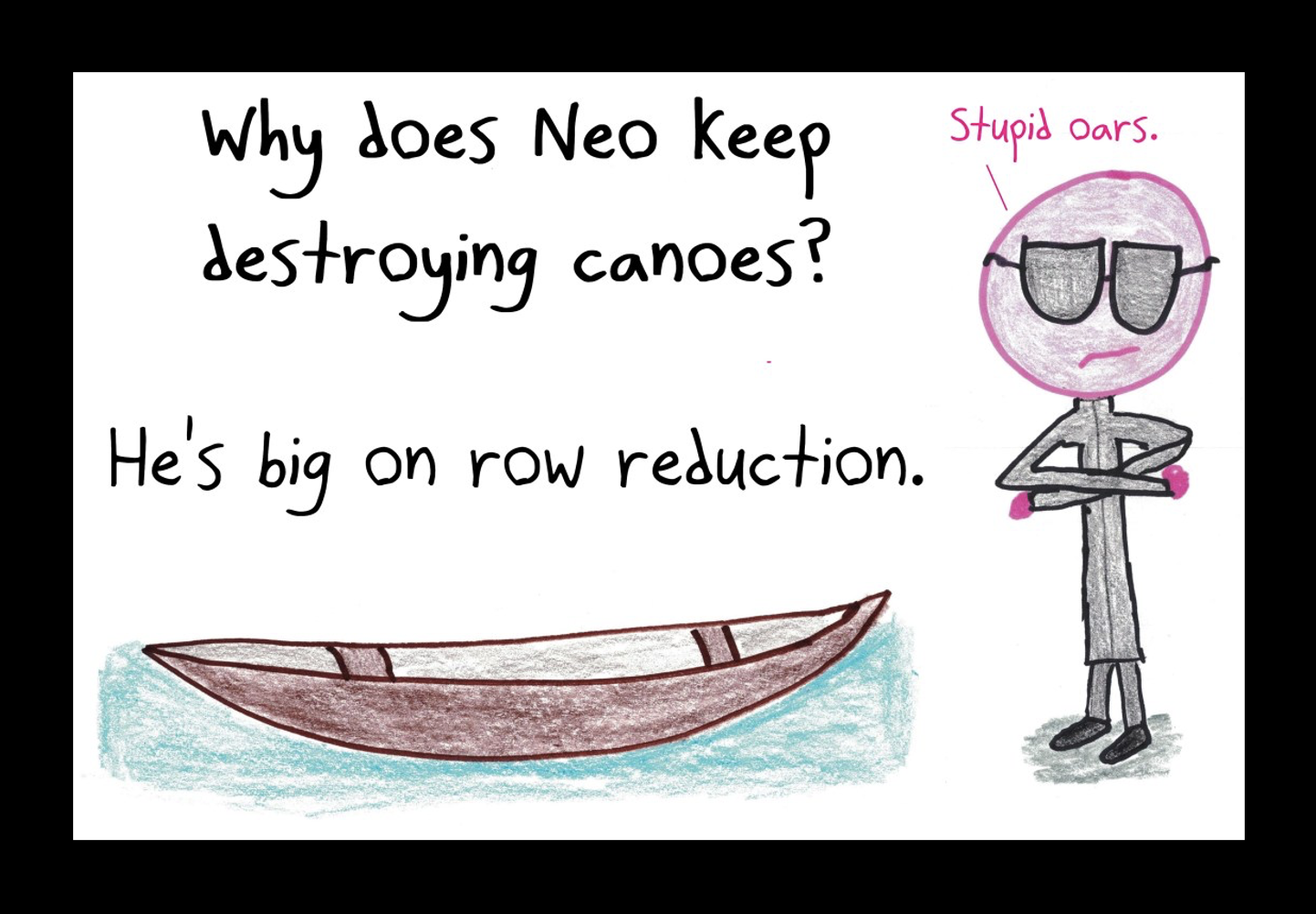
Row reduction using Gaussian elimination — Learn this well in ESC103. It will continue to be used in other courses, including MAT185.
y_{n+1} = y_n + hf(t_n, y_n) — Euler’s method. You’ll see more of this soon.
More Details
You may find the first few weeks of the course relatively easy, but don’t let that fool you. This course starts moving fast when you least expect it. Be on guard to avoid getting lulled into a false sense of security. It will be very difficult if you save all your studying for the day before the exam.
Attend all tutorials throughout the semester. Not only will they help you understand concepts and practice applying them, it’s also free marks. No, seriously: you get participation marks for simply attending tutorials. This counts for 10% of your final grade!
As stated earlier, tutorial problems are your best resource when it comes to learning course content and preparing for the midterm/exam. Full solutions are posted at the end of each week: use these to check your answers and solution methods. Please don’t get into the habit of just checking the solutions and tricking yourself into thinking you can solve the problems without any practice. This can backfire on the midterm and final exam.
Studying for a pure math course for the first time can be challenging. Nevertheless, there are plenty of supports available. The way lecture content is structured allows for plenty of questions from students, so don’t hesitate to raise your hand during lectures. The ESC103 TAs are also very helpful. Almost all of them are EngSci graduates who have taken the course, so they are familiar with its challenges. Feel free to reach out to them if you get stuck on a problem.
Beyond First Year
You’ll be introduced to problem-solving in pure math, something you likely haven’t seen before. This includes solving problems using both geometric and algebraic perspectives.
Your mathematicalprogramming skills will help you in other courses such as CIV102 and will be a great addition to your resume.
The linear algebra portion of the course will be an essential foundation for MAT185 in the Winter semester. The introduction to differential equations in the engineering computation part of the course will give you a sneak peek at the second-year course MAT292 (Ordinary Differential Equations).
Overall, the materials covered here will serve as the basis for many upper-year courses throughout EngSci.
To the engineer, the glass is twice as large as it needs to be
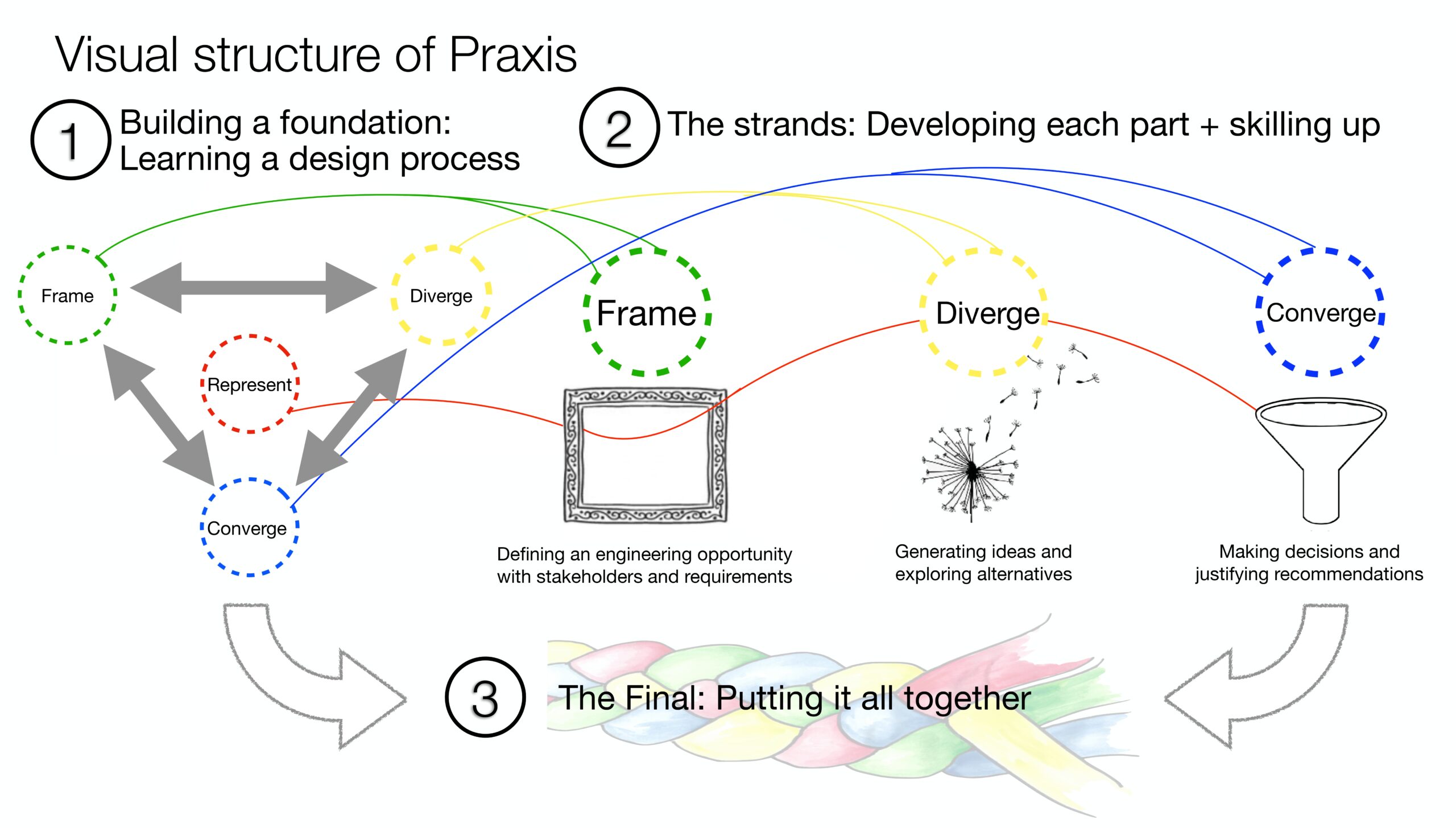
Primary Engineering Design Framework used in Praxis I and II
Praxis I is an introduction to engineering design processes and theory. The course focuses on communication, teamwork, research (a lot of it), and prototyping – all crucial and connected parts of engineering design. An overarching theme is developing an engineering identity, something that unites all parts of the course and that you can carry and develop throughout your career.
At the start of the course, you’ll learn about design theory, which is based on the concept of engineers rigorously documenting and supporting their designs. Documenting your work involves tracking the materials, ideas, and information that went into developing your design. Supporting your work means using research to inform your decisions and testing your design to ensure it will perform as intended. Along the way, you’ll learn to communicate your design processes and products to a wide audience.
Many of your Praxis I activities involve working in a team. A few weeks into the semester, you’ll be placed into a team of 3-5 EngSci students. Together, you’ll learn and apply the Frame, Diverge, Converge, and Represent (FDCR) engineering design process that is fundamental to Praxis I and II. With your team, you’ll frame an engineering opportunity by talking to and observing stakeholders around you. In other words, you’ll talk to people in the community to identify a problem that might be solved with engineering. Then, you’ll develop ideas for tackling the opportunity and begin to challenge and test these ideas. This process will culminate in developing a prototype of your design and a design report that recommends a final design.
Some examples of opportunities from Praxis I this past year include removing stuck hair from twin caster wheels and reducing the inconvenience of carrying a jacket.
Professors
Professor Jennifer Lofgreen
Professor Jennifer Lofgreen
Professor Jennifer Lofgreen completed her PhD in Chemistry at U of T. During that time, she also worked on writing instructions for chemistry students and teaching assistants. In fact, she used to be a teaching assistant for this course herself! She spent time in Sweden teaching academic writing for PhD students. During her time there, she started a second PhD focusing on using philosophy of science to inform research in engineering education. She focuses on the communication half of Praxis I – which is all about arguments and building strong claims!
Professor Chris Bouwmeester
Professor Chris Bouwmeester
“I’m an Associate Professor, Teaching Stream in Biomedical Engineering and I’m responsible for the design part of Praxis, which is all about the engineering method. I’m most interested in giving you a hands-on experience and helping you share and learn from (your) mistakes with a group of peers to set you up for success as a future engineer. I mostly teach/organize/coordinate/shepherd capstone design courses and graduate level courses.
My background is in mechanical engineering and cardiovascular physiology, so I have a special interest in cardiovascular dynamics and devices that address problems with cardiovascular diseases. I’m a big advocate for participating in an exchange program during your studies (I studied for two years in Germany) because I believe that personal growth happens best when you are pushed outside of your comfort zone.”
Course Highlights
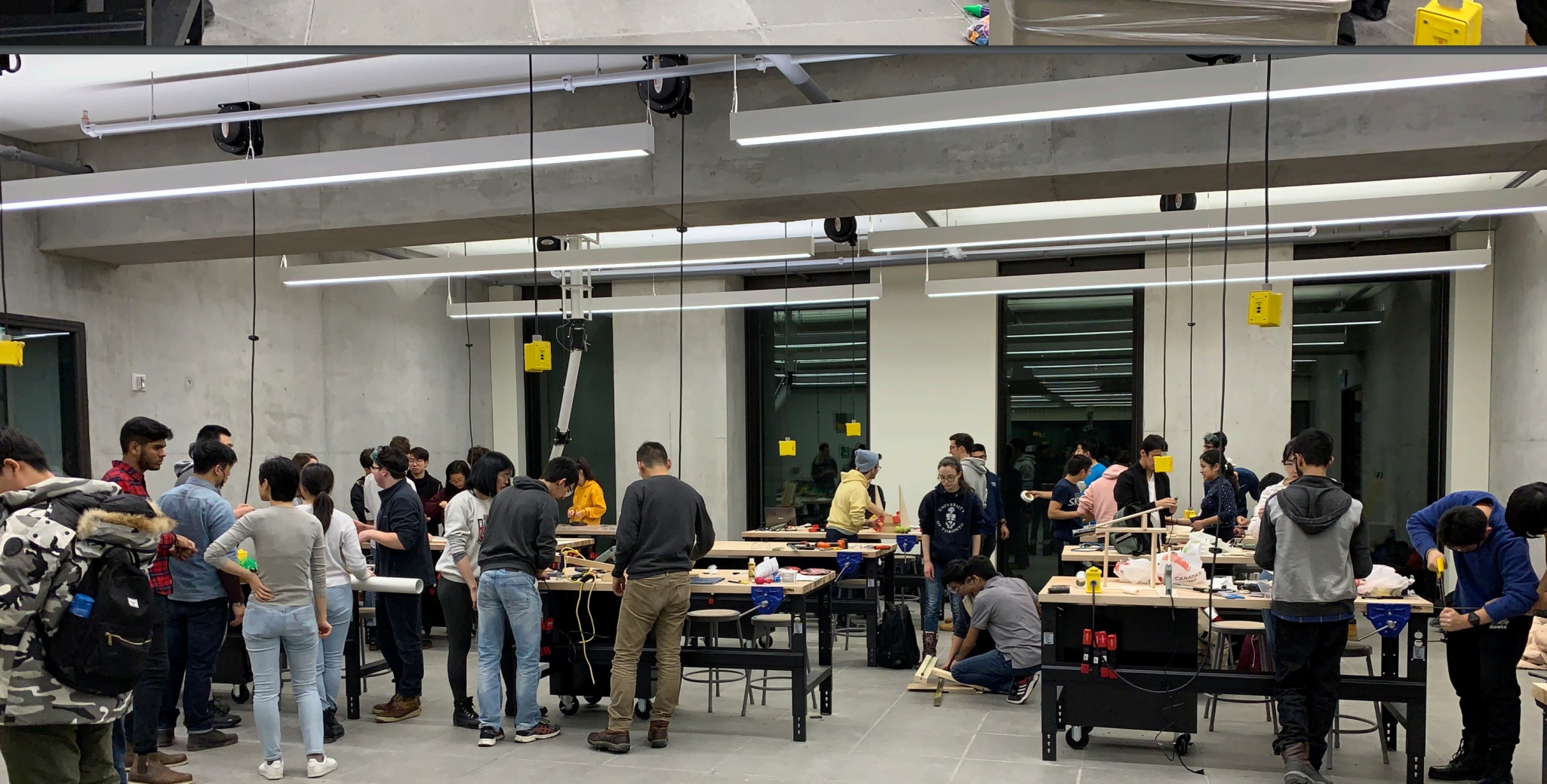
Praxis students prototyping designs in the Myhal Light Fabrication Facility. (It’s worth noting that “Light Fabrication” is “light” as in “not heavy fabrication.” They do NOT make light in this facility. Making light would be, strangely enough, “Heavy Fabrication,” not Light Fabrication at all.)
Explore your lived experience as a first-year EngSci student and collaborate with your team to identify opportunities for improving the student experience.
Developing many different ideas, and prototyping and testing them. Dollar stores are your friend!
Using your new engineering design skills to recommend a design that addresses your opportunity and has the potential to improve the lived experience of first-year EngSci students.
Writing a design report! In engineering, communication is as important as design. No single engineer can be responsible for a product, from the planning and design, to manufacturing and distribution. It’s good practice to formally communicate ideas and information in a written manner.
Week in the Life of a Praxis I Student
Praxis I is a dynamic course that changes significantly from week to week. Here’s a rough approximation of how a week will look for a Praxis I student.
Lectures
There are typically three lectures a week for Praxis I. You’ll learn about engineering design concepts and participate in design and thinking activities. You’ll find that the lectures are integrated well with the tutorials, discussing notable results from tutorial activities and connecting them to different engineering design concepts.
Tutorials (Studios)
Praxis tutorials are referred to as studios. In a small class led by two TAs, you’ll be guided through engineering design activities, project help, and more. Everyone in your team will be in the same studio, so this is where most of your project-specific work and instruction will happen. Here you’ll apply the concepts you’ve learned in lectures and explore how they work and connect.
Practicals
Your timetable contains a two-hour practical block each week, during which you can meet with your team and work on your project. This time will never have scheduled course activities or a room assigned: it’s a time when you know your whole team is available and you can use it as you see fit.
You should definitely schedule regular meeting times with your team, ideally when you work together on your project. Since Praxis is a dynamic course, you may have no meetings some weeks and many hours of meetings on other weeks. The key is to find times that work for your entire team and to not leave all your work until the last minute! We cannot overemphasize the importance of regularly checking in with your team. Through regular team communication, you can keep track of deadlines and allocate work more effectively. Communicating with your team helps ensure that everyone is healthy and offers an opportunity to de-stress all together. The most successful teams in Praxis tend to work together frequently, rather than taking a divide-and-conquer approach.
Assessments
Overall, the course project consists of identifying and framing an engineering design opportunity to improve the lived experience of first-year EngSci students, and developing, prototyping, and verifying design concepts that address the opportunity. During the semester, you’ll work with your team on written reports and have an oral assessment for your team project. You’ll also do an individual written analysis of your experience doing engineering design. Look at the How to Succeed section below for some advice on completing these.
Midterms & Exams
There is typically a midterm and final exam in Praxis I. These exams will test you on the engineering design and communication theories and concepts you have learned, as well as your ability to apply them. Based on our experience, understanding how the course concepts connect to each other can be a useful tool when studying. To find past exams and tests, visit the Praxis I page on courses.skule.ca.
How to Succeed
Record Everything You Do We cannot stress enough how important it is to keep a record of everything you do throughout the design process, both as an individual and as a team. You’ll learn to use many concepts, tools, models, and frameworks (CTMF) throughout both Praxis I and II and will be asked to write about your usage on multiple occasions, so an organized evidence folder will be handy. In particular, the final assessment in Praxis II requires you to reflect on and talk about your usage of Praxis CTMFs in your design projects in Praxis I, CIV102, and Praxis II (and possibly more projects), so keep this in mind and record everything.
Work WITH Your Team As mentioned before, much of Praxis I is done in teams. This is a chance for you to get to know more of your peers, learn from diverse viewpoints, and develop your ability to collaborate. It’s important to get to know how everyone likes to operate and find a good way to work together. Agree on simple rules: “If someone is late, they’ll buy Timbits for everyone,” or, “We will not just shoot down others’ ideas: we’ll give a reason we don’t agree and be open to debate.” If you are having any conflicts with your team, there is teamwork support run by the Insititute for Studies in Transdisciplinary Engineering Education and Practice ISTEP .
Definitely Plan to Work Together Regularly Upper-year students recommend planning early so everyone can do their individual portions as soon as possible. But don’t just divide and conquer. Do some of the work together in the early stages so any individual work stays on track. It’s super important that everyone knows not only what team mates’ tasks are but what their particular challenges, constraints, and timelines are. Plan to review everything together multiple times throughout each stage of the project so that your work really does come from you as a team, not a collection of individuals. If you find a particular teamwork strategy is not working, try something different. Above all, don’t forget to communicate!
Monika’s Experience:
In first-semester Praxis I, my team and I rarely divided up the work. We usually worked on everything together during meetings or on the same things from home. While this approach often took longer and there was no clear division of responsibilities, it helped ensure that everyone stayed on the same page and understood every aspect of the project.
In Praxis II, my team mostly divided tasks and areas of expertise and met occasionally to discuss our progress. During one of the verbal assessments, we realized that we each had different interpretations of the project. This showed that we had not spent enough time discussing our work together or making sure everyone shared the same understanding.
For future Praxis I and II students, I would recommend a mix of those two approaches. Definitively meet a lot but also make sure that the sessions stay productive and that everyone knows what they should do at home.
Review Your Writing at Every Step of the Process Writing is a key part of professional communication, and you’ll be expected to write formally for Praxis I. The reports can be long, and the best strategy is to work on them regularly over time. When you’re revising and editing your work, don’t review it entirely in one go; you’ll find that fatigue impairs your reviewing and editing ability. Instead, focus on one thing at a time, and plan to have space to do multiple rounds, which will improve your work. Also, good engineering writing almost always involves making good use of well-chosen sources. Document your research as you go and make your own notes about your thoughts about your research. Citations always take longer than you expect, so do them as you go.
Ask Questions As with all other courses, ask questions! The teaching team will answer any of your questions about assignments, concepts discussed in lecture, engineering, communication, and much more. You’ll have about 5-10 minutes before and after the lecture to ask quick questions. You can also always email professors for more personal questions or attend their office hours. You should ask questions if you’re having a hard time understanding something. But it doesn’t just need to be if you need help. You can also ask questions or chat with your teaching team if you want to level up!
Summer Student Tip:
The Engineering Communication Program (ECP) is a great place to get help with your Praxis assignments. Last year, one of the TAs even worked there, so you could get feedback from someone familiar with Praxis and what the markers are looking for. You’ll also often find that even ECP tutors not directly affiliated with Praxis are familiar with the projects.
You can practice presentations with them, have them review your papers, or ask for help in any way you need. ECP support is not just useful for Praxis, but for many aspects of your academic journey.
Take Feedback Seriously You’ll receive holistic feedback from TAs, professors, and teammates during studio activities along with written feedback on assignments and teamwork evaluations. Feedback is personalized and is all designed to help you become a better student engineer. Part of developing as an engineer means reflecting critically on the feedback you receive and deciding for yourself what to do with it.
Beyond First Year
You’ll learn how to identify engineering design opportunities and develop creative design concepts. This skill will be useful in future design courses and in your engineering career.
Completing an engineering design process for the first time is a great learning experience for most students. It’s rewarding to find an opportunity, frame it, develop a concept and then prototype it through to proof-of-concept functionality.
As a future engineer, you’ll need to make engineering decisions based on strong arguments and credible, relevant evidence, and think with a sense of logic and rigor.
The research and citations that you do for the course may seem tedious at first, but they’ll prepare you for future design projects and courses by introducing you to the research tools necessary for professional engineering.
If nothing else, this course will give you confidence in your problem-solving abilities. Overcoming the wide variety of challenges will be a source of confidence for you in your engineering design and problem-solving abilities. Additionally, the engineering design frameworks and techniques that you’ll learn in Praxis I will be the foundations in Praxis II, where you’ll focus on applying these skills to a larger scale project.
The right school supplies are essential to your university experience. You’ll use them to take notes in lectures and tutorials, complete problem sets and practice questions, perform calculations and engineering design, and much more! In this post, we’ve compiled a list of important supplies and how they can be used to help your first year in EngSci be as successful as possible.
Digital School Supplies
Laptop – Operating Systems
A laptop can be very useful throughout your time at university. Some students also take notes with laptops, using programs like markdown, LaTeX, or OneNote (include in the free license of MS Officefor all U of T students). A potential upgrade to this setup would be to buy an external mouse (especially useful once you start doing CAD) and a pair of headphones (especially if you’re commuting). Given the amount of time you’ll spend on your laptop, these investments will pay for themselves through increased comfort, usability, and convenience over the next few years.
In terms of operating systems, Windows- and MacOS-based are both suitable options. If you’re not sure which OS to pick, here’s a comparison of the two based on your blog admin’s experiences:
Pro: Windows is compatible with almost any computer program, including most engineering software you may need in EngSci.
Con: Many engineering design and simulation software, such as SOLIDWORKS, Altium, etc. are not compatible with MacOS.
Con: Windows laptops may include certain features that add to the overall price. Powerful processing and graphics features can be very useful. However, you may be paying for more than what you need.
Pro: While some Macs may be more expensive, they generally come with fewer potentially “useless” software and hardware features.
Pro: If you’re hoping to use another OS on the same device, virtual machines and dual boots are easy to set up on a Windows system.
Con: If you wish to run another OS on a Mac, it can be much more complicated and annoying to setup and use.
Con: Windows devices may not have direct integration with your phone.
Pro: If you have other Apple devices, the convenience of your workflow is greatly improved; you can better integrate/transfer your data and files between them, and various iPhone apps can be accessed on Mac, and vice-versa.
Note: If you already have a Windows or a MacOS laptop, switching to another OS solely for specific software is not required. In the rare case that OS-specific software is required, you can use workstations in the Engineering Computing Facility (ECF) labs as well as remote login even when you’re away from campus.
Laptop – Technical Specifications
Throughout your time at EngSci, you will use various engineering software inside and outside of the classroom that require above-average computing power. You will soon find yourself checking the specifications requirements for various computer programs. Below, we’ve listed some minimum and recommended specifications based on commonly used software in EngSci to help you determine whether you need to upgrade your laptop. You can look here for the full recommendation list.
*Note: many students use their laptops for additional tasks such as computer gaming. If you are interested in doing so, you might want to consider laptop specs more powerful than those listed below, as games are typically more resource-intensive (and new games increasingly so). Typically, if a laptop is good for gaming, it will be more than enough for your engineering work; we recommend you do your own research to learn about these topics. For anything regarding computer specs, you can also ask the Blog Admins; they both have experience with Mac/Windows, laptops and PCs, gaming, and more.
Windows laptops: We recommend a 13th Generation Intel Core processor (or newer) or an AMD Ryzen 5 processor (or newer).
These processors meet the requirements for the software commonly used throughout the EngSci program.
RAM or Random Access Memory is the storage that your CPU uses to temporarily store and access information. So, more RAM will allow your laptop to run more applications simultaneously without slowing down.
Note: When checking software system requirements, note that if a software lists 8 GB as the minimum and your laptop has just 8 GB, avoid running multiple other programs simultaneously to prevent slowing down.
As a U of T student, you’ll have access to Microsoft 365 for your personal workstations and an associated 1TB OneDrive storage. This will be more than enough to store your course materials. You can use other methods such as Google Drive for additional storage.
That being said, you’ll still need local storage for installing software. Generally, 512GB of SSD storage will be enough if you’re using it mostly for schoolwork. But if you think you’ll need more storage for personal projects and files, a 1TB SSD is optimal. Overall, an SSD (solid state drive) is recommended over an HDD (hard disk drive).
When checking disk space requirements of software, keep in mind that some software will allow you to install the main application without all add-ons, saving disk space.
In your upper years or when working in design teams, you might need to render complex CAD models that require high-end graphics processing units (GPUs). Other simulation programs, and especially machine learning computations, will require strong GPUs and potentially CUDA-compatible GPUs. However, in those cases, the ECF (Engineering Computing Facility) workstations will usually suffice (you can access them remotely as well.) Some design teams also have their own computers with dedicated graphics cards and high-end CPUs. There are also cloud services such as Google Colab which can be used for machine learning.
Modern laptops have relatively decent integrated graphics, but getting one with a dedicated GPU (Graphics Processing Unit) would future-proof your device and allow you to do graphic-intensive renderings in upper years, if needed. Most NVIDIA GPUs are CUDA-compatible.
Tablets For Notetaking
While pen and paper is still a very common method of notetaking, many students use a tablet and stylus for. Common setups include an iPad and Apple Pencil, a Samsung Galaxy Tab and its included pen, or Microsoft OneNote with a stylus (certain laptops such as Microsoft Surface Pros can double as laptops and tablets).
We suggest carefully reflecting on your learning style to determine if a digital method is for you! Often, students start with paper notes and transition to tablets later in the year. Here are the pros and cons of the two based on your blog admins’ experiences:
Tablets
Paper
Con: Can be very expensive; touchscreen/2-in-1 laptops cost more than their regular counterparts. Digital pens are typically not included in iPad purchases.
Pro: Taking notes on paper is significantly cheaper. You only require stationery, which is often given out for free.
Pro: Tablets greatly help with organization; they keep all your notes digitally and cloud backups allow you to access them with any device.
Con: To access your notes, you’ll need to carry around all your notebooks and stationery. Furthermore, you’ll need to print various assignments.
Pro: Digital notes are easily searchable and allow you to include internal and external links related to the content
Con: Links to online materials will need to be stored separately and searching through handwritten notes can be difficult based on your individual organization methods.
Con: Devices can run out of battery power at inopportune moments. You’ll need to carry around a charging block and cables to combat this issue.
Pro: No batteries required and virtually fail-proof. Writing by hand also eliminates digital distractions, and some studies suggest that taking notes on paper can improve memory retention and comprehension.
Pro: Notetaking apps allow you to move, resize, erase, modify, and change absolutely anything in seconds with only a few taps (no more eraser dust, different colors of highlighters, and frustration that your answer didn’t fit in the box provided).
Con: Sometimes professors may erase or change the content they’ve written on the blackboard, needing you to make modifications to your notes. With handwritten notes that means using an eraser or striking through, which can become frustrating and messy over time.
Amanda’s Experience
I started the semester using an iPad because that’s what I did in high school, and I found that a lot of our first-year professors used posted slides for lectures. The iPad worked well for classes where professors mainly wrote on the chalkboard, like Calc I, since I could copy notes directly into my digital notebook in Goodnotes. I also found that using a digital notebook made it much easier to quickly erase, reorganize, and format notes during fast-paced lectures. It also worked well for lectures with posted slides because I could download them before class and add the professor’s annotations and important speaking points.
My strategy was to take notes during lectures and then only work on problem sets and homework at home. However, once midterms came around, I realized that simply taking notes in class without revisiting them later meant I wasn’t retaining the information as well as I needed to. Because there was so much content happening all at once, I found that most of my studying became relearning the material instead of practicing problems.
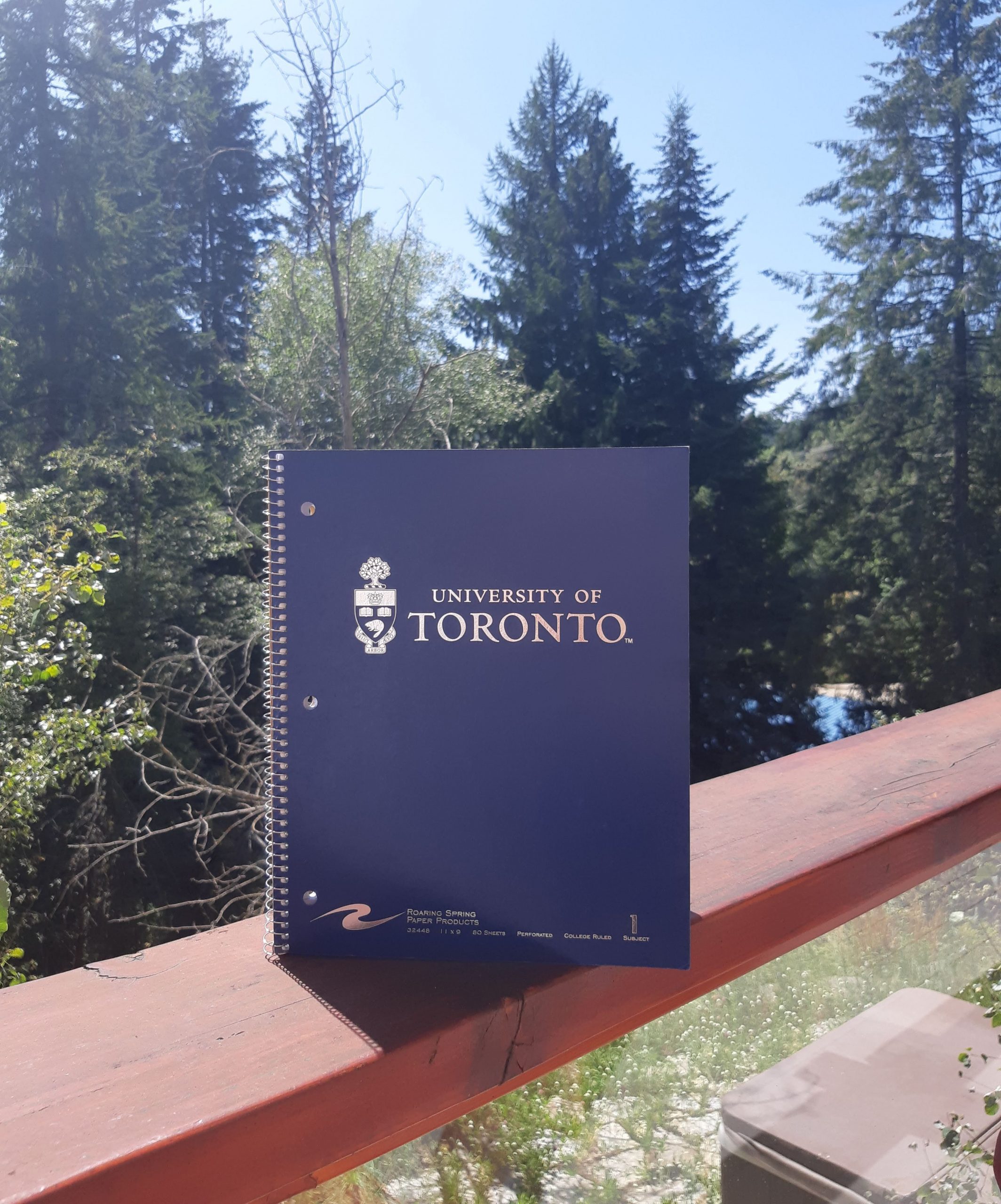
I knew this study strategy was not working for me. One of my friends used a five-subject notebook for all her classes, and I realized that could be a good compact solution. I liked that I could keep all my notes in one place and easily bring it with me everywhere.
I started a new strategy where I continued taking notes on my iPad during lectures and wrote down important speaking points, but later in the week I would revisit the lecture and make more organized notes in my notebook. These notes combined lecture content, professor annotations, and textbook material. I tried to stay as consistent as possible and make notes every week, so I was not cramming right before midterms or exams.
This combination ended up working well for me because by the time midterms came around, I already had all the content organized in one place and could spend much more time doing practice problems instead of relearning concepts. I do not think this study method will work for everyone. I had friends who could learn everything directly from lectures and retain it well, but that just did not work for me, and it took some adapting to figure out what did.
I think first year is the perfect time to figure out which note-taking methods and materials work best for you, whether that’s using a tablet, notebooks, or a combination of both. It’s completely normal to feel overwhelmed by the number of lectures and content each week, and it’s okay to spend time outside of class revisiting and relearning material in whatever format helps you learn best.
Monika’s Experience
Going into second year, I’m leaning towards only using a tablet for all my course notes and only using paper for practice work that I don’t need to keep. In first year, I was always switching between paper and my iPad. I would say that if you want to use a combination of both, then you should still choose one primary method for each course. For me, I was using a mix of both in most of my courses.
Looking back, that may also be one of the reasons why I usually did not use my personal notes very much when studying for tests or exams. My system was ideal for not having consistent notes in any course (which is obviously an exaggeration), but I still think it highlights an important point: I would avoid mixing note-taking methods too much within a single course.
My strategy for second year is to continue using Goodnotes, which I’ve been using for several years, and create a dedicated notebook for each course, adding all notes to that notebook throughout the semester. I have found that when I simply create a folder in Goodnotes and start a new note for every class, there is too much clutter. It becomes harder to find information, and sometimes the files end up organized in a confusing order if I am not consistently following a naming convention.
I still think practicing on paper is valuable, so I plan to continue what I do now: printing physical copies of past papers and solving them by hand. This gives me the benefits of a fully digital note-taking system while still allowing me to practice problems in a way that feels natural and exam-like.
Summer Student Tip!
Enrolled engineering students receive a free ECF printing quota for use in Engineering Computing Facility lab. At the beginning of the semester, you’ll likely receive instructions in your ESC180 course on how to create an ECF account. Once your account is set up, you can log into computers in the labs using your credentials and print for free within your quota. You can also check your remaining quota on the ECF Services website
Internet
On U of T campus, you’ll have access to school WiFi. Off campus, UTORvpn can be used for accessing resources restricted to on-campus networks. To stay safe online and protect your privacy, make a habit of using the VPN.
Students are also common targets for phishing scamsespecially through email and social media. Be cautious when clicking links, downloading attachments, or responding to unexpected messages asking for personal information. U of T’s Information Security team maintains excellent resources on common scams, phishing awareness, and online safety that are worth reviewing before the semester begins.
Based on our experience, the Casio FX-991EX and the Sharp EL-W516 are both effective calculators. The Casio FX-991CW is another approved calculator that’s sold in the U of T Engineering Store. Our advice is to choose whichever approved calculator you prefer and become familiar with its functions, since features for topics like complex numbers, physical constants, and statistical tables can be very helpful throughout your courses. Keep in mind that calculators in EngSci are almost always used for simple calculations – so your choice of calculator will not greatly impact your success in the program.
From your academic advisors: make sure you know each course’s policy for calculator use during assessments, in particular midterms and final exams!
Traditional School Supplies
Notebooks and Binders
Notebooks or binders are crucial if you plan to take your course notes with pen and paper. Depending on how many notes you take or your writing style, you’ll use between 150 to 500 pages per semester. Many students use notebooks and binders for lectures, scrap work, and practice problems. This can be an efficient method of storing notes.
Here’s a comparison between notebooks and binders:
U of T Notebook
Notebooks
Binders
Pro: Notebooks keep all notes in a sequential order, making it easy to find information from specific lectures.
Con: If you aren’t regularly organizing your notes into the correct categories in your binders, information from specific lectures may be difficult to locate.
Con: Not as flexible in terms of storing additional materials, such as the occasional handwritten quizzes, printed handouts from lectures, etc.
Pro: You can keep your handwritten quizzes in a binder for easy reference when studying for midterms/exams.
Pro: Instead of needing to manage many individual sheets of paper, you can keep track of your notes based on sections in your notebook.
Pro: Binders offer flexibility – you can move papers around and insert pages into existing categories without having to start a new notebook.
Con: Can be bulky if you’re carrying separate notebooks for all your classes.
Pro: You can simply carry a pack of loose-leaf papers to your classes and then sort them into the relevant categories in your binders.
The takeaway is that the best system is the system that works for you. Some people will use notebooks, others will use binders – and some may not use paper at all!
Stationery
You should bring pens, pencils, erasers, and rulers. Optionally, you can also purchase set squares, protractors, and compasses.
Invest in good pens and pencils. Each course and professor is different, but in our experience, both pens and pencils are usually allowed during midterms and exams. Be sure to check with your instructor, though, as policies can vary. A lot of our peers have preferred pencils because they’re erasable and often you do need to erase a lot.
Rulers are important in exams for drawing charts and diagrams. For classes, a ruler can keep your notes straight, draw that perfect truss bridge, or create the cleanest Cartesian plane axis.
Monika’s favorite pens: A lot of my friends and I have found love for the MUJI pens and stationeries for their minimal design and feel.
Picture of Monika’s pencil case
Textbooks
Most courses will use a textbook for problem sets or just course material. Having the textbook is (usually) not mandatory, and it’s often up to you to decide how often you want to use it. It’s recommended to check with your professors during the first week of classes before purchasing one.
Personal Take #1: Historically, some courses (e.g., PHY180) have required students to purchase textbooks for online homework. However, make sure to check with your professors to see if there is a homework-only option. In previous years, students were often offered a textbook + online submission package for ECE159 but were able to get only the access codes for homework for a cheaper price by emailing the professor.
Personal Take #2: If you really want a physical copy, you should consider getting the Stewart textbook, which is used in ESC194 and ESC195 in first year and AER210 in second year. You can also find extra copies of older editions in the common room.
Stewart Calculus Textbook used in ESC194, ESC195 and AER210
Monika’s Experience with the Stewart Calculus Textbook
I was one of the people who decided to buy the textbook, and for several months – especially toward the end of the first semester – I carried it around almost everywhere (it’s really huge and heavy). I liked the fact that, because it was mine, I could write in it and highlight things. However, looking back, I think getting the physical book is most useful if you plan to study at home, because it’s really inconvenient to carry such a large book around. I would often need a second bag just to bring it with me, and there was not much advantage compared to the online version. During the second semester, I still used the textbook when studying at home, but I stopped bringing it to libraries.
Stewart Calculus Textbook used in ESC194, ESC195 and AER210
Bags
No matter how you study, you’re probably going to need a solid backpack or bag to bring all your supplies to class. The size and type of bag that’s right for you will vary depending on your study strategy and learning style. If you’re planning to bring a tablet for note taking you can select a small, compact bag. However, if you’re bringing every one of your notebooks/textbooks, you’ll need a heavy-duty backpack with industrial straps. Regardless of your pick, we recommend a bag or backpack that fulfills these requirements:
Water resistant material to help keep your electronic devices safe in case of a downpour.
A tip from Christina: Rain covers for backpacks are inexpensive, weigh almost nothing, and are really great in the rain or snow.
Comfortable straps and padding so that walks to class don’t ruin your posture
Quick-access pockets so you can easily access your T-Card, keys or PRESTO cards
Other Organizational Materials
The list we’ve compiled above is not comprehensive and may not be exactly right for you. We recommend that you explore tools, supplies, and other resources that help you stay organized. Many students love to highlight their notes using a variety of neon colors, some mark each page in the textbooks with different tabs, and some like just writing everything down in a plain old notebook. The supplies that you need are the ones that will help you study and stay organized the best, so keep an open mind and try some new things until you find the right strategy for you.
Once you’ve got your timetable, you may be wondering what you’ll actually be doing throughout your day. This page will teach you about lectures (LEC), tutorials (TUT), practicals(PRA), and office hours – plus what to expect for each one.
Note: Not every course will exactly follow these descriptions. For example, some instructors may encourage more questions during lectures and fewer during tutorials. Make sure you follow these instructions. If you’d like to learn more about how LECs, TUTs, and PRAs are structured for a particular course, check out the blog post for that course and read the “Week in the Life” section.
Lectures (LEC)
Instructors: Professors
Session Length: 1 hour (may be longer in upper years)
Location: Lecture halls
Class Size: Around 150-300 students
Attendance: Highly recommended
Main Objective: Learn new concepts
In lectures, your professor will introduce you to new material. Your in-lecture experience will vary based on your professor; some prefer writing with chalk on a blackboard while talking (chalk-and-talk), some create PowerPoint slides, and some write digitally using a stylus while projecting to a screen.
MY150, a lecture hall in the Myhal Building (MY), is where lectures for Praxis courses like ESC101 are traditionally held.
It’s important to find what works best for you, but we recommend attending all lectures.
PRO TIP: turn off your devices and notifications during lecture so your brain uses this time efficiently to focus, digest the new info you’re learning and commit it to memory.
Paying attention to what the professor is saying during a live lecture is invaluable as it allows you to note what you find important and more effectively retain concepts. You might think you can review a friend’s lecture notes later, but simply attending the lecture more thoroughly teaches you the content (potentially in less time than if you had to self-learn) and keeps you up to speed with the rest of the course.
Some of your courses will hold graded pop quizzes during lectures. Plus, lectures are a great place to see your classmates, while listening to your professors talk about engineering is both a cool experience and a great privilege. Remember, access to our top-tier professors (who are experts in their respective fields) is one of the most rewarding parts of the program, and the in-person interaction with them is part of what you’re paying for!
Tip: if your professor posts slides or template notes beforehand, print or download them before class so that you can make annotations during lecture! Depending on the course or lecture style, you may have to change your notetaking methods. Take this as an opportunity to experiment with what works best for you. Want to learn more about the most efficient note taking methods? Consult the U of T Learning Strategist’s resources (Tools & Resources – Current Engineering Undergraduates).
Tutorials (TUT)
Instructors: Teaching Assistants (TAs)
Session Length: 1-2 hours
Location: Classrooms
Class Size: Typically around 30 students
Attendance: May be mandatory
Main Objective: Practice, including completing examples based on lectures, clarifying lecture content, and completing quizzes (for marks)
A classroom on the third floor of the Myhal Centre, where you will have some tutorials. The rooms are designed for a small class in which collaborative learning takes place. [Source]
Tutorials are like a standard high school class of 20-30 students, except instead of learning new content, you’ll practice concepts that were introduced in lecture. Most TAs will use tutorials to work through sample problems, go over complex concepts from class, introduce interesting applications, or just answer your questions.
Tutorials will likely be the time where you’ll write quizzes or hand in problem sets (if applicable). TAs will usually recommend working with your classmates at your table in completing various practice problems and encourage you to share your results with others or seek guidance. Some tutorials will take attendance or hold quizzes that will count towards your grades- so attend regularly and arrive prepared.
We very strongly recommend you attend every tutorial. They’ll help you understand concepts, fill in gaps in your knowledge, and give you a lot of experience solving exam-style questions. The TAs are often senior EngScis or master’s students, and are there specifically to help you so take advantage.
Practicals (PRA)
Instructors: TAs and Lab Coordinators
Session Length: 3 hours or less (depending on how quickly you finish your work)
Location: Experimental labs or Computer labs (ECF)
Class Size: Around 40 students or less
Attendance: Usually mandatory
Main Objective: Apply your learning in the real world
The activities during your practicals depend on the course. For example, practicals for physics courses will require you to conduct experiments, while practicals for courses like Praxis I, II, and III will often have a similar structure to their tutorial counterparts.
An apparatus in the thermodynamics lab of the Mechanical Engineering building, in which you will have labs for CHE260, a second year thermodynamics course.
Some courses will require you to write lab reports based on the experiments or work done during practicals, while others won’t. For experiment-based practicals, such as for PHY180, the sessions may not be mandatory every week, or you may have mandatory practicals every other week. In these cases, note which weeks are mandatory for you, as this may differ from your peers in the same lecture cohort.
The Secret Weapon…Office Hours
Instructors: Professors and/or TAs
Session Length: Varies
Location: Instructor’s office, classrooms or virtual
Class Size: Varies
Attendance: Optional
Main Objective: Ask questions about course material, upcoming exams/assessments, etc.
Office hours are specific times during the week when you can get extra help directly from professors and/or TAs. They are typically held in the instructor’s office or online. These will not be included in your timetable but are set by each course instructor individually. At the beginning of the term, professors will announce office hours that fit into students’ timetables.
Professors and TAs hold regular office hours throughout the semester, with some instructors offering additional sessions before major assignments, midterms, and exams.
What Can You Gain from Office Hours?
Strengthen your understanding of lecture concepts and course material.
Get insights directly from the people who write the exams, especially during review office hours before assessments.
Learn about professors’ and TAs’ research interests and potential summer research opportunities.
Explore topics that interest you and discover ways to learn more about them.
Develop relationships with instructors, who may later be able to serve as references for scholarships, research positions, internships, or graduate school applications.
Get to know your professors as people, making it easier and less intimidating to approach experienced professionals throughout your degree.
Office hour schedules will be shared at the beginning of the semester, so be sure to take advantage of them early and often.
You’ll have a timetable for each semester of university. In first year, your timetables are made for you. You can access your timetables in late June on ACORN, U of T’s student information service and a hub for everything you need to manage your student life. Your timetable provides the times, locations, and sections for the lectures (LEC), tutorials (TUT), and practicals (PRA) for each of your courses throughout the week. Above is a sample first-year EngSci timetable from Fall 2025. You’ll see similarities with your timetable for the upcoming semester.
Don’t worry if details such as room numbers haven’t shown up on your own timetable yet – they’ll be added before the start of classes. It’s also typical to see timetable conflicts between courses early in the summer while the timetable’s being finalized. We advise you to wait at least until mid-August to report any conflicts to your academic advisors as they should be resolved before then. Also, make sure to check your timetables right before the first day of classes, as last-minute changes may occur.
Sample First-Year EngSci Fall Semester Timetable (2025)
Reading Your Timetable
Course Code
Each colour in your timetable corresponds to a different course (e.g., all ESC180 class activities will be the same colour). However, the text will be different. Each block will have either a “LEC,” “PRA,” or “TUT,” followed by a number.
Sections
On the same line as the LEC/PRA/TUT label are four numbers. Examples include LEC 0102 or TUT 0107. First-year EngSci is a large group, so students are divided into smaller cohorts for lectures. If your LECs include 0101, you are in cohort #1, and if they include 0102, you are in cohort #2. Some lectures, such as those for ESC101, are common to both sections: all shared lectures will be indicated as LEC 0101 by default.
Within your cohort, there are smaller sections for tutorials and practicals, which is why TUTs and PRAs can have numbers like 0107 or 0111. These groups are distinct for each class; you’ll have the opportunity to meet many different classmates throughout your coursework in first year! You’ll remain in the same cohort throughout first year, but your section may change in second year.
Time
One unique thing about U of T is “U of T time”! All classes start ten minutes after the hour. For example, if your timetable indicates you have a class starting at 2:00 PM, the instructor will begin teaching at 2:10 PM. This gives you time to travel between buildings to get from one class to another.
Reading Locations
The first two letters indicate the building code. For example, the code for the Galbraith Building is GB. To learn more about all the buildings and their codes, check the Campus Buildings section of our blog.
The three or four numbers indicate the room number itself, with the first number indicating the floor the room is on. For example, GB144 is room #144 on the first floor of the Galbraith Building, while BA2195 is room #2195 on the second floor of the Bahen Centre. If you’re having trouble locating any of the buildings for your classes, then check out this great interactive campus map. Toronto’s ClassFind is another great resource to find step-by-step directors to specific classrooms.
This ESC194 lecture occurred from 5:00 PM – 6:00 PM at the Sandford Fleming Building (SF), on the first floor, in room 1101. It was for students in Section #2 (hence, the “0102”).
Important Things to Note
All your lectures, tutorials, practicals, and midterms in first year will be during the school week (Monday – Friday) from 9:00 AM – 7:00 PM. In your timetable, there will be two-hour gaps during which midterms will be scheduled; in the sample timetable above, this test block was on Mondays and Thursdays from 9:00 AM – 11:00 AM (this may be different for your year).
Final exam schedules come out later in the semester, but they are usually held Monday – Saturday between 9am and 9pm
Every day, you’ll have at least one hour-long break between classes, which acts as a lunch period (this break may not occur at the same time every day). We recommend you use it to take a break and eat with friends! Be sure to check out some of our food recommendations.
Many of your back-to-back classes will be in different buildings. This may seem odd at first, but walking is an excellent healthy break between the long sitting times in lectures. Due to the proximity of the engineering buildings, the classes are also within reasonable walking distance; plus there’s U of T time, so you won’t need to run.
First-year schedules usually cannot be rearranged unless religious, medical, Varsity athletic, or other important accommodations need to be made. If you have a significant request, we encourage you to speak with your academic advisor.
You should follow your timetable and attend all of your designated lectures and tutorials. Tutorials and practicals may include attendance or quizzes for marks, so if you have a justification for attending a different time slot just once, speak with that course’s teaching team to make a request. If you require recurring accommodation, speaking with your Academic Advisor is the best option.
In first year, between going to class, doing homework, and studying, you’ll likely put in around 50 hours of work per week (this number may increase or decrease based on midterms, projects, and exams). This will likely be more than what you had in high school, and it is okay to feel a little bit overwhelmed! Yes, first year will be challenging, but you can absolutely get good grades, engage in extracurricular activities, and make time for personal endeavours with proper time management, focus, and effort.
Try your best to attend all lectures, tutorials, and practicals (especially those which take attendance). Try and find a schedule that works for you and always remember to take breaks and relax. There are plenty of supports available to you through the university. We also encourage you to talk to upper years to learn their strategies for success in EngSci and beyond; they’ll always be happy to help!