What is a Design Team?
A design team is an engineering student group that works to design, build, and showcase engineering projects (such as autonomous robots, machine learning research papers, or space satellites) through global competitions, journal publications, and more. Design teams cover all areas of engineering and often require a diverse group of interdisciplinary engineers to complete all aspects of their projects.
Why Join a Design Team?
On design teams you’ll work on innovative projects, solve unique and interesting problems, apply knowledge from your classes, and develop significant real-world experience, all of which can help you land internships and research positions. Many engineering students join design teams to strengthen technical skills, explore a particular industry or major, meet new people from U of T and around the world, advance their career, and build cool things! You can visit this website to explore more of the clubs and design teams affiliated with U of T Engineering.
If you want to get a head start, be sure to attend the Club Fair meetups happening in person on August 12, 2026 from 3 p.m. – 5 p.m. EDT and online on August 13, 2026 from 10 a.m. – 12 p.m. EDT. The registration link will be sent through the EngSci Orientation Newsletter a week before the session. If you haven’t subscribed yet, it’s not too late. We hope to see you there!

U of T Engineering has over 20 design teams. With so many options, how do you pick the right one? Below are some of the design teams most popular with EngSci students. This is not a complete list, so we recommend you explore for yourself, attend club fairs and introductory meetings, and talk to peers and upper years to find the perfect design team for you. Remember: while it’s common for students to join design teams, it’s not mandatory; there are other ways to further your career and get involved at U of T. If you want to take some time during your first year to settle into university life, you can join these design teams at any point during your time at U of T.
Vehicular Design Teams:
Relevant majors: Aerospace, Phys, ECE, Robo, Energy Systems, MI
UTAT is an exciting, award-winning, and record-breaking design team comprising undergraduate and graduate students working on amazing design projects in the aerospace field. Watch there 2023 recruitment video here to see some of the team’s coolest projects:
Their divisions include:
- Rocketry: builds and launches hybrid, liquid, and solid engineered rockets, capable of achieving tens of thousands of feet in altitude. In 2022, they launched the first experimental hybrid rocket flown in Canada. Their Defiance rocket achieved an apogee of 30,500 ft and top speed of Mach 1.4 at Launch Canada 2024, earning them second place in the competition. They’re currently developing their first-ever liquid propellant rocket called Discovery.
- Space Systems: builds and launches CubeSats for scientific missions. In 2023, they launched the first fully-student-build and student-funded satellite in Canada, and are currently working on mission concepts for their new satellite latch.
- Unmanned Aerial Systems: builds aerial vehicles including autonomous multirotor drones (AEAC subteam), remote-controlled aircraft (SAE subteam), and autonomous racing drones (ADR subteam).
- Aerospace Policy: researches the legal and societal implications of aerospace and paves the way to effectively navigate regulatory frameworks, developing methods to address technology gaps in these areas. They present at various conferences around the world and have various outreach initiatives.
In these divisions, you can work on a variety of sub teams and develop a vast repertoire of technical experience. If you’d like to join UTAT, attend one of their many recruitment events, or simply reach out to the director of the division/portfolio which most interests you!

“Since my first year, joining UTAT-Space Systems has been a dream come true for me and many others who share a passion for exploring space. This incredible team has allowed me to work alongside a community of the brightest students at U of T, pushing the boundaries of innovation and contributing to the design of a spacecraft that actually goes to space. My favourite moment with UTAT was when the entire team came together to watch our first-ever satellite, HERON Mk II, launch aboard the SpaceX Falcon 9 rocket last November. That moment was a testament to our hard work, dedication, and the limitless possibilities of what a student team can achieve.”
EngSci 2T5 + PEY (Aerospace), Aerodynamics Lead @ UTAT Rocketry
“I chose to join UTAT Rocketry two years ago because I was trying to figure out what I liked in the Aerospace Industry. I wasn’t sure what my passion and interests were so I joined hoping to learn more about them. As time went by, I realized that designing is my main interest and focus so getting involved by becoming part of the Aerodynamics Subsystem was essential for me to keep developing my knowledge and skills.”
“Being part of a design team will be challenging and time-consuming, however, it is one of the most rewarding experiences I’ve had during my first three years of university. Trying out different ways of organizing my time has been the key to figuring out what works for me and my lifestyle. It is always hard at the beginning, but you need to fail to learn and try again. Just keep trying, and as long as you give your best you are improving! Remember that nothing good comes easy.”
Relevant majors: ECE, Robo, MI
Founded in 2016, aUToronto is dedicated to building autonomous cars. With a Chevrolet Bolt EUV as the basis, the team has developed and implemented their own autonomy stack into the car, which consists of perception, planning, and control, and all the software and electromechanical aspects.
From 2016 to 2021, the team emerged victorious in the GM/SAE AutoDrive Challenge Round I, taking four consecutive wins. They then started working towards a Level 4 autonomous vehicle capable of complete navigation in urban driving environments to compete in Round II. Recently the team placed first overall at the 2025 SAE AutoDrive Challenge™ Round II. Their sub teams include Perception, Autonomy, Mechatronics and Infrastructure, and Operations.
Whether you’re interested in perception and artificial intelligence, control, electronics, or autonomous vehicles in general, apply to aUToronto. You’ll have the chance to work on the incredible challenge of autonomous vehicles, with world-class mentorship from industry partners and faculty. Even if you’re a first-year student, they’re interested in seeing your enthusiasm and commitment to learning; best of luck with your application!
Relevant majors: Aero, ECE, Energy, MSF
The Blue Sky Solar Racing team has designed, built, and raced solar-powered vehicles since 1995. The cars are highly optimized, weighing less than 1/3 the average F1 car while capable of reaching 100 km/h running entirely on solar energy! They compete in the Bridgestone World Solar Challenge, and consistently place highly amongst their competition – both for their engineering skills and their operational and strategic execution.
Whether you’re interested in the mechanical, aerodynamic, electrical, operational, or solar energy aspects of the vehicles, Blue Sky Solar Racing is a great place to learn technical skills and contribute to the future of sustainable vehicles. If you’re interested, attend one of their recruitment sessions. You can even see their cars on display in the Bahen Centre! Read more about their team on their website.

Research Assistant @ Balloon Astrophysics Group, Blue Sky Mechanical Co-Lead and Aerodynamics Team Member
“Back in my first year, I was on the hunt for a design team to join for more hands-on experience outside of school and something to beef up my resume, but I found it tough to stick with a team and put in good effort. Then, at the start of my second year, I joined Blue Sky, and everything changed. I realized I needed more than just technical experience — I needed a team where I could really enjoy the work and the people around me. That’s exactly what I found with Blue Sky. It wasn’t just about the field I’m interested in; I genuinely enjoyed working with the team members.”
“A lot of new students worry about balancing schoolwork and extracurriculars. For me, when you really enjoy what you’re doing and have a great group of people to do it with, it doesn’t feel like work at all. It’s fun, and you learn a ton along the way. My advice to incoming EngSci students? Take your time to find something you love doing, and you’ll have an awesome experience!”
Relevant majors: BME, ECE, Energy, Phys, Robo
UTCV builds small vehicles powered by chemical reactions. Divided into the mechatronics, operations, power, and reactions subteams, as a UTCV member you’ll gain hands-on chemical lab experience and get to practice technical skills.
They compete in the American Institute for Chemical Engineers’ Chem-E-Car Competitions against universities from around the world; at their most recent competition in Orlando, they placed sixth out of 46 teams. Currently, UTCV continues to build their chemically powered electric cars, while researching how to scale them up into real, full-sized vehicles.
Relevant majors: Aero, Phys
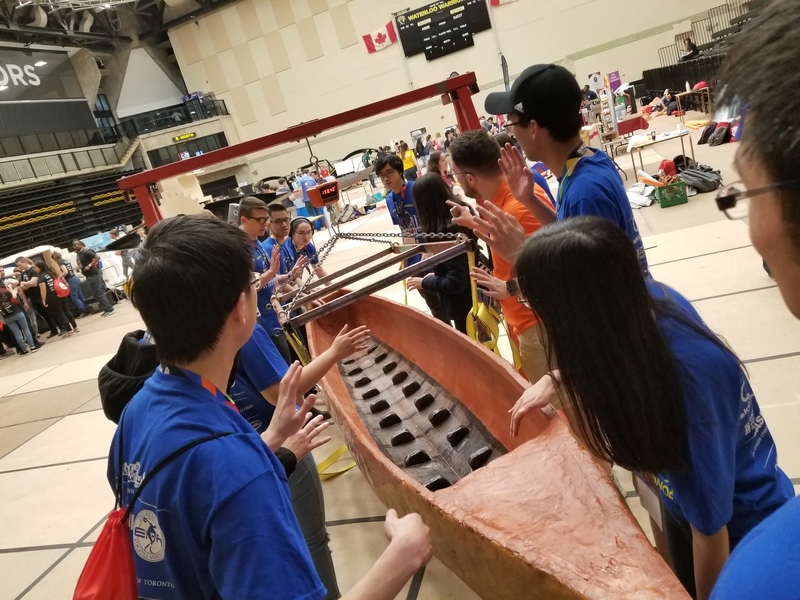
Concrete Canoe transforms regular concrete into a strong, not-very-dense, and fast canoe! Their process includes material science as they find the optimal concrete composites, mechanical design for the canoe’s physical structure, and manufacturing with industry-grade tools and precision. You’ll engage with CAD, proprietary software for simulation, and CNC machining (and of course, some good ol’ fashioned elbow grease).
They compete in the annual Canadian National Concrete Canoe Competition, at which they’re evaluated based on their final product, technical report, presentation, and paddling race. The race categories include the men’s endurance, women’s endurance, men’s sprint, women’s sprint, and co-ed sprint. If you want to combine engineering design with athletic performance, get involved with Concrete Canoe!
Relevant majors: Aero, Phys
Concrete Toboggan builds toboggans with fully concrete running surfaces. Their design subteam designs and manufactures the toboggan, including its concrete “skis”, carbon fiber superstructure, and braking and steering systems. Their spirit subteam focuses on the presentation, marketing, sponsorship, and aesthetic aspects of the team.

Concrete Toboggan competes against over 20 North American universities in the annual Great Northern Concrete Toboggan Race (GNCTR), at which they’re evaluated based on their performance through a challenging course, design, technical presentation, and team spirit! They consistently achieve top placements, including winning first place overall at GNCTR Toronto in 2025. If you’re interested in anything from aerodynamics and manufacturing, to presentations, artwork, and wacky costumes, you should check out their team. You can also check out one of their toboggans in the Myhal Lobby!
Relevant majors: Aero, ECE, Energy, Phys
UTSM designs and builds extremely fuel-efficient vehicles. They’re currently developing a Prototype Battery Electric Vehicle, and an Urban Concept Hydrogen Fuel Cell Vehicle (with the only fuel being hydrogen and oxygen, and the only byproducts being energy and water).
In UTSM, you can expect to strengthen your skills in mechanical and aerobody design, gain a deep understanding of efficient vehicles and sustainable energy, and build some sleek-looking cars, one of which is on display in the Myhal Lobby. UTSM competes in annually in the Shell Eco Marathon Americas (SEMA) competition. Check out their team at the SEMA last year:
Relevant majors: Robo, ECE, MI, Aero
Robotics for Space Exploration is U of T’s Mars Rover Team. They design and build Mars Rovers for competitions such as the University Rover Challenge, European Rover Challenge, and Canadian International Rover Challenge.
RSX’s subteams resemble those of NASA Rover teams, and include CANSAT (designing a space probe), Science (developing the rover’s ability to perform research tasks while on “Mars”), Software (focusing on control, autonomy, and communications), Arm (creating a robotic arm), Mechanical, and Electrical teams.
In addition to competing in Rover Challenges across the world, RSX hosts their annual Space Exploration Engineering Kompetition (SEEK) and performs outreach at various Space Conferences. If you’re interested, make sure to check them out at a club fair or reach out directly! Look at their promotional video from 2024 to see some of their work:

Hopes to pursue a career in surgical robotics
“I joined RSX’s Arm subteam because [coming into university], I knew I loved robots, but wasn’t sure which areas [most interested me]. The Arm subteam gave me opportunities to engage in all aspects of robot design, including mechanical, electrical and software, […]. I’ve learned valuable skills in PCB design and ROS, and designed the mechanics of the arm around the harsh environments and tasks in which we compete.”
Relevant majors: Aero, ECE, Robo, Energy, MI
Founded in 1997, UTFR is an award-winning team that designs and builds electric formula racecars and competes in various Formula Racing competitions around the world. Every year, their subteams develop the electrical, autonomous, and mechanical aspects of a new race car. UTFR members undergo extensive training in various technical areas and have plenty of chances to contribute to the car’s development. Take a look at the latest car that the team’s racing at competitions this summer:
Their 2024 model, UT24, placed first in the New Hampshire Formula Hybrid and Electric competition, and 9th at Formula SAE Electric Michigan. Their 2025 model, UT25 placed second in the New Hampshire Formula Hybrid and Electric competition. Read more on the team’s success on the Engineering News Page. Also be sure to check out their Instagram for some updated videos about their 2026 competitions.
If you’re interested in the team and want to contribute to future successes, keep an eye out for UTFR’s recruiting cycle.
HPVDT focuses on the design and construction of innovative, high-performance human-powered vehicles. Currently, they’re working on a speed bike and a human-powered plane. In recent years, their vehicles have broken world speed records! As a team member, you might work on mechanical or electrical computer-aided design (CAD), finite element analysis (FEA), embedded programming, vehicle aerodynamics, microcontrollers and microprocessors, or machining. If you’re interested in accelerating human biomechanics to a whole new level, feel free to sign up on their webiste!

Electrical Design Intern @ Engineering Design Lab | Head of Electronics @ HPVDT
“Hello! I’m Jaden, EngSci Robo 2T6 and Head of Electronics at HPVDT. I joined HPVDT initially as a mechanical subteam member in September 2022, but I quickly redirected my focus to the electrical subteam when the magic electronics caught my attention. A unique aspect of HPVDT, and what initially drew me in, is the combination of an engineering and athletic competition; our projects test the limits of athletic achievement and engineering design, which to me is an appealing endeavour ?. Above all, I’m beyond stoked to be working on a variety of groundbreaking projects with a close-knit team of passionate individuals, and I look forward to seeing many new faces in the workshop this coming Fall. Welcome to SKULE!”
Non-Vehicular Design Teams:
Relevant majors: ECE, Robo, MI, MSF, BME
IEEE (Institute of Electrical and Electronics Engineers) is the world’s largest organization for the advancement of technology. IEEE U of T, while less of a traditional design team, provides plenty of opportunities in which students can build plenty of diverse, interesting projects and accelerate their technical skills.
IEEE hosts programming and interview workshops and tech talks and has recently started design teams dedicated to building Application-Specific Integrated Circuits (ASIC) and Micromouse robots. Their Tech Team always builds fascinating projects through electronics and software. Most importantly, IEEE hosts huge hackathons such as NewHacks (a beginner-friendly hackathon), MakeUofT (Canada’s largest makeathon) and Hack the Student Life (an AWS-centered hackathon).
If you’re interested in developing both your technical and professional abilities, make sure to sign up for the IEEE U of T Newsletter so you never miss an event, and take the next step towards your career in tech!

Currently researching on how to make AI smarter through neuromorphic computing and hardware acceleration
“IEEE U of T [shares] similar values of technological progress and innovation, but we focus on empowering students with the skills and exposure needed to tackle the problems of the future. IEEE is not only for those who like computers; we want to instill the skills for students to truly get into the EngSci spirit of interdisciplinary engineering! This coming year IEEE will host all of its staple events, […] with some new additions […]”
“I joined IEEE last year as the Co-Director of the Tech Team. As someone who values practical experience, I learned so much from being hands-on and applying my learning through unique projects like a Pepsi Turret, and creating workshops for U of T Students! I can’t recommend enough for curious students to get involved with IEEE, especially through our unique First Year Associate program, to get mentorship and guidance from our amazing team.”
Relevant Majors: BME, ECE, MI, Robo
UT BIOME is a design team that develops medical devices. They select high-impact projects and undergo the complete engineering design process, including research, design, prototyping, and testing. Their recent projects have included a device for continuous bladder irrigation, and a modular leg prosthetic for children. Whether you’re interested in biology, software, or mechanical design, UT BIOME has a role for you.
Furthermore, they collaborate with other Canadian universities to present annual events such as the Canadian Undergraduate Biomedical Engineering Conference (CUBEC), and MedSprint biomedical engineering design-a-thon. For more information, check out their Instagram page.
Relevant majors: BME, MI, MSF
iGEM is a design team focusing on synthetic biology. Every year since 2007, the team designs a synthetic biology research project and competes with other schools at the annual International Genetically Engineered Machine Grand Jamboree.
IGEM’s primary subteams include Wetlab (hands-on experiments bringing biology to life), Drylab (the digital tools of synthetic biology, modelling, bioinformatics, and machine learning), Hardware (creating electronic solutions for synthetic biology projects), and Human Practices (engaging with stakeholders and researching societal implications of the research).

Passionate about bioelectronics, neurorobotics, control systems, and public health
“iGEM Toronto excites me about bioinformatics, from cracking DNA codes to designing disease-fighting proteins. This year, my Dry Lab team is building machine learning models for plasmid generation and using sequence analysis to validate the ORIs. I hope to leverage these skills in designing biocompatible interfaces for my bioelectronics research.”
Relevant majors: MI, ECE, Robo, MSF
UTMIST is a team consisting of over 60 undergraduate and graduate students dedicated to clearing “the MIST around machine intelligence for the eager young minds.” Their Academics Department hosts lecture series on machine learning topics such as introductory PyTorch and Large Language Models. Their Engineering Department consists of subteams led by student directors, who submit proposals to recruit their own team for machine learning research projects in a six-month development cycle. If you want to immerse yourself in machine learning and gain academic and professional experience, check UTMIST’s website and get involved!
Relevant majors: Robo, ECE, MI,
Founded in 2004, UTRA has built robots for all kinds of purposes. Their teams include Sumo, RoboSoccer, Combat, Pacbots, Autonomous Rover, Robonars workshops, and an annual hackathon called UTRAHacks. Their most popular subdivision is the Autonomous Rover Team, which builds a fully autonomous rover to compete in the annual International Intelligent Ground Vehicle Competition, while Sumo robotics is a beginner-friendly competition in which you can compete against your peers!
Robots are complex systems; UTRA members learn about the mechanical, electrical, software, and artificial intelligence systems that comprise various types of robots. Check out their website to learn more about their teams, and how to get involved.
Intended Major: ECE/Robo (with potential minor in AI) | Interested in cool tech
“I joined UTRA to extend my hardware skills; as a member of the embedded systems subteam, I’ve had the chance to test and implement electrical systems, use electronic computer-aided design, and learn software such as the Robot Operating System. I’ve gained an invaluable amount of mentorship from the amazing team leads (almost all of whom are upper-year ECEs and EngScis)!”
“Along with some teammates, I attended the 31st IGVC, which was an amazing experience; it was great to engage in the fast-paced development of our rover, and witness that of tens of teams from around the world.”
Relevant majors: Phys, MSF
UTSD, comprised of engineering and architecture students, designs and builds an earthquake- resistant high-rise structure out of balsa wood. They design the structure and floor plans of the tower with CAD software and test their designs using industry-grade analysis software, custom-built simulation scripts, and real dynamic testing apparatuses at U of T labs.
UTSD competes in the Earthquake Engineering Research Institute’s Annual Seismic Design Competition. If you’re interested in physics, design, software, and construction, consider joining their team. Check out their Seismic Academy video series on their YouTube channel, through which you’ll learn the theoretical and applied math and physics behind earthquake-resistant buildings.
Relevant majors: ECE, BME, Robo
Spark builds interactive mechatronic displays that are placed around campus and at various events. These displays are often inspired by board games, video games, interesting experiments, art displays, and just about anything you may find at a science museum! Spark is divided into mechanical and electrical subteams; members learn about mechatronics design, human-machine interactions, and more, to design and build amazing technology that hundreds can have fun with. If you just want to see their builds, check out their list of projects, or find (and play with) an actual display on campus!
Relevant majors: MSF, MI
UTSPAN combines many mathematical fields to study and predict the performance of sports teams. The student group’s goals are to connect members who share a passion for sports analytics, organize and conduct research, and connect members to industry leaders in the field. UTSPAN is always working on cool projects involving math and machine learning, and they host many seminars about these topics. In the past, they’ve even worked with Canada’s national basketball team. If you want to combine programming, math, and sports, you can’t go wrong with this club. Fun fact: they won the NFL’s Big Data Bowl in 2023.
Relevant majors: Phys, MSF
After you complete CIV102 (Structures and Materials), you may want to do more bridge-building endeavours. The Troitsky Bridge Building Team incorporates engineering design and calculations to create bridges to withstand great loads.
The U of T division is divided into multiple teams. These compete at the annual Troitsky Bridge Building Competition at Concordia University and are judged based on their bridge’s performance under a hydraulic press, and a structural analysis report and writeup. For the last three years, the first-place prize has gone to teams from U of T!
Relevant majors: Aero, ECE, Energy, Phys
UTWind unites students across engineering and environmental sciences to design and build a small-scale wind turbine. Their subsystems include aerodynamics, controls, mechanical and manufacturing, power systems, and sustainability. They compete against universities from across the world at the annual International Small Wind Turbine Contest, held at the Hanze University of Applied Science in Delft, Netherlands. In 2022, they won first place overall! If you’re interested, feel free to drop in during a work session in the Myhal Arena!