
When people find out I’m not very good at building circuits, they’re shocked!
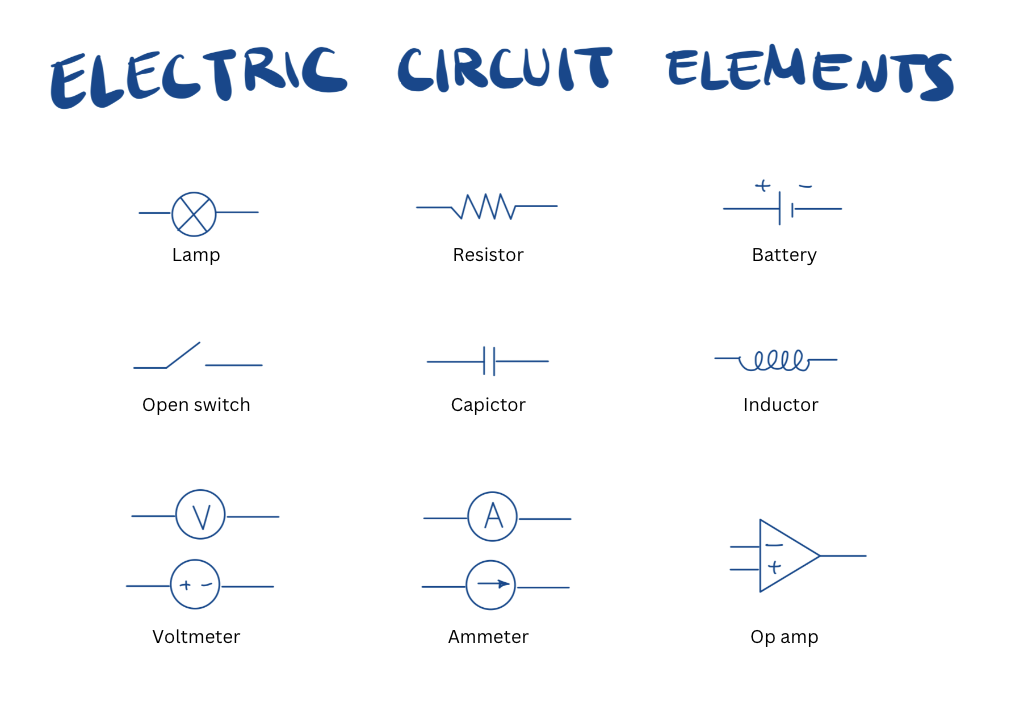
Circuits are the building blocks of all electrical devices – including the device on which you’re reading this. In EngSci’s introductory circuits course, ECE159, you’ll be introduced to circuit properties such as current, voltage, and resistance, as well as circuit components like sources, resistors, capacitors, inductors, and op-amps. You’ll learn about DC (direct current) and AC (alternating current) circuits and will use techniques like mesh analysis, nodal analysis, Thévenin equivalents, differential equations, and complex numbers to analyze circuits.
The goal of the course is to solve circuits for their properties by understanding how their components interact. These interactions are expressed mathematically, so a large portion of this course is solving systems of equations. Succeeding in the course requires understanding the theory behind circuit analysis, being able to build circuits in real life, and most importantly, knowing how to apply the right formulas in the right situations. Are you ready to learn the fundamentals of harnessing electricity?
Practice and regular review will be your best friends in this course. The key is to become familiar with the approach required for each type of question, since there are only a limited number of question types that can appear on a test. Also, while electricity can be more difficult to visualize than larger mechanical systems, try to build a conceptual understanding of how circuits behave so that the equations and results feel intuitive rather than purely memorized.
Professor

Professor Micah Stickel
Professor Micah Stickel is a Teaching Stream Associate Professor in the Department of Electrical & Computer Engineering. He completed his undergrad, masters, and PhD degrees at U of T with a focus on electromagnetic networks and developing devices for high-frequency systems. He’s a returning professor for this course and is well-known for his incredibly clear and engaging presentation, his insightful worked examples, and the occasional joke in lecture.
Professor Interview
“The heart of the course is really about problem solving […] It’s really about understanding how circuits behave with the hope that once you develop the ability to analyze circuits, then you can design circuits, and that’s the power that math and science together bring to engineering.”
“For [students] who go into [mechatronics, robotics, or any combination of software and hardware], the core ideas [of circuits] will come back. […] They’re really critical ideas.”
“I’ve described engineers as master approximators. […] To analyze [an electric circuit] we’d need Maxwell’s equations, the fundamentals of electromagnetics, and vector calculus, which [results in a] difficult problem. […] We don’t need to think of [the circuit] at an atomic level [and can] approximate it with a resistor, capacitor, or inductor […] Electric circuits are fundamentally just approximations of a real-world system”
Course Highlights
- Labs: Every other week, you’ll gain hands-on experience by building and testing circuits on breadboards. Come prepared to experiment, troubleshoot, and have fun!
- Have you ever looked at a circuit diagram and thought, “I wish I knew what this all meant”? Well, you’ll be able to interpret and analyze many different types of circuits after ECE159!
- This course will introduce you to using complex numbers to model real systems.
Week in the Life of an ECE159 Student
Lectures
There are typically three hours of ECE159 lectures a week. There you’ll learn the circuit laws you’ll use to solve problems on assignments. The professor will conceptually explain circuit topics, as well as go through examples of circuit analysis. Note these examples down: they serve as models for midterm and exam questions.
Tutorials
There is one hour of ECE159 tutorials built into your weekly schedule. While tutorials touch upon theory, the emphasis will be on learning how to problem-solve. Your TA will work through lots of examples, and we recommend taking notes of their problem-solving steps. ECE159 TAs are extremely helpful, so make sure to pay attention!
Practicals (Labs)
ECE159 labs are held every other week. Make sure to do the pre-labs before every lab session: they’re worth marks and are crucial to your ability to understand the lab. They can be a time crunch because the whole lab is done in a three-hour period. During this time, you’ll build circuits in the lab and observe their properties with different electrical instruments such as oscilloscopes.
Your performance during labs will be graded. Although three hours may seem like a lot of time, the labs can be time-consuming and many students won’t end up finishing some labs on time. TAs will grade the notes you take during labs, your ability to build circuits, and your respect for the workspace. Some TAs will also mark your ability to keep your lab notebooks organized, so make sure you get in the practice of including your name, the date, and prelab questions in your notebook every time you start a new lab.
Midterm and Exam
ECE159 has a midterm and a final exam. They consist of circuit analysis questions, and each question can be thought of as multiple difficult questions packed into one. You’ll be permitted to bring a single double-sided handwritten aid sheet.
How to Succeed
Quick tips and equations
- Passive Sign Convention: if positive current flows out of the positive terminal of a voltage source, then the element is delivering power. Otherwise, it’s absorbing power.
- Consider the hydraulic analogy, where voltage and current are analogous to water pressure and flow of water, respectively.
- V = IR (Ohm’s Law)
- P = VI (Electric Power)
- These are general equations to represent voltage and current in a circuit:
- v(t) = v(\infty) + [v(0) - v(\infty)]e^{-t/\tau} or
- i(t) = i(\infty) + [i(0) - i(\infty)]e^{-t/\tau}
- You’ll learn how to use complex numbers to model AC circuits. Normally, this would involve many difficult computations. However, certain types of Faculty-approved calculators can perform almost any complex calculation for you.
- Remember that circuit analysis is a mere representation of the physical world. If, during a lab, your data isn’t exactly as you had expected, don’t worry: small sources of error are common.
More Details
This course may start off looking like basic high school review. However, it kicks into gear later, so make sure not to fall behind so you aren’t caught off-guard. New topics will be introduced very quickly and they’ll build upon each other.
Technically speaking, you could get through this course just by knowing nodal and mesh analysis. However, you’ll waste considerable time on questions if they’re all that you use. Pay attention to concepts that can speed up your problem solving. Examples include the fact that parallel branches have the same voltage or that certain op-amp configurations are designed to perform addition, subtraction, differentiation, and integration.
The best way to remember the equations and how they connect is by writing an equation sheet as the course progresses. This will also be a helpful resource when you work through homework problem sets – and on the exams, you’ll be allowed a single double-sided handwritten aid sheet.
This course is about problem-solving, so the more practice questions you do, the more successful you’ll be. You’ll be assigned many textbook problems related to the lecture topics, and staying up to date with the homework is a great way to practice and reinforce the material covered in class. The lectures are also very interactive and focus on working through lots of examples together as a class. Find past ECE159 midterms and exams on courses.skule.ca.
Introductory circuits is a very old and standard course. There are many online videos and textbooks that you can use if you’re struggling with a concept and need a new perspective.
Beyond First Year
- You’ll get crucial experience in building circuits, which is important in engineering prototyping (you’ll likely need this in Praxis III in your second year, and you can use these skills on design teams and for personal projects).
- This course will provide a foundation for all upper-year electrical engineering courses and the coursework for majors such as ECE and Robotics.
- Even if you don’t find electronics interesting, the problem-solving skills you develop in this course will be used heavily in future courses with many connected concepts and equations, such as thermodynamics.